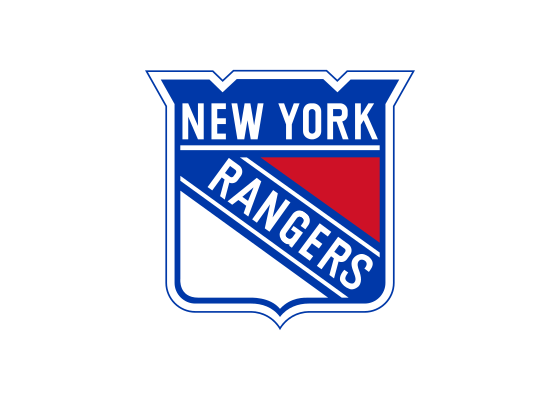
The New York Rangers shield logo features diagonal “RANGERS” lettering across a red, white, and blue crest, honoring American patriotism while creating one of hockey’s most stable and instantly recognizable visual identities since 1926.
The Rangers logo represents exceptional consistency in professional sports branding, maintaining its core shield structure and diagonal wordmark across nearly a century. The design communicates New York confidence through bold simplicity, rejecting the illustrated mascots and complex crests adopted by many franchises. The red, white, and blue palette positions the team as quintessentially American while the shield shape suggests heritage, protection, and institutional permanence.
What distinguishes this mark is its refusal to chase design trends. While other Original Six teams experimented with modernization or alternate logos, the Rangers doubled down on their classic shield, understanding that consistency builds equity. The minimal refinements over decades, primarily in outline weight and color saturation, demonstrate how restraint serves longevity. This approach has made the logo equally at home on vintage wool sweaters and contemporary digital platforms.
Meaning and Symbolism
- Shield shape evokes both law enforcement badges and medieval heraldry, reinforcing the “Rangers” law-and-order association
- Red, white, and blue diagonal sections reference the American flag without literal stars-and-stripes replication
- Diagonal “RANGERS” creates dynamic movement within a static shield format, suggesting action and aggression
- “NEW YORK” positioned above maintains geographic pride and differentiates from the Islanders
- Symmetrical composition allows the mark to function equally well in any orientation or application
Design and History
Created in 1926 when Madison Square Garden owner Tex Rickard founded the franchise, the logo emerged from the nickname “Tex’s Rangers,” a play on the Texas Rangers law enforcement agency. The design’s genius lies in its architectural clarity. The shield provides structure, the diagonal band creates visual interest, and the simplified three-color approach ensures reproduction fidelity across any medium or scale.
Early iterations featured slightly rounder shield proportions and thinner outlines, giving the mark a more delicate appearance appropriate to 1920s aesthetics. Gradual refinements through 1947, 1952, and 1967 adjusted these proportions without altering the fundamental concept. The 1978 update introduced the lighter, brighter blue that persists today, moving away from the navy of earlier decades. This shift toward royal blue improved broadcast visibility and differentiated the Rangers from navy-heavy teams.
The shield’s consistency allowed the organization to experiment with alternate logos in the 1990s without threatening the primary mark’s equity. These experiments ultimately reinforced that the classic shield needed no replacement, only occasional refinement.
Typography
The diagonal “RANGERS” wordmark employs bold, condensed capitals with subtle serifs that balance traditional and athletic sensibilities. The letterforms feature consistent weight and tight spacing that maximizes legibility within the narrow diagonal band. “NEW YORK” uses similar proportions but in a horizontal arrangement, creating clear hierarchy between location and team name. Both elements employ white letters with blue outline against red backgrounds, ensuring maximum contrast and readability from distance.
FAQ
Q: Why has the logo remained virtually unchanged for nearly 100 years? A: The design achieved functional perfection early. Its clarity, flexibility, and cultural resonance made change unnecessary. Unlike teams whose early logos featured outdated illustration styles or problematic imagery, the Rangers shield translates seamlessly across eras and media.
Q: What’s the significance of the diagonal orientation? A: The diagonal band adds dynamism to what could otherwise be a static, formal shield. It creates visual movement and prevents the mark from feeling too corporate or governmental, maintaining athletic energy within a structured framework.
Q: Have other teams successfully maintained similar consistency? A: Among Original Six franchises, only Montreal’s CH crest rivals the Rangers shield for longevity and minimal evolution. Most teams have undergone significant redesigns, making the Rangers’ consistency exceptional rather than typical in professional hockey.
More logos with similar colors