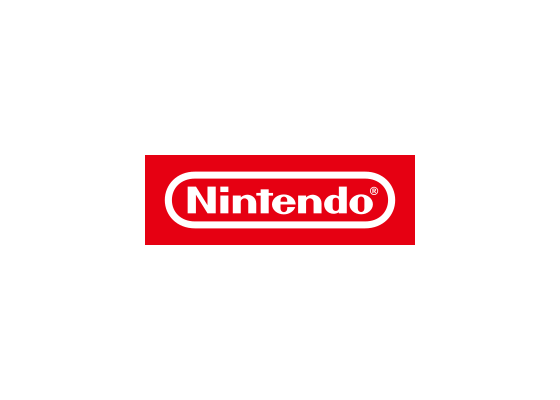
The Nintendo logo features bold red (#E60012) lettering inside a white (#FFFFFF) rounded rectangle (pill shape) with a red border, creating one of gaming’s most instantly recognizable wordmarks.
Nintendo Co., Ltd. is a Japanese multinational consumer electronics and video game company headquartered in Kyoto, Japan. Founded in 1889 by Fusajiro Yamauchi as a playing card manufacturer producing hanafuda cards, Nintendo transformed into the world’s most influential gaming company through revolutionary hardware including the NES, Game Boy, Nintendo 64, Wii, and Switch. The company created legendary franchises such as Super Mario, The Legend of Zelda, Pokemon, and Animal Crossing that have defined multiple generations of gaming culture. Nintendo’s name combines “nin” (entrusted), “ten” (heaven), and “do” (hall or shop), often interpreted as “leave luck to heaven.”
The modern Nintendo logo is a red wordmark set inside a rounded rectangle, commonly described as a “pill shape” or “racetrack” border. The evolution toward this mark was gradual: in 1967 the basic typeface and red color were established, the oval frame was added in 1970, briefly removed, then reintroduced permanently in 1977. The typeface resembles Helvetica Black with a signature detail: the lowercase-height “t” letters are slightly cropped, giving the wordmark its own typographic personality. In 2016, Nintendo introduced two versions still in use today: the classic red text on white with a red border, and an inverted version with white text and border on a solid red background.
Meaning and Symbolism
- Bright red (#E60012): Represents energy, excitement, and playfulness, positioning Nintendo as an entertainment company rather than a technology manufacturer.
- Pill-shaped border: Creates a distinctive container that makes the logo instantly recognizable on game packaging, consoles, and retail displays.
- White interior: Ensures maximum legibility and conveys simplicity and the family-friendly appeal that defines Nintendo’s brand.
- Bold typography: Projects confidence and Nintendo’s position as the gaming industry’s pioneer and enduring leader.
- Color inversion flexibility: The ability to swap red and white allows the logo to work on virtually any background or product surface.
Design and History
Nintendo’s earliest logos reflected its origins as a traditional Kyoto playing card company, featuring the words “Nintendo Koppai” written in black ink in a traditional Japanese calligraphic style. Through the 1950s and 1960s, as the company modernized and pursued international audiences, the identity went through multiple experimental phases. In 1968, the wordmark was placed on a white hexagonal badge with a red outline. By 1970, the hexagonal frame was replaced with the rounded, oval shape that resembles the emblem known today.
The iconic red pill-shaped logo solidified during Nintendo’s explosive entry into video games in the late 1970s and 1980s. When the Nintendo Entertainment System (NES) launched in 1985 and the company needed a global identity that transcended language barriers, the simple red-and-white wordmark proved ideal. Unlike competitors using complex technological imagery, Nintendo’s straightforward mark worked equally well on Japanese Famicom cartridges, American NES boxes, and European Game Boy packaging.
Nintendo maintained remarkable logo consistency even as gaming evolved from 8-bit sprites to high-definition 3D graphics. While competitors redesigned identities to appear cutting-edge, Nintendo’s unwavering branding accumulated decades of trust and nostalgia. The 2016 update introduced the current dual-version system without altering the fundamental design, preserving continuity with a brand identity that has been essentially stable for over 40 years.
Typography
The Nintendo wordmark uses a typeface closely resembling Helvetica Black, with consistent stroke weights and generous letter spacing. The most distinctive typographic detail is the slightly cropped “t” letters, which sit at a lowercase height rather than reaching the full cap height. This subtle modification gives the wordmark its own personality while maintaining the clean, geometric authority of the base typeface. The bold weight ensures legibility from tiny handheld screens to massive convention banners.
FAQ
Q: When did Nintendo adopt its current logo?
A: The red pill-shaped logo emerged in the 1970s and solidified during the Famicom/NES era. The current dual-version system (red on white and white on red) was introduced in 2016. The fundamental design has been essentially unchanged for over 40 years.
Q: What does the name Nintendo mean?
A: Nintendo combines Japanese characters meaning “leave luck to heaven” (nin-ten-do). Founder Fusajiro Yamauchi chose a name reflecting traditional values and acceptance of fortune’s role in business.
Q: Where is Nintendo headquartered?
A: Nintendo Co., Ltd. is headquartered in Kyoto, Japan, where it has been based since its founding as a playing card company in 1889. The Kyoto headquarters reflects the company’s deep roots in Japanese tradition.
More logos with similar colors