Skip to Content
    Support us
    A-Z Agency Colors Country Designer Industry Tags Year Trending Reports
    Olympics 1972 Munchen sports Germany black turquoise whiteDE Deutschland GermansportsGermanyblackturquoisewhite

    1972 Summer Olympic Games in Munich

    • Logo
    • Germany
    • Sports
    • Olympics 1972 Munchen

    Olympics 1972 Munchen Logo

    Explore the iconic Olympics 1972 Munchen logo – its design, history, and visual identity.

    Trending Popular
    Olympics 1972 Munchen logo - free SVG vector, sports brand from Germany

    Olympics 1972 Munchen Brand Colors

    Browse more logos with black, turquoise and white colors.

    Olympics 1972 Munchen Brand Facts

    Key information about Olympics 1972 Munchen: origin, designer, industry, and logo introduction year.

    Websiteen.wikipedia.org
    DesignerCoordt von Mannstein
    AgencyGraphicteam Köln
    CountryGermany
    IndustrySports
    Logo Introduced1972
    Download Olympics 1972 Munchen logo Embed Olympics 1972 Munchen logo
    views · downloads this week
    4.2 (59 ratings)

    Explore the Olympics 1972 Munchen brand, discover Olympics 1972 Munchen colors, and download the Olympics 1972 Munchen vector logo in SVG or PNG formats. Browse related logos and logos with similar colors.

    Summer Olympic Games Logos

    Olympics 1988 Seoul logo vector - free SVG download

    Olympics 1988 Seoul

    Sports
    Olympics 2020 Tokyo logo vector - free SVG download

    Olympics 2020 Tokyo

    Sports
    Olympics 1992 Barcelona logo vector - free SVG download

    Olympics 1992 Barcelona

    Sports
    Olympics 1996 Atlanta logo vector - free SVG download

    Olympics 1996 Atlanta

    Sports
    Olympics 1968 Mexico logo vector - free SVG download

    Olympics 1968 Mexico

    Sports
    Olympics 1976 Montreal logo vector - free SVG download

    Olympics 1976 Montreal

    Sports
    Olympics 2008 Beijing logo vector - free SVG download

    Olympics 2008 Beijing

    Sports
    Olympics 2004 Athens logo vector - free SVG download

    Olympics 2004 Athens

    Sports
    Olympics 2000 Sydney logo vector - free SVG download

    Olympics 2000 Sydney

    Sports
    Olympics 1964 Tokyo logo vector - free SVG download

    Olympics 1964 Tokyo

    Sports
    Olympics 2016 Rio logo vector - free SVG download

    Olympics 2016 Rio

    Sports
    Olympics 2012 London logo vector - free SVG download

    Olympics 2012 London

    Sports
    Olympics 1980 Moscow logo vector - free SVG download

    Olympics 1980 Moscow

    Sports
    Olympics 2024 Paris logo vector - free SVG download

    Olympics 2024 Paris

    Sports
    Olympics 2028 LA logo vector - free SVG download

    Olympics 2028 LA

    Sports

    The 1972 Summer Olympics, officially the Games of the XX Olympiad, were held in Munich, West Germany, from August 26 to September 11, 1972. The sporting events were tragically overshadowed by the Munich massacre on September 5, when Palestinian terrorists from the Black September group took eleven Israeli athletes and coaches hostage in the Olympic Village, all of whom were killed along with a West German police officer. The Games featured 7,134 athletes from 121 nations competing in 195 events across 21 sports.

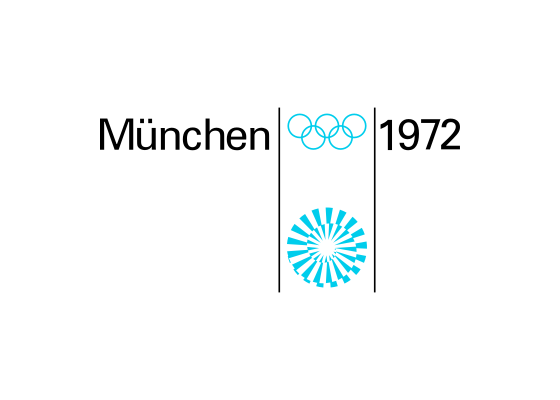
    The Munich 1972 emblem is a spiral of radiating lines that form a bright, sun-like corona, rendered in a distinctive cyan blue. Designed by Coordt von Mannstein of Graphicteam Köln, the mark is part of a comprehensive visual identity conceived by Otl Aicher, one of the most important graphic designers of the 20th century. The spiral form suggests radiance, energy, and openness, qualities the organizing committee explicitly sought to project in contrast to the last Olympics held in Germany, the politically charged 1936 Berlin Games. Below the emblem, “Munich 1972” is set in Univers, the typeface Aicher selected as the foundation of the entire visual system. The emblem exists not as an isolated mark but as one element within what is widely considered the most complete and influential Olympic design system ever created.

    Meaning and Symbolism

    • Radiant spiral: The spiral of lines radiates outward from the center, creating a sun-like form that communicates warmth, openness, and optimism. The form is deliberately un-monumental, rejecting the heavy, authoritarian aesthetic that the 1936 Berlin Games had projected.
    • Cyan blue: The distinctive blue-cyan was the primary color of the entire Munich visual system. It was a deliberate departure from the red, black, and gold of German national symbolism, choosing instead a color associated with sky, water, and openness.
    • Democratic design: The spiral, with its equal-weight radiating lines, is a democratic form. It has no hierarchy, no center that dominates. This egalitarian quality was intentional, reflecting West Germany’s desire to present itself as an open, modern, democratic society.
    • Systemic design: The emblem was designed to function within a comprehensive visual system rather than as a standalone mark. Its graphic language, the line weight, the geometry, the color, informed every element of the Olympic experience from pictograms to wayfinding to uniforms.

    Design and History

    The Munich 1972 visual identity, led by Otl Aicher, is the single most influential design system in Olympic history. Aicher, a co-founder of the Ulm School of Design (Hochschule für Gestaltung Ulm), brought a rigorous, systematic approach to every visual element of the Games.

    The emblem by Coordt von Mannstein was one component of a system that included revolutionary pictograms (Aicher’s geometric athlete figures became the template for virtually all Olympic pictograms that followed), a comprehensive color palette centered on the distinctive cyan, consistent typography in Univers, and a modular graphic framework that could be applied across thousands of applications.

    The political context was essential to understanding the design choices. The last Olympics held in Germany were the 1936 Berlin Games, staged by the Nazi regime as a propaganda spectacle. Munich 1972 needed to project the opposite: lightness, openness, democracy, and internationalism. Aicher’s system achieved this through every design decision, from the bright, unthreatening color palette to the informal, horizontal layout of the Olympic Park’s tent-like roof structures designed by Frei Otto.

    The Munich massacre on September 5, in which eleven Israeli athletes and coaches were killed by Palestinian terrorists, shattered the Games’ atmosphere of openness and naivety. The decision to continue the Games after a memorial ceremony remains one of the most debated choices in Olympic history. The visual identity, designed to communicate joy and openness, became associated with both the aspirational ideals the Games represented and the devastating reality that intruded upon them.

    Despite the tragedy, the Munich 1972 design system’s influence on graphic design and Olympic branding has been immense. Aicher’s pictogram system, color methodology, and systematic approach to visual identity became the model that every subsequent Olympics has built upon. The idea that an Olympic visual identity should be a comprehensive, coordinated system rather than just a logo and a color palette, that was Munich’s legacy to design.

    Typography

    The entire Munich 1972 visual system used Univers, Adrian Frutiger’s seminal sans-serif typeface. Aicher’s commitment to a single typeface family across all applications, from the emblem wordmark to wayfinding to printed materials, created a level of typographic consistency that had not been attempted at an Olympic scale before. The choice of Univers reflected the design system’s values: clarity, neutrality, and systematic organization.

    FAQ

    Q: Who designed the Munich 1972 visual identity? A: Otl Aicher led the comprehensive design system. The emblem specifically was designed by Coordt von Mannstein of Graphicteam Köln. Aicher’s team created the pictograms, color system, typography guidelines, and environmental graphics.

    Q: Why is Munich 1972 considered the most influential Olympic design? A: Otl Aicher created the first truly comprehensive Olympic visual identity system, including revolutionary pictograms, a systematic color palette, and consistent typography. Every subsequent Olympics has built on this model.

    Q: What was the Munich massacre? A: On September 5, 1972, Palestinian terrorists from the Black September group took eleven Israeli athletes and coaches hostage in the Olympic Village. All eleven hostages, one West German police officer, and five terrorists were killed. The Games controversially continued after a memorial ceremony.

    The Munich 1972 emblem and Olympic rings are trademarks of the International Olympic Committee. This page is for educational and reference purposes only.


    More Sports logos from Germany

    Ratiopharm Ulm logo vector - free SVG download

    Ratiopharm Ulm

    Sports
    Erzgebirge Aue logo vector - free SVG download

    Erzgebirge Aue

    Sports
    Grizzlys logo vector - free SVG download

    Grizzlys

    Sports
    Adler Mannheim logo vector - free SVG download

    Adler Mannheim

    Sports
    Kettler logo vector - free SVG download

    Kettler

    Sports
    Krefeld Pinguine logo vector - free SVG download

    Krefeld Pinguine

    Sports
    Eisbaren logo vector - free SVG download

    Eisbaren

    Sports
    Riesen Ludwigsburg logo vector - free SVG download

    Riesen Ludwigsburg

    Sports

    More logos with similar colors

    Mojo logo vector - free SVG download

    Mojo

    Technology
    SmartRent logo vector - free SVG download

    SmartRent

    Technology
    Fashion For Good logo vector - free SVG download

    Fashion For Good

    Fashion
    Druid Apache logo vector - free SVG download

    Druid Apache

    Software

    The "1972 Summer Olympic Games in Munich" appears in: Athletics Logos , Competition Logos , Europe Logos , Recreation - Sport Logos , Olimpics Logos and Summer Logos .

    Frequently asked questions about the Olympics 1972 Munchen logo

    The 1972 Summer Olympic Games in Munich logo represents a sports brand from Germany, designed in 1972 by Coordt von Mannstein at Graphicteam Köln. Learn more on the official Olympics 1972 Munchen website.

    Why is the Olympics 1972 Munchen logo in SVG format?
    The Olympics 1972 Munchen logo is provided as an SVG (Scalable Vector Graphics) file because vectors offer unlimited scaling without pixelation, smaller file sizes than raster images, and are ideal for responsive web design. SVG logos work perfectly across all screen sizes — from mobile devices to billboard prints — maintaining crisp edges at any resolution.
    Should I use SVG or PNG for the Olympics 1972 Munchen logo?
    Use SVG for websites, apps, and any digital design requiring scalability. SVG files are resolution-independent and load faster. Use PNG (converted from SVG at 300 DPI) for presentations, printed materials, or software that doesn’t support SVG. Convert using Adobe Illustrator, Inkscape, Affinity Designer, or online tools like CloudConvert. Export at 300 DPI for print, 72-150 DPI for web.
    What software can open the Olympics 1972 Munchen SVG logo?
    The Olympics 1972 Munchen SVG logo opens in both code editors (VS Code, Sublime Text, Notepad++) and graphic design software (Figma, Adobe Illustrator, Affinity Designer, Sketch, Inkscape). Modern web browsers can also display SVG files directly. For quick edits, online editors like SVGEdit or Method Draw work without installing software.
    What font does the Olympics 1972 Munchen logo use?
    Many professional brands, including Olympics 1972 Munchen, use custom-designed typefaces for their logos to ensure unique brand identity and trademark protection. If the Olympics 1972 Munchen logo uses a custom font, no exact public version may exist. For similar typography, analyze the logo’s letter characteristics (serif vs sans-serif, weight, spacing) and search font databases like WhatTheFont, Identifont, or MyFonts for close alternatives.
    What is a Logo or Logotype?
    A logo is a graphic mark, emblem, or symbol used to aid public identification and recognition. Logos fall into three classifications: ideographs (abstract forms), pictographs (iconic designs), and logotypes/wordmarks (text-based). The logo is central to a brand’s visual identity system.
    Can I use the Olympics 1972 Munchen logo legally?
    The Olympics 1972 Munchen logo is a registered trademark and cannot be used commercially without explicit written permission from Olympics 1972 Munchen. This website provides the logo for educational, informational, and reference purposes only. For commercial projects, partnerships, or official brand assets, contact Olympics 1972 Munchen’s communications or legal department directly.
    Where can I find Olympics 1972 Munchen brand guidelines?
    Official Olympics 1972 Munchen brand guidelines typically include logo usage rules, color codes, typography, spacing requirements, and prohibited modifications. Check the Olympics 1972 Munchen website for a “Brand,” “Press,” “Media Kit,” or “Resources” section. Official assets are also available through press kits and authorized partner portals.
    Do I need to credit logotyp.us when using the Olympics 1972 Munchen logo?
    No attribution to logotyp.us is required. However, the Olympics 1972 Munchen logo itself is trademarked intellectual property — using it requires permission from Olympics 1972 Munchen, regardless of where you downloaded it. This site serves as a reference library; downloading a logo here does not grant usage rights.

    Report Outdated Logo

    logotyp.us

    Download high-quality vector logos in SVG format — free for designers, developers, and brand enthusiasts. Browse 4,700+ brand logos by industry, country, color, and designer.

    Help Keep This Free Logos and Brands
    Browse
    • Logos by Industry
    • Logos by Country
    • Logos by Color
    • Logos by Designer
    • A–Z Logo Index
    Discover
    • Popular Logos
    • Search Logos
    • Logo Reports
    Top Countries
    • United States
    • United Kingdom
    • Global
    • Japan
    • Germany
    • Canada
    • France
    • India
    • Sweden
    • Spain
    • Italy
    • Australia
    • Switzerland
    • Netherlands
    • China
    • View All Countries →

    © 2026 logotyp.us. All logos are trademarks of their respective owners.

    Build 0307-1037