Winter Olympic Games Logos
The 1976 Winter Olympics, officially the XII Olympic Winter Games, were held in Innsbruck, Austria, from February 4 to 15, 1976. It was the second time the Tyrolean city hosted the Winter Games, after 1964. Innsbruck received the Games after Denver, Colorado, the original host, withdrew in 1972 when Colorado voters rejected a public funding referendum. The Games featured 37 events across 10 disciplines, with athletes from 37 nations competing.
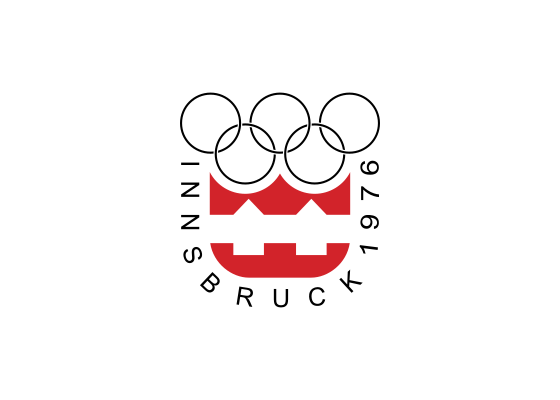
The Innsbruck 1976 emblem features the Innsbruck coat of arms bridge motif, a stylized rendering of the bridge over the River Inn that gives the city its name (“Inn-bruck” translating to “bridge over the Inn”). The bridge form is integrated with Olympic elements and rendered in red, connecting the emblem to Austria’s national colors. The design acknowledges both the city’s identity and its status as a returning Olympic host. Below the emblem, “INNSBRUCK 1976” is set in a clean typeface with the Olympic rings beneath. The mark is compact and heraldic in character, drawing more from the tradition of civic emblems than from the emerging field of corporate graphic design.
Meaning and Symbolism
- Bridge motif: The bridge is the foundational symbol of Innsbruck, embedded in the city’s name (Inn + Bruck = bridge over the Inn). Using it as the emblem’s core element was a direct statement of civic identity.
- Heraldic tradition: The emblem’s character draws from European heraldic and civic seal traditions, giving it a formal, authoritative quality that connected the Games to the city’s long history.
- Red color: The red references the Austrian national flag (red-white-red) and the coat of arms of the Tyrol region. The single color gave the mark bold presence across applications.
- Returning host: Innsbruck’s status as a two-time Winter Olympics host was unusual. The emblem communicated continuity and established competence, a city that knew how to stage the Games because it had done so before.
Design and History
The Innsbruck 1976 emblem reflected a Games that came together under unusual circumstances. Denver, Colorado, had originally won the bid for the 1976 Winter Olympics but withdrew in 1972 after voters in a statewide referendum rejected the use of public funds. Innsbruck, which had hosted the 1964 Winter Games and still had much of the infrastructure in place, stepped in as a replacement host.
This substitute status shaped the visual identity. There was less time and budget for the kind of ambitious branding exercise that a long-planned Olympics might receive. The emblem leaned on Innsbruck’s established civic identity rather than creating something entirely new, a practical choice that also communicated authenticity and readiness.
The 1976 Winter Games were compact and well-organized, benefiting from Innsbruck’s experience and existing facilities. The city’s Alpine setting in the Tyrolean mountains provided a natural backdrop for the competition, and the intimate scale of the town gave the Games a warmth and accessibility that larger host cities sometimes struggle to achieve.
The Games featured notable sporting moments, including Rosi Mittermaier’s near-sweep of the alpine skiing events (she won gold in downhill and slalom before losing the giant slalom by 12 hundredths of a second) and Franz Klammer’s legendary downhill run, one of the most dramatic individual performances in Winter Olympics history, achieved in front of his home crowd.
The broader visual identity was functional and efficient, prioritizing clarity across the established venue network that Innsbruck had maintained since 1964. The environmental graphics and wayfinding served the practical needs of a compact Games in a familiar setting.
Typography
“INNSBRUCK 1976” is set in a clean, uppercase sans-serif typeface beneath the emblem. The letterforms are straightforward and functional, providing clear identification beneath the heraldic mark above. For the broader brand system, typography maintained legibility across the Alpine environments of the competition venues.
FAQ
Q: Why did Innsbruck host the 1976 Winter Olympics?
A: Denver, Colorado, the original host, withdrew in 1972 after Colorado voters rejected public funding in a referendum. Innsbruck, which had hosted the 1964 Winter Games, stepped in as a replacement with its infrastructure still intact.
Q: What does the bridge in the Innsbruck emblem represent?
A: The bridge references the city’s name, which translates to “bridge over the Inn” (the river that flows through Innsbruck). It is the city’s foundational civic symbol.
Q: What made the 1976 Innsbruck Olympics memorable?
A: Franz Klammer’s legendary downhill ski run before his home Austrian crowd and Rosi Mittermaier’s near-sweep of the women’s alpine skiing events were among the most dramatic sporting moments.
The Innsbruck 1976 emblem and Olympic rings are trademarks of the International Olympic Committee. This page is for educational and reference purposes only.