Summer Olympic Games Logos
The 1976 Summer Olympics, officially the Games of the XXI Olympiad, were held in Montreal, Quebec, Canada, from July 17 to August 1, 1976. They were the first Olympic Games held in Canada and remain the only Summer Olympics hosted by the country. The Games were affected by a boycott of 29 African nations protesting New Zealand’s participation following its rugby team’s tour of apartheid South Africa. Montreal’s Olympics are also remembered for the massive cost overruns on the Olympic Stadium, which took the city 30 years to pay off.
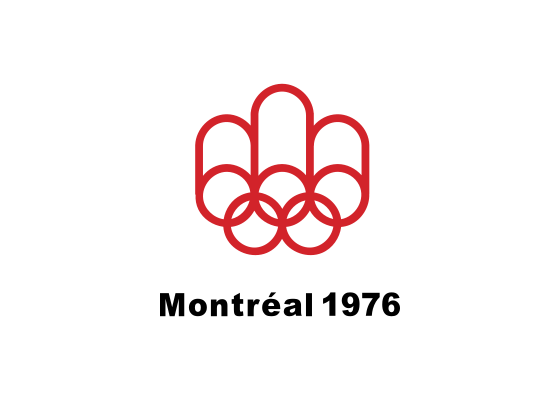
The Montreal 1976 emblem, designed by George Huel, is a geometric composition that integrates the Olympic rings with the letter “M” for Montreal. The five rings are arranged atop three rectangular blocks that form an “M” shape, creating a visual bridge between the Olympic symbol and the host city’s initial. The entire composition is rendered in a single red color, referencing the Canadian flag. The design is architectural in character, with the clean, geometric blocks suggesting both a winner’s podium and the modernist architecture that characterized Montreal’s Olympic construction. Below the emblem, “Montreal 1976” is set in a clean typeface with the five-ring symbol.
Meaning and Symbolism
- “M” for Montreal: The three rectangular blocks at the base form the letter “M,” directly identifying the host city. This typographic approach was clean and unambiguous.
- Olympic rings integration: The five rings are positioned atop the “M” blocks, creating a unified composition where the city and the Games are visually inseparable. The rings appear to rest on the podium-like blocks.
- Podium reference: The three blocks, with the center one taller, suggest an Olympic medal podium. This reference connects the emblem to the competitive heart of the Games.
- Red color: The single red references both the Canadian flag and the strong visual impact that monochromatic marks achieve. Like the Moscow 1980 emblem that would follow, the single-color approach gave the mark bold presence.
- Architectural character: The geometric, block-like construction of the “M” reflects the modernist architectural ambitions of Montreal’s Olympic infrastructure, particularly the stadium designed by Roger Taillibert.
Design and History
The Montreal 1976 emblem, designed by George Huel, was part of a visual identity for Games that became as famous for their financial consequences as for their athletic achievements. The Olympic Stadium, an ambitious modernist structure designed by French architect Roger Taillibert, went dramatically over budget, and the city of Montreal did not finish paying for the Games until 2006, three decades after the closing ceremony.
The emblem itself was a clean, efficient design that communicated its message without ambiguity. The integration of the “M” and the Olympic rings was a logical solution, and the monochromatic red gave the mark a bold simplicity that worked across all applications. It was a product of the mid-1970s graphic design sensibility, which favored geometric construction, bold color, and clear communication over the illustrative complexity that would characterize later Olympic brands.
The 1976 Games were notable for several reasons beyond the financial story. Nadia Comaneci, the 14-year-old Romanian gymnast, scored the first perfect 10 in Olympic gymnastics history, a moment that changed the sport forever. The African boycott, which removed 29 nations from competition, highlighted the increasing intersection of Olympic sport and international politics. And the Games introduced new security measures following the Munich massacre four years earlier.
The broader visual identity extended the red palette and geometric language across the Games experience. The pictogram system, environmental graphics, and wayfinding all maintained the clean, modernist quality of the emblem. Despite the financial controversy, the Montreal Olympics produced a visual identity that reflected the design ambitions of its era.
Typography
“Montreal 1976” is set in a clean sans-serif typeface beneath the emblem. The typography is functional and modern, consistent with the geometric character of the mark above. The letterforms are neutral and legible, allowing the bold red emblem to carry the visual identity. For the broader brand system, typefaces maintained this clean, modernist quality.
FAQ
Q: What does the “M” shape represent in the Montreal 1976 emblem?
A: The three rectangular blocks form the letter “M” for Montreal, with the Olympic rings positioned atop them. The composition integrates the host city’s initial with the universal Olympic symbol.
Q: Who designed the Montreal 1976 emblem?
A: George Huel designed the emblem. The geometric, architectural composition reflected the modernist design sensibilities of the mid-1970s.
Q: Why are the Montreal Olympics remembered for financial issues?
A: The Olympic Stadium’s construction went massively over budget, and the city of Montreal did not finish paying off the debt until 2006, thirty years after the Games.
The Montreal 1976 emblem and Olympic rings are trademarks of the International Olympic Committee. This page is for educational and reference purposes only.