Winter Olympic Games Logos
The 1980 Winter Olympics, officially the XIII Olympic Winter Games, were held in Lake Placid, New York, from February 13 to 24, 1980. It was the second time Lake Placid hosted the Winter Games, following 1932. The Games are immortalized in sporting history for the “Miracle on Ice,” in which the United States ice hockey team, composed of amateur and college players, defeated the heavily favored Soviet Union team in a semifinal match that became one of the most celebrated moments in American sports.
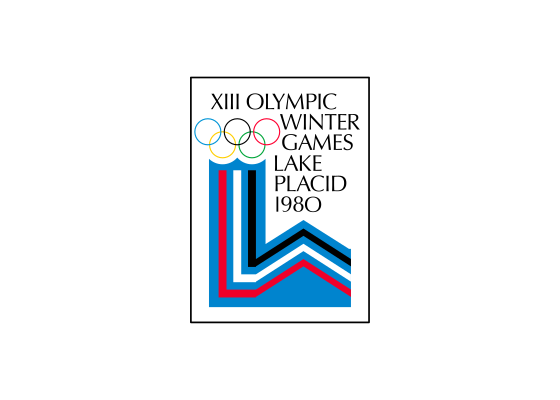
The Lake Placid 1980 emblem features a series of geometric triangle forms arranged to suggest the peaks of the Adirondack Mountains, rendered in the five Olympic colors. The triangles are stacked horizontally in a row, their pointed peaks rising upward to create a mountain range silhouette. The five colors, blue, yellow, black, green, and red, are distributed across the triangular forms, connecting the mountain imagery to the universal Olympic symbol. Below the mountains, “Lake Placid 1980” is set in a clean typeface with the Olympic rings beneath. The design is clean and direct, communicating the mountain setting through geometric abstraction rather than illustrative detail.
Meaning and Symbolism
- Mountain peaks: The triangular forms directly represent the Adirondack Mountains surrounding Lake Placid. The geometric abstraction reduces the landscape to its essential visual element: peaks against sky.
- Five Olympic colors: The distribution of the five ring colors across the mountain forms connects the local landscape to the international Olympic tradition. Each color represents one of the five inhabited continents.
- Geometric simplicity: The clean, angular forms reflect the graphic design sensibilities of the late 1970s, when geometric abstraction and clean lines were dominant in corporate and institutional design.
- Mountain village identity: Lake Placid is a small village in the Adirondack Mountains of upstate New York. The emblem’s focus on mountain peaks rather than urban imagery communicated the intimate, nature-centered character of the host location.
Design and History
The Lake Placid 1980 emblem was part of a visual identity for Games held in one of the smallest communities ever to host the Olympics. Lake Placid, with a population of just a few thousand, had hosted the 1932 Winter Games and used its existing infrastructure as a foundation for the 1980 bid.
The geometric mountain design was appropriate for a venue defined by its natural setting. The Adirondack Mountains provided both the landscape and the terrain for alpine, cross-country, and ski jumping events, while the village’s ice facilities hosted skating and hockey. The emblem’s mountain imagery connected all of these sporting activities to their shared environment.
The 1980 Winter Games are remembered almost entirely for the Miracle on Ice. The U.S. hockey team’s victory over the Soviet Union on February 22, 1980, in the context of Cold War tensions and the Soviet invasion of Afghanistan, transcended sports to become a national moment. Al Michaels’ broadcast call, “Do you believe in miracles? Yes!” became one of the most famous phrases in American sports broadcasting. The team went on to defeat Finland to win the gold medal.
Beyond hockey, the Games featured Eric Heiden’s extraordinary achievement of winning all five individual speed skating events, from 500 to 10,000 meters, a feat never matched before or since. Heiden’s dominance was one of the greatest individual performances in Olympic history.
The broader visual identity served the practical needs of a compact Games in a small mountain community, providing wayfinding, venue identification, and brand presence across a relatively concentrated geographic area. The simplicity of the mountain emblem made it effective at all scales, from venue banners to merchandise pins.
Typography
“Lake Placid 1980” is set in a clean, modern typeface beneath the mountain emblem. The letterforms are functional and straightforward, appropriate for the no-frills character of a small-town Winter Olympics. For the broader brand system, typography prioritized clarity and legibility across outdoor mountain environments.
FAQ
Q: What are the triangle shapes in the Lake Placid 1980 emblem?
A: The triangles represent the peaks of the Adirondack Mountains surrounding Lake Placid, rendered in the five Olympic colors. The geometric abstraction reduces the landscape to its essential form.
Q: What was the “Miracle on Ice”?
A: The U.S. ice hockey team, composed of amateur and college players, defeated the heavily favored Soviet Union team in a semifinal match on February 22, 1980. The victory, in the context of Cold War tensions, became one of the most celebrated moments in American sports history.
Q: How many times has Lake Placid hosted the Winter Olympics?
A: Twice. Lake Placid hosted the Winter Games in 1932 and 1980, making it one of the few communities to host the Olympics more than once.
The Lake Placid 1980 emblem and Olympic rings are trademarks of the International Olympic Committee. This page is for educational and reference purposes only.
More logos with similar colors