Winter Olympic Games Logos
The 1998 Winter Olympics, officially the XVIII Olympic Winter Games, were held in Nagano, Japan, from February 7 to 22, 1998. The Games featured 68 events across 14 disciplines, with athletes from 72 nations competing. Nagano, a mountain city in the Japanese Alps, had previously been a candidate for the 1940 and 1972 Winter Olympics. The 1998 Games were notable for the introduction of women’s ice hockey and the first full participation of NHL players in Olympic hockey.
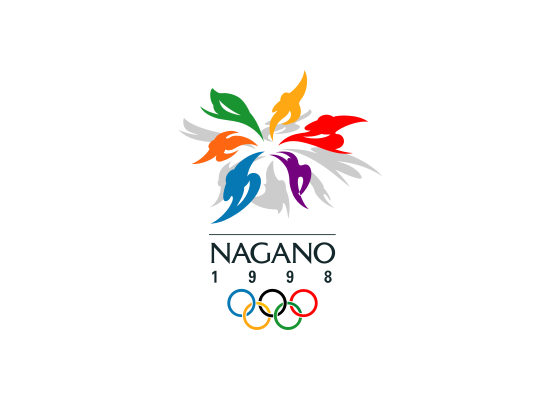
The Nagano 1998 emblem, known as the “Snowflower,” depicts six stylized human figures arranged in a radial pattern to form a flower or snowflake shape. Each figure represents a different winter sport, and each is rendered in a different color: red, orange, green, blue, purple, and magenta. The figures are positioned with their legs at the center and their bodies extending outward like petals, their arms raised in celebration. The overall form reads simultaneously as a flower in bloom, a snowflake, and a circle of athletes. Below the emblem, “NAGANO 1998” is set in a clean typeface with the Olympic rings beneath. Designed by Masahiro Kayano in collaboration with Landor Associates, the emblem’s combination of natural imagery and athletic motion captured both the mountain setting and the human spirit of the Games.
Meaning and Symbolism
- Six figures as petals: The six human figures, each in a different pose suggesting a different winter sport, are arranged as petals of a flower. This transforms individual athletic achievement into a collective, natural form, suggesting that the Games are greater than any single competition.
- Snowflake reading: The radial symmetry and the six-fold pattern reference the hexagonal structure of snowflakes. The dual reading, flower and snowflake, connects the warmth of human celebration with the cold of winter sports.
- Multi-color palette: Each figure in a different color represents the diversity of nations and cultures that the Olympics bring together. The vibrant, saturated colors contrast with the white snow of the mountain setting, creating visual energy and optimism.
- Natural and human: The “Snowflower” name itself captures the emblem’s central concept: the meeting point between nature (snow, flowers, mountains) and human aspiration (athletics, celebration, gathering). This duality was central to how Nagano presented itself, a mountain city where traditional Japanese culture met winter sport.
Design and History
The Nagano 1998 emblem was designed by Masahiro Kayano with development support from Landor Associates. The “Snowflower” concept emerged from the organizing committee’s desire to express the relationship between the natural environment of the Japanese Alps and the athletic spirit of the Winter Games.
Nagano was a smaller, more traditional city than many Olympic hosts, and the emblem reflected that character. Rather than the sleek, corporate aesthetics that were beginning to dominate Olympic branding in the 1990s, the Snowflower had an exuberance and folk-art quality that felt closer to festival illustration than to corporate identity. The six figures are not precisely rendered athletic forms; they are loose, joyful, almost childlike in their energy. This gave the emblem warmth and accessibility.
The choice of a flower motif for a Winter Olympics was deliberately counterintuitive. Winter Games typically lean into imagery of ice, snow, and cold. Nagano’s emblem argued that winter is also a season of beauty and vitality, that the mountains produce flowers as well as snow. This optimistic reading of winter aligned with the Japanese cultural appreciation for the beauty of all seasons and the transience of natural forms.
The Games themselves were held across Nagano and several surrounding mountain communities, including Hakuba, Karuizawa, Nozawa Onsen, and Yamanouchi. The dispersed venue structure made the visual identity particularly important for creating a sense of cohesion across the Games experience. The bright, multicolored palette of the Snowflower emblem provided that coherence, appearing on signage, merchandise, and venue dressing across the mountain region.
Nagano 1998 was also significant for the controversy surrounding its bid records. After winning the hosting rights, the Nagano organizing committee destroyed financial records related to the bid process, raising questions about the bidding practices that would later lead to IOC reforms.
Typography
“NAGANO 1998” is set in a clean, uppercase sans-serif typeface beneath the emblem. The letterforms are modern and neutral, providing structural stability beneath the organic, multicolored Snowflower above. For the broader brand system, typography balanced legibility with the warmth and energy of the emblem, maintaining a professional quality across wayfinding, publications, and broadcast graphics.
FAQ
Q: What is the “Snowflower” in the Nagano 1998 logo?
A: The Snowflower is a composition of six stylized human figures arranged in a radial pattern that reads as both a flower in bloom and a snowflake. Each figure represents a different winter sport and is rendered in a different color.
Q: Who designed the Nagano 1998 emblem?
A: Masahiro Kayano designed the emblem in collaboration with Landor Associates. The concept combined natural imagery (flowers, snowflakes) with athletic figures to express the relationship between Nagano’s mountain environment and the spirit of the Games.
Q: Why was a flower chosen for a Winter Olympics emblem?
A: The flower motif was deliberately counterintuitive, reflecting the Japanese cultural appreciation for beauty in all seasons. The “Snowflower” concept argued that winter is a season of vitality and beauty, not just cold and ice.
The Nagano 1998 emblem and Olympic rings are trademarks of the International Olympic Committee. This page is for educational and reference purposes only.
More logos with similar colors