Summer Olympic Games Logos
The 2000 Summer Olympics, officially the Games of the XXVII Olympiad, were held in Sydney, Australia, from September 15 to October 1, 2000. Often referred to as the “best Olympics ever” by IOC President Juan Antonio Samaranch, the Games featured 300 events across 28 sports, with 10,651 athletes from 199 nations competing. The Sydney Games are remembered for Cathy Freeman’s 400-meter gold medal run, which carried profound significance for Indigenous Australians.
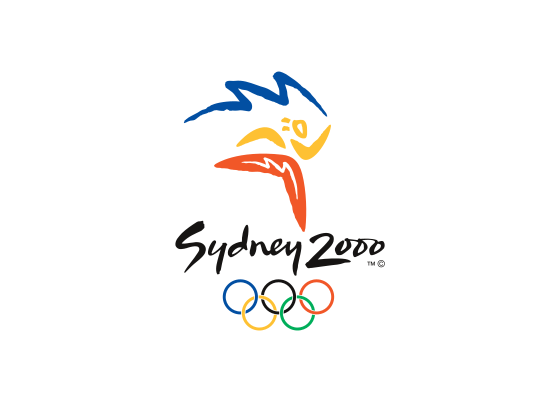
The Sydney 2000 emblem depicts a stylized athlete in motion, composed of two boomerang-like shapes that form the figure’s body and a series of curved lines suggesting smoke or vapor trails above. The overall composition simultaneously reads as a running figure, boomerangs in flight, and the sails of the Sydney Opera House. Designed by Michael Bryce of FHA Image Design, the mark uses blue, orange, and yellow, colors drawn from the Australian landscape and the harbor setting of Sydney. The boomerang shapes connect the emblem to Indigenous Australian culture, while the Opera House suggestion anchors it to the city’s most recognizable architectural landmark. Below the figure, “Sydney 2000” is set in a clean typeface with the Olympic rings beneath. The emblem was unveiled in 1996 and praised for the elegance of its multiple visual readings.
Meaning and Symbolism
- Boomerang shapes: The figure’s torso and limbs are formed from curved, boomerang-like shapes that reference Indigenous Australian culture. The boomerang is one of the most recognizable symbols of Australia and connects the Games to the country’s oldest cultural traditions.
- Sydney Opera House: The curved lines above the figure suggest the sail-shaped roofs of the Sydney Opera House, Jorn Utzon’s masterpiece on Bennelong Point. This architectural reference anchors the emblem to Sydney specifically, rather than Australia generally.
- Running athlete: The figure’s dynamic posture communicates athletic movement and energy. The body is tilted forward in a running position, with arms and legs extended, creating a sense of speed and momentum.
- Smoke/vapor trails: The curved lines above the figure also suggest smoke or steam, which could reference either the Olympic torch or the Australian landscape. The layered lines create a sense of upward movement and celebration.
- Color palette: The blue references Sydney’s harbor and the Pacific Ocean, while the orange and yellow suggest the Australian outback, sunlight, and the warm tones of the landscape.
Design and History
The Sydney 2000 emblem was designed by Michael Bryce, creative director of FHA Image Design in Brisbane, and unveiled in 1996. The design achieved something difficult: it encoded multiple Australian cultural references into a single, fluid form without any of them overwhelming the others. The boomerang, the Opera House, and the athletic figure exist simultaneously within the same lines, and depending on the viewer’s focus, one or another reading comes forward.
The inclusion of boomerang shapes was culturally significant. The 2000 Olympics coincided with a period of national conversation about reconciliation with Indigenous Australians, and the emblem’s reference to Aboriginal culture was both praised as inclusive and scrutinized for whether it represented genuine engagement or symbolic appropriation. The organizing committee worked to ensure that Indigenous Australian culture was woven throughout the Games experience, from the opening ceremony’s “Deep Sea Dreaming” and “Awakening” segments to Cathy Freeman’s lighting of the Olympic cauldron.
Freeman’s 400-meter gold medal, run in front of a home crowd at Stadium Australia, became the defining moment of the Sydney Olympics and one of the most emotionally charged moments in Olympic history. The visual identity’s Aboriginal references were validated by the centrality of Indigenous Australian athletes and culture to the Games’ narrative.
The broader brand system extended the emblem’s color palette and organic curves across a visual identity that felt distinctly Australian. The pictogram set for individual sports maintained the fluid, curved line quality of the emblem, and the environmental graphics transformed Sydney’s harbor and venues into a cohesive Olympic landscape. The mascots, Olly, Syd, and Millie, represented Australian native animals (a kookaburra, a platypus, and an echidna) and complemented the emblem’s connection to Australian nature and culture.
Typography
“Sydney 2000” is set in a clean, modern sans-serif typeface positioned below the emblem. The letterforms are neutral and straightforward, providing a stable typographic base that allows the fluid, organic emblem to carry the visual personality. For the broader brand system, typefaces maintained legibility and accessibility across the full range of Olympic applications while complementing the emblem’s curved, dynamic character.
FAQ
Q: What are the curved shapes in the Sydney 2000 logo?
A: The emblem contains multiple visual readings within a single form: boomerang shapes referencing Indigenous Australian culture, the sails of the Sydney Opera House, and a figure of a running athlete. These elements are integrated into one fluid composition.
Q: Who designed the Sydney 2000 emblem?
A: Michael Bryce of FHA Image Design in Brisbane designed the emblem. It was unveiled in 1996 and praised for the elegance of its layered symbolism.
Q: Why are the Sydney 2000 Olympics considered historically significant?
A: The Games are often called the “best Olympics ever,” a phrase used by IOC President Juan Antonio Samaranch. They are particularly remembered for Cathy Freeman’s 400-meter gold medal, which carried deep significance for Indigenous Australian reconciliation.
The Sydney 2000 emblem and Olympic rings are trademarks of the International Olympic Committee. This page is for educational and reference purposes only.
More logos with similar colors