Summer Olympic Games Logos
The 2004 Summer Olympics, officially the Games of the XXVIII Olympiad, were held in Athens, Greece, from August 13 to 29, 2004. The Games returned to the country where both the ancient Olympics and the first modern Olympics (1896) were held. Athens hosted 10,625 athletes from 201 nations competing in 301 events across 28 sports. The marathon followed the historical route from Marathon to Athens, completing a circuit that began 2,500 years earlier.
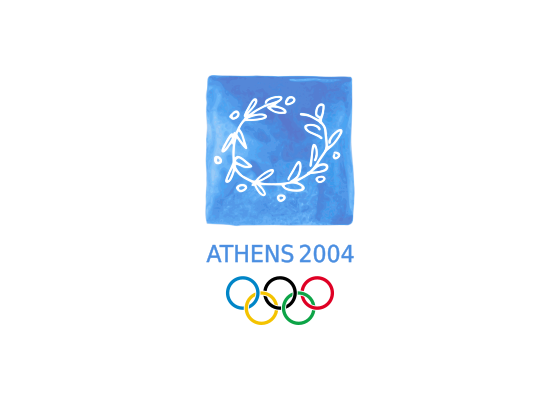
The Athens 2004 emblem depicts a stylized olive wreath, known as a kotinos, rendered in white and blue against an open sky. The wreath is simple, almost childlike in its execution, with a loose, organic line that avoids the precision of formal graphic design in favor of something more human and ancient. The blue and white color palette references the Greek national flag and the light of the Aegean Sea. Below the wreath, “ATHENS 2004” is set in a serif typeface, and the Olympic rings appear beneath. Developed with Wolff Olins, the emblem was unveiled in 2003, replacing an earlier bid-phase emblem. The olive wreath referenced the original prize given to victors at the ancient Olympic Games at Olympia, connecting the modern event directly to its 2,800-year-old origins.
Meaning and Symbolism
- Olive wreath (kotinos): The kotinos was the only prize awarded to victors at the ancient Olympic Games. It was cut from the sacred olive tree near the temple of Zeus at Olympia. Using it as the emblem’s central element connected the 2004 Games to the oldest layer of Olympic tradition.
- Blue and white: The colors are the Greek national colors, seen on the flag and across the architecture and seascape of the country. The blue also references the Aegean sky, and the white suggests the marble of ancient temples.
- Hand-drawn quality: The wreath’s loose, organic line quality was deliberate. It suggested something made by hand rather than by machine, evoking the handcraft of ancient artisans and the human scale of the original Games, which were local festivals before they became global spectacles.
- Simplicity: The emblem is striking in its simplicity compared to the complexity of many Olympic marks. A single wreath, two colors, minimal decoration. This restraint communicated confidence in the power of the symbol itself.
Design and History
The Athens 2004 emblem went through a notable evolution. The original bid-phase emblem, unveiled in 1997, was a more complex design. The organizing committee decided to replace it with the olive wreath concept, developed with Wolff Olins, which was unveiled in 2003.
The decision to center the emblem on the kotinos was conceptually perfect for Athens. No other host city could claim the same direct connection to the ancient Games. The wreath was not just a symbol of Greece; it was the original symbol of Olympic victory, the thing you received if you won. Using it for the emblem of the Games returning to their birthplace was a move that needed no explanation.
The simplicity of the design was also a response to the increasing visual complexity of Olympic branding. By the early 2000s, Olympic emblems had become elaborate compositions of color, pattern, and symbolism. Athens went the other direction, stripping the design down to a single, recognizable form. The hand-drawn quality of the wreath gave it warmth and humanity, qualities that the ancient Greek concept of the Olympics, as a celebration of human physical achievement, demanded.
The broader brand system extended the blue-and-white palette across all Games materials, creating a visual experience that was unmistakably Greek. The pictogram set for individual sports drew on ancient Greek pottery figures, maintaining the connection to antiquity while creating practical, modern icons for wayfinding and broadcast. The environmental graphics across Athens transformed the city into a stage for the Games, with the olive wreath appearing on banners, venue dressing, and merchandise.
The 2004 Games themselves were historically significant beyond the return to Greece. The marathon followed the route that Pheidippides is said to have run in 490 BC, from the battlefield of Marathon to Athens, adding a layer of historical resonance that no other host city could replicate.
Typography
“ATHENS 2004” is set in a serif typeface with classical proportions that reference Greek and Roman inscription lettering. The serifs and moderate stroke contrast give the text an authoritative, timeless quality appropriate for the birthplace of the Olympics. The typography complements the hand-drawn wreath by providing structural formality as a counterpoint to the organic emblem. For the broader brand system, typeface selections maintained this balance between classical reference and contemporary function.
FAQ
Q: What is the wreath in the Athens 2004 logo?
A: It is a kotinos, an olive wreath identical in concept to the prize awarded to victors at the ancient Olympic Games at Olympia. It was the only award given to ancient Olympic champions.
Q: Why were the 2004 Olympics significant for Athens?
A: Athens is the birthplace of the modern Olympics (the first modern Games were held there in 1896) and Greece is the home of the ancient Olympics, which began around 776 BC. The 2004 Games represented a return to the origins of the Olympic movement.
Q: Why is the wreath drawn in a loose, hand-made style?
A: The organic, hand-drawn quality was intentional, evoking the handcraft of ancient artisans and the human scale of the original Olympic Games. It contrasted with the polished, complex graphic design of other Olympic emblems, communicating simplicity and authenticity.
The Athens 2004 emblem and Olympic rings are trademarks of the International Olympic Committee. This page is for educational and reference purposes only.
More logos with similar colors