Winter Olympic Games Logos
The 2006 Winter Olympics, officially the XX Olympic Winter Games, were held in Turin (Torino), Italy, from February 10 to 26, 2006. The Games featured 84 events across 15 disciplines, with athletes from 80 nations competing. Italy last hosted the Winter Olympics in Cortina d’Ampezzo in 1956, making the 2006 Games a return to Italian winter sports tradition after a 50-year gap.
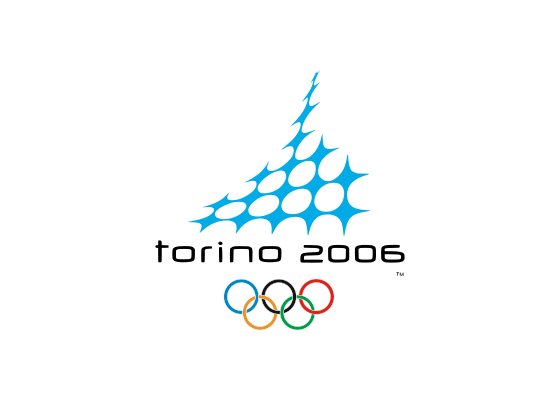
The Torino 2006 emblem depicts a stylized profile of a mountain or ice crystal, composed of a network of fine white lines woven together to create a mesh-like structure against a blue background. The form simultaneously suggests a snow crystal, a mountain peak, and the silhouette of the Mole Antonelliana, Turin’s most iconic building. Designed by Benito Leonori, the mark uses a single construction principle, interconnected lines forming a three-dimensional lattice, to create multiple visual associations. The emblem is rendered primarily in white and ice blue, with “TORINO 2006” set beneath in a clean sans-serif and the Olympic rings below. It was unveiled in 2002 and praised for its technical elegance and ability to evoke winter through abstraction rather than literal depiction.
Meaning and Symbolism
- Woven line structure: The emblem’s defining feature is its construction from a network of fine, interlocking lines that form a three-dimensional mesh. This web-like structure suggests the crystalline structure of ice and snow at a molecular level, connecting the visual identity to the fundamental physical reality of winter.
- Mole Antonelliana profile: The overall silhouette references the Mole Antonelliana, Turin’s tallest building and most recognizable landmark. Originally built as a synagogue in the 19th century, it is now home to the National Museum of Cinema. Its tapered spire is one of the most distinctive architectural profiles in Italy.
- Mountain and crystal: Beyond the architectural reference, the tapering form reads as both a mountain peak and a snow crystal, combining the natural landscape of the Italian Alps with the geometric precision of frozen water.
- Blue and white palette: The cool blue and white color scheme is among the most restrained in Olympic history. It communicates winter directly and elegantly, without the multi-color complexity of many Olympic palettes.
Design and History
The Torino 2006 emblem was designed by Benito Leonori and unveiled in 2002. The design won praise from the graphic design community for its sophisticated abstraction. Rather than depicting a specific winter sport or a literal Italian landmark, Leonori created a form that evokes winter through its structure, the lattice of lines suggesting crystalline ice formations, while simultaneously encoding the city’s architectural identity through its silhouette.
The Mole Antonelliana is to Turin what the Eiffel Tower is to Paris or the Empire State Building is to New York: the building that defines the skyline. Embedding its profile within an abstract ice crystal was a solution that communicated both “Turin” and “winter” without resorting to the obvious approach of simply drawing the building. The recognition is there for anyone who knows the city, while viewers who have never visited Turin simply see a beautiful ice formation.
The emblem’s technical quality was also notable. The fine-line construction required precise rendering to maintain legibility at small sizes, and the design team developed careful guidelines for minimum reproduction sizes and background colors. The luminous quality of the white lines against blue gave the emblem a glow-like effect that worked particularly well in broadcast applications and on the dark backgrounds of evening ceremonies.
The broader brand identity for Torino 2006 extended the crystalline aesthetic through pattern work and environmental graphics. The Italian approach to the Games was characteristically elegant, emphasizing design quality and cultural sophistication across venues, merchandise, and communications. The pictogram set for individual sports maintained the fine-line quality of the emblem, creating visual continuity across the full range of Olympic materials.
Turin itself was a city in transition during the 2006 Games, shifting from its traditional identity as an industrial capital (home to Fiat) toward a cultural and gastronomic destination. The Olympics accelerated that transformation, and the visual identity’s emphasis on elegance and sophistication contributed to the new narrative the city was building about itself.
Typography
“TORINO 2006” is set in a clean, uppercase sans-serif typeface beneath the emblem. The letterforms are modern and unadorned, with proportions that complement the geometric precision of the crystalline mark above. The typography’s restraint allows the complex, luminous emblem to remain the visual focus. For the broader brand system, typefaces maintained this clean, contemporary quality across wayfinding, publications, and digital applications.
FAQ
Q: What does the Torino 2006 emblem represent?
A: The emblem is a stylized form composed of interlocking lines that simultaneously suggests a snow crystal, a mountain peak, and the silhouette of the Mole Antonelliana, Turin’s most iconic building.
Q: Who designed the Torino 2006 emblem?
A: Benito Leonori designed the emblem, which was unveiled in 2002. It was praised for its technical elegance and sophisticated abstraction.
Q: What is the Mole Antonelliana?
A: The Mole Antonelliana is Turin’s tallest building, originally constructed as a synagogue in the 19th century and now home to the National Museum of Cinema. Its distinctive tapered spire defines Turin’s skyline and is referenced in the emblem’s overall silhouette.
The Torino 2006 emblem and Olympic rings are trademarks of the International Olympic Committee. This page is for educational and reference purposes only.
More logos with similar colors