Skip to Content
    Support us
    A-Z Agency Colors Country Designer Industry Tags Year Trending Reports
    Olympics 2008 Beijing sports China blue green red goldCN ChinesesportsChinabluegreenredgold

    2008 Summer Olympic Games in Beijing

    • Logo
    • China
    • Sports
    • Olympics 2008 Beijing

    Olympics 2008 Beijing Logo

    Explore the iconic Olympics 2008 Beijing logo – its design, history, and visual identity.

    Trending Popular
    Olympics 2008 Beijing logo - free SVG vector, sports brand from China

    Olympics 2008 Beijing Brand Colors

    Browse more logos with blue, green, red and gold colors.

    Olympics 2008 Beijing Brand Facts

    Key information about Olympics 2008 Beijing: origin, designer, industry, and logo introduction year.

    Websiteen.wikipedia.org
    DesignerGuo Chunning
    CountryChina
    IndustrySports
    Logo Introduced2008
    Download Olympics 2008 Beijing logo Embed Olympics 2008 Beijing logo
    views · downloads this week
    4.2 (59 ratings)

    Explore the Olympics 2008 Beijing brand, discover Olympics 2008 Beijing colors, and download the Olympics 2008 Beijing vector logo in SVG or PNG formats. Browse related logos and logos with similar colors.

    Summer Olympic Games Logos

    Olympics 2012 London logo vector - free SVG download

    Olympics 2012 London

    Sports
    Olympics 1992 Barcelona logo vector - free SVG download

    Olympics 1992 Barcelona

    Sports
    Olympics 2000 Sydney logo vector - free SVG download

    Olympics 2000 Sydney

    Sports
    Olympics 1964 Tokyo logo vector - free SVG download

    Olympics 1964 Tokyo

    Sports
    Olympics 1972 Munchen logo vector - free SVG download

    Olympics 1972 Munchen

    Sports
    Olympics 2016 Rio logo vector - free SVG download

    Olympics 2016 Rio

    Sports
    Olympics 1988 Seoul logo vector - free SVG download

    Olympics 1988 Seoul

    Sports
    Olympics 1968 Mexico logo vector - free SVG download

    Olympics 1968 Mexico

    Sports
    Olympics 2024 Paris logo vector - free SVG download

    Olympics 2024 Paris

    Sports
    Olympics 1980 Moscow logo vector - free SVG download

    Olympics 1980 Moscow

    Sports
    Olympics 2028 LA logo vector - free SVG download

    Olympics 2028 LA

    Sports
    Olympics 1976 Montreal logo vector - free SVG download

    Olympics 1976 Montreal

    Sports
    Olympics 2004 Athens logo vector - free SVG download

    Olympics 2004 Athens

    Sports
    Olympics 2020 Tokyo logo vector - free SVG download

    Olympics 2020 Tokyo

    Sports
    Olympics 1996 Atlanta logo vector - free SVG download

    Olympics 1996 Atlanta

    Sports

    The 2008 Summer Olympics, officially the Games of the XXIX Olympiad, were held in Beijing, China, from August 8 to 24, 2008. The opening ceremony, directed by Zhang Yimou, began at 8:08 PM on 08/08/08, a sequence considered extremely auspicious in Chinese culture. The Games featured 302 events across 28 sports, with athletes from 204 nations competing. China topped the gold medal table with 51 golds.

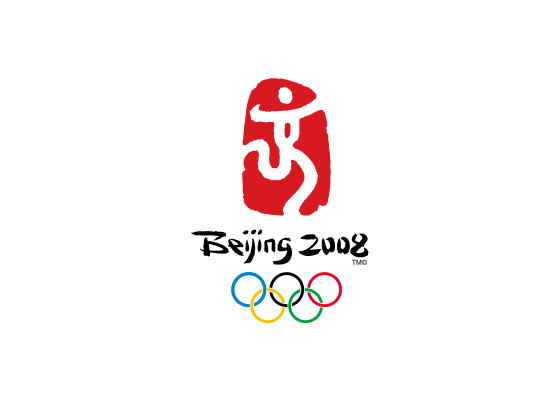
    The Beijing 2008 emblem, known as “Dancing Beijing,” takes the form of a traditional Chinese seal stamp rendered in red, containing a stylized figure of a person running with arms raised in celebration. The figure simultaneously reads as the Chinese character “jing” (京), meaning “capital,” the second character in “Beijing.” Designed by Guo Chunning and selected from 1,985 submissions, the mark combines three distinctly Chinese cultural elements: the red seal stamp format, the calligraphic brushwork of the figure, and the embedded Chinese character. Below the seal, “Beijing 2008” is set in a brushstroke-influenced typeface, and the Olympic rings appear beneath. The emblem was unveiled on August 3, 2003, exactly five years before the opening ceremony.

    Meaning and Symbolism

    • Red seal stamp (zhuan): The square red seal is one of the most recognizable formats in Chinese visual culture, used for centuries to authenticate documents, art, and official correspondence. Placing the Olympic emblem within a seal format immediately signals Chinese identity and authority.
    • Running figure / “jing” character: The central figure’s dual reading is the emblem’s most elegant quality. For viewers who read Chinese, the running person clearly forms the character 京. For international viewers, the calligraphic strokes read as a joyful, dynamic human figure. Neither reading requires the other, yet both are present simultaneously.
    • Calligraphic brushwork: The figure is rendered in the loose, expressive style of Chinese calligraphy rather than precise geometric construction. The strokes have the energy and spontaneity of brush-on-paper, connecting the emblem to thousands of years of Chinese artistic tradition.
    • Red color: The red of the seal references Chinese cultural associations with luck, celebration, and vitality. It is also the dominant color of the Chinese national flag.

    Design and History

    The Beijing 2008 emblem was the result of a global design competition that attracted 1,985 submissions. Guo Chunning’s winning concept went through extensive refinement before its unveiling on August 3, 2003. The date was chosen deliberately: exactly five years before the planned opening ceremony, itself scheduled for August 8, 2008.

    “Dancing Beijing” was one of the most culturally specific Olympic emblems ever created, and it succeeded because the cultural references it drew upon, the seal stamp, calligraphy, and the dual reading of figure and character, were each powerful enough to communicate independently. A viewer who knows nothing about Chinese seals still sees a joyful running figure. A viewer who recognizes the seal format immediately understands its significance. The mark operates on multiple levels without requiring knowledge of all of them.

    The emblem also carried significant political weight. The 2008 Olympics were China’s moment to present itself to the world as a modern, confident, culturally rich nation. The choice of a traditional seal format over a contemporary, abstract mark was a statement: China was proud of its history and did not need to adopt Western design conventions to be taken seriously on the international stage.

    The broader brand system was equally ambitious. The pictogram set for the individual sports was designed in the style of ancient Chinese seal script, creating a unified visual language that extended the emblem’s cultural references across all 302 events. The mascots, the five Fuwa characters, each referenced a specific element of Chinese culture and nature. The environmental graphics, wayfinding, and venue dressing for the Bird’s Nest stadium and the Water Cube created one of the most visually cohesive Olympic experiences ever staged.

    The opening ceremony, with its massive scroll painting, movable type demonstration, and precisely choreographed performers, extended the visual identity into performance. Zhang Yimou’s direction created a spectacle that was inseparable from the brand’s visual language.

    Typography

    “Beijing 2008” is set in a brushstroke-influenced typeface that echoes the calligraphic character of the seal above. The Latin letterforms retain the organic, slightly irregular quality of brush-on-paper, connecting the English text to the Chinese artistic tradition that defines the emblem. For the broader brand system, typefaces were selected to balance this calligraphic warmth with the functional clarity needed for wayfinding and informational contexts across a massive multi-venue event.

    FAQ

    Q: What is the “Dancing Beijing” emblem? A: It is a stylized figure of a running person, rendered within a traditional Chinese red seal stamp. The figure simultaneously forms the Chinese character “jing” (京), meaning “capital,” the second character in “Beijing.”

    Q: Who designed the Beijing 2008 emblem? A: Guo Chunning designed the emblem, which was selected from 1,985 submissions in a global design competition. It was unveiled on August 3, 2003.

    Q: Why is the emblem shaped like a stamp? A: The red seal stamp (zhuan) is a format used in Chinese culture for centuries to authenticate documents and art. Using this format as the emblem’s structure immediately communicates Chinese cultural identity and authority.

    The Beijing 2008 emblem and Olympic rings are trademarks of the International Olympic Committee. This page is for educational and reference purposes only.


    More Sports logos from China

    Kunlun Red Star logo vector - free SVG download

    Kunlun Red Star

    Sports
    Tianjin Tianhai logo vector - free SVG download

    Tianjin Tianhai

    Sports
    Shandong Taishan logo vector - free SVG download

    Shandong Taishan

    Sports
    Olympics 2022 Beijing logo vector - free SVG download

    Olympics 2022 Beijing

    Sports
    Qingdao logo vector - free SVG download

    Qingdao

    Sports
    Guangzhou City logo vector - free SVG download

    Guangzhou City

    Sports
    Guangzhou logo vector - free SVG download

    Guangzhou

    Sports
    Shenzhen logo vector - free SVG download

    Shenzhen

    Sports

    More logos with similar colors
    Absolute Nutrition logo vector - free SVG download

    Absolute Nutrition

    Software
    Polybius logo vector - free SVG download

    Polybius

    Crypto
    Ada logo vector - free SVG download

    Ada

    Sports
    VisualEditor logo vector - free SVG download

    VisualEditor

    Internet
    Gelsenwasser logo vector - free SVG download

    Gelsenwasser

    Energy
    Sega Sammy logo vector - free SVG download

    Sega Sammy

    Media
    Autolus logo vector - free SVG download

    Autolus

    Pharmaceuticals
    Brasil Telecom logo vector - free SVG download

    Brasil Telecom

    Telecom
    CRA logo vector - free SVG download

    CRA

    Healthcare
    Donor Concierge logo vector - free SVG download

    Donor Concierge

    Healthcare
    Atlantic Union logo vector - free SVG download

    Atlantic Union

    Banking and Finance
    Maxis logo vector - free SVG download

    Maxis

    Telecom

    The "2008 Summer Olympic Games in Beijing" appears in: Asia Logos , Athletics Logos , Competition Logos , Recreation - Sport Logos , Olimpics Logos and Summer Logos .

    Frequently asked questions about the Olympics 2008 Beijing logo

    The 2008 Summer Olympic Games in Beijing logo represents a sports brand from China, designed in 2008 by Guo Chunning. Learn more on the official Olympics 2008 Beijing website.

    Why is the Olympics 2008 Beijing logo in SVG format?
    The Olympics 2008 Beijing logo is provided as an SVG (Scalable Vector Graphics) file because vectors offer unlimited scaling without pixelation, smaller file sizes than raster images, and are ideal for responsive web design. SVG logos work perfectly across all screen sizes — from mobile devices to billboard prints — maintaining crisp edges at any resolution.
    Should I use SVG or PNG for the Olympics 2008 Beijing logo?
    Use SVG for websites, apps, and any digital design requiring scalability. SVG files are resolution-independent and load faster. Use PNG (converted from SVG at 300 DPI) for presentations, printed materials, or software that doesn’t support SVG. Convert using Adobe Illustrator, Inkscape, Affinity Designer, or online tools like CloudConvert. Export at 300 DPI for print, 72-150 DPI for web.
    What software can open the Olympics 2008 Beijing SVG logo?
    The Olympics 2008 Beijing SVG logo opens in both code editors (VS Code, Sublime Text, Notepad++) and graphic design software (Figma, Adobe Illustrator, Affinity Designer, Sketch, Inkscape). Modern web browsers can also display SVG files directly. For quick edits, online editors like SVGEdit or Method Draw work without installing software.
    What font does the Olympics 2008 Beijing logo use?
    Many professional brands, including Olympics 2008 Beijing, use custom-designed typefaces for their logos to ensure unique brand identity and trademark protection. If the Olympics 2008 Beijing logo uses a custom font, no exact public version may exist. For similar typography, analyze the logo’s letter characteristics (serif vs sans-serif, weight, spacing) and search font databases like WhatTheFont, Identifont, or MyFonts for close alternatives.
    What is a Logo or Logotype?
    A logo is a graphic mark, emblem, or symbol used to aid public identification and recognition. Logos fall into three classifications: ideographs (abstract forms), pictographs (iconic designs), and logotypes/wordmarks (text-based). The logo is central to a brand’s visual identity system.
    Can I use the Olympics 2008 Beijing logo legally?
    The Olympics 2008 Beijing logo is a registered trademark and cannot be used commercially without explicit written permission from Olympics 2008 Beijing. This website provides the logo for educational, informational, and reference purposes only. For commercial projects, partnerships, or official brand assets, contact Olympics 2008 Beijing’s communications or legal department directly.
    Where can I find Olympics 2008 Beijing brand guidelines?
    Official Olympics 2008 Beijing brand guidelines typically include logo usage rules, color codes, typography, spacing requirements, and prohibited modifications. Check the Olympics 2008 Beijing website for a “Brand,” “Press,” “Media Kit,” or “Resources” section. Official assets are also available through press kits and authorized partner portals.
    Do I need to credit logotyp.us when using the Olympics 2008 Beijing logo?
    No attribution to logotyp.us is required. However, the Olympics 2008 Beijing logo itself is trademarked intellectual property — using it requires permission from Olympics 2008 Beijing, regardless of where you downloaded it. This site serves as a reference library; downloading a logo here does not grant usage rights.

    Report Outdated Logo

    logotyp.us

    Download high-quality vector logos in SVG format — free for designers, developers, and brand enthusiasts. Browse 4,700+ brand logos by industry, country, color, and designer.

    Help Keep This Free Logos and Brands
    Browse
    • Logos by Industry
    • Logos by Country
    • Logos by Color
    • Logos by Designer
    • A–Z Logo Index
    Discover
    • Popular Logos
    • Search Logos
    • Logo Reports
    Top Countries
    • United States
    • United Kingdom
    • Global
    • Japan
    • Germany
    • Canada
    • France
    • India
    • Sweden
    • Spain
    • Italy
    • Australia
    • Switzerland
    • Netherlands
    • China
    • View All Countries →

    © 2026 logotyp.us. All logos are trademarks of their respective owners.

    Build 0307-1037