Winter Olympic Games Logos
The 2010 Winter Olympics, officially the XXI Olympic Winter Games, were held in Vancouver and Whistler, British Columbia, Canada, from February 12 to 28, 2010. The Games featured 86 events across 15 disciplines, with athletes from 82 nations competing. Canada finished atop the gold medal standings with 14 golds, the most ever won by a host country at a Winter Olympics.
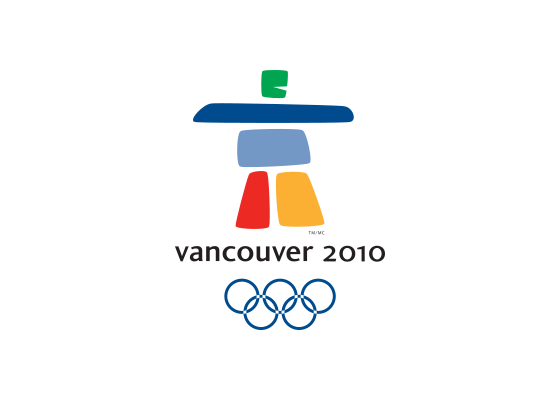
The Vancouver 2010 emblem, named Ilanaaq, depicts a stylized inukshuk, the stone landmark figures built by the Inuit and other Indigenous peoples of the Canadian Arctic. The figure stands with arms outstretched in a welcoming gesture, constructed from five geometric shapes rendered in green, blue, and warm tones that transition from sea green at the base through sky blue to golden and red at the top. The name “Ilanaaq” means “friend” in Inuktitut, the language of the Inuit people. Below the figure, “Vancouver 2010” is set in a clean sans-serif with the Olympic rings beneath. Designed by Elena Rivera MacGregor of the Rivera Design Group, the emblem was unveiled in April 2005 and became one of the most recognizable and commercially successful Olympic brands in history.
Meaning and Symbolism
- Inukshuk form: The inukshuk is a stone structure traditionally used by Inuit peoples as landmarks for navigation, to mark food caches, or to indicate safe travel routes. Its use as an Olympic emblem connected the Games to Canada’s Indigenous heritage and the country’s northern landscape.
- Welcoming gesture: The figure’s outstretched arms suggest an embrace, communicating hospitality and the welcoming of the world to Canada. The human proportions of the form, head, arms, legs, make it read as a figure of greeting rather than an abstract structure.
- Color gradient: The five colored sections reference Canada’s diverse landscape: the green suggests the Pacific coast forests, the blues reference the ocean and sky, and the warm tones at the top suggest autumn foliage and the warmth of Canadian hospitality. The colors also loosely correspond to the five Olympic ring colors.
- “Ilanaaq” name: Naming the emblem, rather than simply describing it, gave it a personality and a cultural anchor. “Friend” in Inuktitut is a statement about how Canada wanted to present itself to the world.
Design and History
The Vancouver 2010 emblem was unveiled on April 23, 2005, following a design process led by Elena Rivera MacGregor. The choice of an inukshuk was both praised and debated. Supporters saw it as a powerful statement of Canadian identity that connected the Olympics to the country’s Indigenous peoples and northern landscape. Critics, particularly some Inuit leaders, noted that inuksuit (the plural form) are primarily associated with the Arctic, not British Columbia, and that the emblem risked reducing a complex cultural tradition to a sports logo.
The debate was genuine and thoughtful, and the organizing committee engaged with it seriously. The counter-argument was that the inukshuk had already become a broadly recognized Canadian symbol, appearing on the flag of the territory of Nunavut and in public art installations across the country. Using it for the Olympics extended its symbolic reach rather than diminishing it.
Commercially, the Vancouver 2010 brand was extraordinarily successful. The emblem’s simple, geometric form worked well across merchandise, and the warm color palette gave it a friendliness that consumers responded to. Revenue from licensing and merchandise exceeded expectations, and the Ilanaaq figure became one of the best-selling Olympic brands of all time.
The broader visual identity extended the color palette and geometric language of the emblem through patterns inspired by Pacific Northwest Indigenous art, creating a visual system that was distinctly Canadian without relying on cliches. The mascots, Miga, Quatchi, and Sumi, drawn from Indigenous mythology, complemented the inukshuk emblem within a coherent cultural framework.
The Vancouver Games themselves were widely considered a success, from the emotional moment of Alexandre Bilodeau winning Canada’s first-ever gold medal on home soil to Sidney Crosby’s overtime goal in the men’s hockey final. The Ilanaaq emblem became synonymous with those memories, which is ultimately what the best Olympic brands achieve.
Typography
“Vancouver 2010” is set in a clean, modern sans-serif typeface positioned below the inukshuk figure. The letterforms are straightforward and unadorned, allowing the emblem to carry the visual personality. For the broader brand system, the typography maintained this clean, accessible quality across wayfinding, publications, and digital platforms, balancing the cultural richness of the emblem with the functional clarity that a major event requires.
FAQ
Q: What is the stone figure in the Vancouver 2010 logo?
A: It is a stylized inukshuk, a stone landmark traditionally built by Inuit and other Indigenous peoples of the Canadian Arctic. The Vancouver 2010 version is named Ilanaaq, meaning “friend” in Inuktitut.
Q: Who designed the Vancouver 2010 emblem?
A: Elena Rivera MacGregor of the Rivera Design Group designed the emblem. It was unveiled in April 2005.
Q: Why were the colors chosen for the Vancouver 2010 emblem?
A: The five colors represent elements of Canada’s landscape: green for the Pacific coast forests, blues for the ocean and sky, and warm tones for autumn foliage and hospitality. They also loosely correspond to the five Olympic ring colors.
The Vancouver 2010 emblem and Olympic rings are trademarks of the International Olympic Committee. This page is for educational and reference purposes only.
More logos with similar colors