Summer Olympic Games Logos
The 2012 Summer Olympics, officially the Games of the XXX Olympiad, were held in London, United Kingdom, from July 27 to August 12, 2012. London became the first city to host the modern Olympics three times, following 1908 and 1948. The Games featured 302 events across 26 sports, with over 10,500 athletes from 204 nations competing. The opening ceremony, directed by Danny Boyle, was widely praised as a celebration of British culture and history.
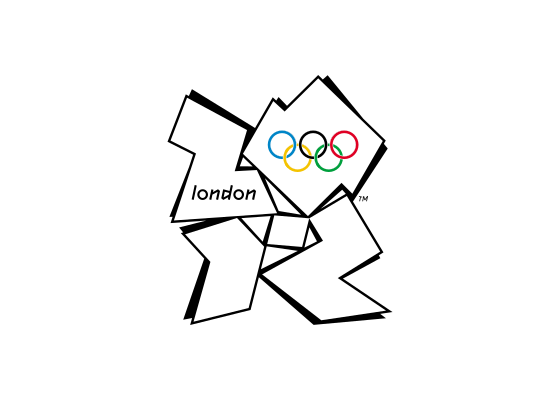
The London 2012 emblem is a jagged, angular composition of the numerals “2012” rendered in fractured, graffiti-influenced shapes. Designed by Wolff Olins, the mark deliberately abandoned the organic, illustrative approach that had dominated Olympic branding for decades. The numerals are broken into sharp-edged, interlocking fragments that create a dense, energetic form. Within the composition, the word “london” is embedded in one section and the Olympic rings in another. The emblem was designed to work in any color, with the primary version rendered in a vivid pink, though orange, green, and blue variations were equally prominent. Unveiled in June 2007 at a cost of 400,000 pounds, it became one of the most debated pieces of graphic design in Olympic history.
Meaning and Symbolism
- Fractured numerals: The broken, angular “2012” was intended to represent the energy and dynamism of London as a city. The shattered forms suggest disruption, youth culture, and the fast pace of urban life rather than the classical harmony typical of Olympic design.
- Color flexibility: The emblem was designed as a shape that could be filled with any color or pattern, allowing it to adapt across different sports, venues, and contexts. This was an early example of what would later become common in dynamic brand identity systems.
- Embedded text and rings: Rather than placing the host city name and Olympic rings below or beside the emblem, Wolff Olins integrated them directly into the jagged composition, making them part of the overall form rather than separate elements.
- Youth orientation: The angular, street-art aesthetic was a deliberate attempt to connect the Olympics with a younger audience. The organizing committee’s stated goal was to “inspire a generation,” and the visual language was calibrated to feel contemporary and accessible to teenagers and young adults.
Design and History
The London 2012 emblem was unveiled on June 4, 2007, and the reaction was immediate and intense. Public opinion polls showed overwhelming negative response. Commentators called it ugly, confusing, and overpriced. An online petition to scrap it gathered tens of thousands of signatures. Some viewers claimed to see suggestive imagery in the angular forms. A brief animated version triggered seizure warnings and was pulled from broadcast. The Iran Olympic Committee threatened to boycott, claiming the shapes spelled “Zion.”
Wolff Olins, the London-based brand consultancy that created the emblem, defended it as intentionally provocative. The agency’s position was that Olympic emblems had become formulaic, pretty marks that all looked alike, and that London, a city defined by punk, multiculturalism, and creative disruption, deserved something that reflected its actual character rather than a polished, inoffensive symbol.
The controversy gradually subsided. By the time the Games opened in 2012, the emblem had become familiar and even accepted. The broader brand system, which used the angular forms as a framework for vivid color and pattern, proved effective across the enormous range of applications an Olympics requires: venue signage, merchandise, broadcast graphics, tickets, volunteer uniforms, and digital platforms. The system’s flexibility, its ability to absorb different colors and imagery while maintaining visual coherence, was the emblem’s strongest functional quality.
Whether you consider the London 2012 emblem a success depends on what you think an Olympic emblem should do. If the job is to be beautiful and universally liked, it failed spectacularly. If the job is to be memorable, to generate conversation, and to represent its host city authentically, there is an argument that it succeeded more completely than any Olympic emblem before or since. Five years after the Games, it remained one of the most recognizable Olympic brands in history, which is more than can be said for many prettier emblems.
Typography
The word “london” within the emblem is set in a lowercase sans-serif that conforms to the angular geometry of the surrounding shapes. For the broader brand system, the typeface 2012 Headline was created as a custom display font with angular, geometric forms that echoed the emblem’s fragmented aesthetic. Body text used cleaner, more conventional typefaces for legibility, but the headline font gave all official communications an immediately recognizable visual signature.
FAQ
Q: Who designed the London 2012 emblem?
A: Wolff Olins, a London-based brand consultancy, designed the emblem. It was unveiled in June 2007 and reportedly cost 400,000 pounds to develop.
Q: Why was the London 2012 logo so controversial?
A: The jagged, angular design was a radical departure from the organic, illustrative style that had characterized Olympic branding for decades. Public reaction was overwhelmingly negative at first, with criticism focusing on its perceived ugliness and high cost. Wolff Olins defended it as an intentionally provocative design that reflected London’s creative culture.
Q: What do the shapes in the London 2012 logo represent?
A: The shapes form the numerals “2012” in a fractured, graffiti-influenced style. The word “london” and the Olympic rings are embedded within the angular composition. The fragmented forms were intended to represent London’s energy, diversity, and youth culture.
The London 2012 emblem and Olympic rings are trademarks of the International Olympic Committee. This page is for educational and reference purposes only.
More logos with similar colors