Winter Olympic Games Logos
The 2014 Winter Olympics, officially the XXII Olympic Winter Games, were held in Sochi, Russia, from February 7 to 23, 2014. Sochi, a subtropical resort city on the Black Sea coast, became the warmest city ever to host a Winter Olympics. The Games featured 98 events across 15 disciplines, with athletes from 88 nations competing. Russia topped the medal table with 33 medals, including 13 golds.
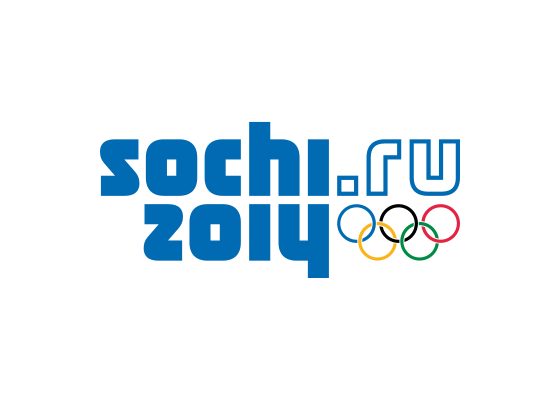
The Sochi 2014 emblem pairs the word “sochi” with its mirror reflection “2014,” the two elements separated by a period to form “sochi.ru,” directly referencing Russia’s internet domain. Designed by Interbrand, the mark was the first Olympic emblem to incorporate a web address as its fundamental structure. The logotype is set in a clean, rounded sans-serif with lowercase lettering, giving it a contemporary, digital-native quality. The mirror relationship between the text and numerals creates visual symmetry while communicating that these were Games designed for the internet age. Beneath the logotype, the Olympic rings appear in their standard five-color arrangement. The emblem was unveiled in December 2009 and represented a deliberate departure from the pictorial tradition of Olympic emblems.
Meaning and Symbolism
- ".ru" web address: The integration of Russia’s country-code domain into the emblem’s structure was unprecedented. It positioned the Sochi Games as the first truly digital Olympics, acknowledging that for most of the global audience, the Games would be experienced online rather than in person.
- Mirror reflection: The word “sochi” and the year “2014” mirror each other vertically, creating a visual reflection that references both the reflection of the Caucasus Mountains in the Black Sea and the duality of the host location, a subtropical coast staging winter sports.
- Lowercase lettering: The use of lowercase was deliberate and unusual for Olympic branding, which typically favors uppercase for authority. The lowercase treatment made the mark feel approachable, modern, and internet-native.
- Clean geometry: The rounded sans-serif letterforms and minimal color palette (the logotype itself is rendered in a single color, typically blue or white) stripped away the illustrative complexity typical of Olympic emblems, embracing simplicity.
Design and History
The Sochi 2014 emblem was unveiled on December 1, 2009, replacing an earlier emblem that had been used during the bid phase. Interbrand developed the identity, and the concept of building the emblem around a URL was both praised for its originality and questioned for its longevity, since web addresses are inherently tied to a specific technological era.
The design reflected a genuine strategic insight: the Sochi Olympics would be consumed digitally by billions of people who would never visit the Black Sea coast. Making the emblem itself a navigable web address collapsed the distance between the brand mark and the digital experience. In 2009, this was forward-thinking. Whether the “.ru” reference aged well is debatable, but as a snapshot of the moment when the Olympics fully entered the digital age, the concept was sharp.
Sochi itself presented an unusual branding challenge. The city was not widely known internationally, and its subtropical climate seemed counterintuitive for a Winter Games. The organizing committee leaned into this tension rather than hiding from it, using the warmth of the location as a differentiator. The broader visual identity included a patchwork quilt pattern representing the diversity of Russia’s cultural traditions, from Gzhel ceramics to Khokhloma woodwork to Kubachi metalwork. Each pattern referenced a specific Russian folk art tradition, and together they created a vivid, colorful system that worked across merchandise, venue dressing, and broadcast graphics.
The Games themselves were the most expensive in Olympic history at an estimated $51 billion, a figure that reflected massive infrastructure investment in a region that had limited winter sports facilities before the bid. The visual identity needed to project confidence and modernity on a scale that matched the investment.
Typography
The Sochi 2014 logotype uses a custom rounded sans-serif typeface with uniform stroke width and generous, open letterforms. The lowercase treatment and rounded terminals give the characters a friendly, digital quality. The mirrored “2014” uses the same typeface, maintaining visual consistency across the reflected composition. For the broader brand system, complementary typefaces were selected to maintain the clean, modern character across wayfinding, publications, and digital platforms.
FAQ
Q: Why does the Sochi 2014 logo include “.ru”?
A: The emblem incorporates Russia’s internet country-code domain to form “sochi.ru,” making it the first Olympic emblem structured as a web address. This reflected the organizing committee’s focus on digital engagement and the reality that most people would experience the Games online.
Q: Who designed the Sochi 2014 emblem?
A: Interbrand, the global brand consultancy, designed the emblem. It was unveiled in December 2009, replacing an earlier bid-phase emblem.
Q: What is the patchwork pattern associated with Sochi 2014?
A: The visual identity included a patchwork quilt motif composed of patterns drawn from traditional Russian folk arts, including Gzhel ceramics, Khokhloma woodwork, and other regional craft traditions. The quilt represented the cultural diversity of Russia.
The Sochi 2014 emblem and Olympic rings are trademarks of the International Olympic Committee. This page is for educational and reference purposes only.
More logos with similar colors