Summer Olympic Games Logos
The 2016 Summer Olympics, officially the Games of the XXXI Olympiad, were held in Rio de Janeiro, Brazil, from August 5 to 21, 2016. Rio became the first South American city to host the Olympic Games, and the first Portuguese-speaking host city. The Games featured 306 events across 28 sports, with golf and rugby sevens returning to the Olympic program for the first time in over a century.
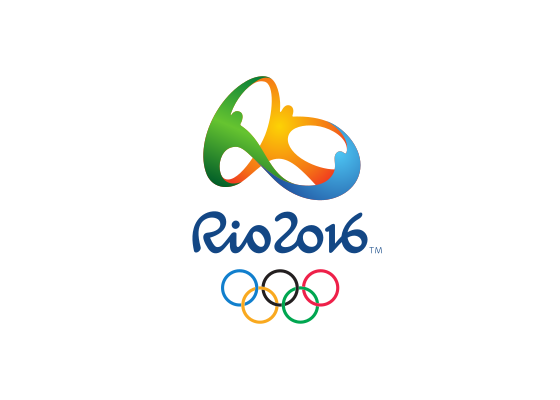
The Rio 2016 emblem depicts three figures interlocked in a continuous embrace, their forms flowing together to create a single organic shape. Designed by the Brazilian agency Tatil Design, the mark uses gradients of green, blue, yellow, and orange that reference both the Brazilian flag and Rio’s tropical landscape. The figures have no beginning or end. They merge into one another, their limbs forming curves that suggest Sugarloaf Mountain, the sea, and the sun simultaneously. The overall silhouette is roughly triangular, grounding the fluid forms with structural stability. Below the emblem, “Rio 2016” is set in a custom rounded typeface that echoes the mark’s organic curves. It was the first Olympic emblem selected through a formal design competition in Brazil, with Tatil’s entry chosen from among submissions by several invited agencies.
Meaning and Symbolism
- Three interconnected figures: The interlocking human forms represent the coming together of athletes, the city, and the spirit of the Games. Their continuous flow, with no distinct separation between bodies, communicates unity and connection.
- Topographic suggestion: The flowing contours simultaneously read as Rio’s geography: the rounded peaks of Sugarloaf Mountain and Corcovado, the curve of Copacabana beach, and the undulation of the surrounding hills. This dual reading, human and landscape, is the emblem’s defining quality.
- Color gradients: The greens, blues, yellows, and oranges transition smoothly across the forms, referencing both the Brazilian national colors and the sensory richness of Rio de Janeiro. The gradient treatment gives the mark depth and warmth that a flat-color approach would not achieve.
- Organic form language: Where most Olympic emblems of the era used geometric construction or calligraphic gesture, Rio 2016 went fully organic. The curves are freeform, reflecting the natural landscape and the Brazilian cultural tendency toward fluidity and warmth in visual expression.
Design and History
The Rio 2016 emblem was unveiled on December 31, 2010, during New Year’s celebrations at Copacabana Beach, a setting that underscored the emblem’s connection to Rio’s public life and natural beauty. Tatil Design, a Rio-based agency with decades of experience in Brazilian brand identity, developed the mark through an invited competition organized by the Rio 2016 organizing committee.
Tatil’s creative director, Fred Gelli, described the concept as rooted in four pillars: contagious energy, harmonious diversity, exuberant nature, and the Olympic spirit. The design team studied Rio’s physical landscape extensively, translating the city’s distinctive topography into the flowing contours of the human figures. The result is an emblem that feels like Rio in a way that transcends literal depiction.
The mark drew comparisons to Henri Matisse’s paper cutouts, particularly “The Dance,” and the comparison is apt. Like Matisse’s work, the Rio emblem finds complex meaning in apparently simple, joyful forms. The figures are not anatomically detailed. They are pure gesture, pure embrace, and the absence of specificity makes them universal while the color palette and organic language make them unmistakably Brazilian.
Rio 2016 was a historically significant Games for South America, representing the continent’s first opportunity to host the Olympics. The emblem needed to carry that weight while also being warm, accessible, and celebratory. Tatil’s solution managed all three, creating what many designers consider one of the strongest Olympic emblems of the 21st century.
The broader brand system extended the emblem’s language through a series of patterns, pictograms, and environmental graphics that maintained the organic, gradient-rich aesthetic across venues, merchandise, and broadcast.
Typography
“Rio 2016” is set in a custom typeface with rounded, soft letterforms that directly echo the emblem’s organic curves. The letters have a handmade quality, with slightly irregular strokes that feel warm and human rather than mechanical. The numerals “2016” share the same rounded treatment, integrating seamlessly with the wordmark. For broader applications, the brand system used typefaces that maintained this warmth while providing the legibility needed for wayfinding and informational contexts.
FAQ
Q: Who designed the Rio 2016 emblem?
A: The Brazilian agency Tatil Design, led by creative director Fred Gelli, designed the emblem. It was selected through an invited competition among Brazilian agencies.
Q: What do the figures in the Rio 2016 logo represent?
A: The three interlocking figures represent the unity of athletes, the city of Rio, and the Olympic spirit. Their flowing forms also suggest Rio’s landscape, including Sugarloaf Mountain, the coastline, and the surrounding hills.
Q: Was Rio 2016 the first Olympics in South America?
A: Yes. Rio de Janeiro was the first South American city to host the Olympic Games. It was also the first Games held in a Portuguese-speaking country.
The Rio 2016 emblem and Olympic rings are trademarks of the International Olympic Committee. This page is for educational and reference purposes only.
More logos with similar colors