Winter Olympic Games Logos
The 2018 Winter Olympics, officially the XXIII Olympic Winter Games, were held in PyeongChang, South Korea, from February 9 to 25, 2018. The Games featured 102 events across 15 disciplines, with athletes from 92 nations competing. PyeongChang won the hosting bid in 2011, defeating Munich and Annecy on the first ballot.
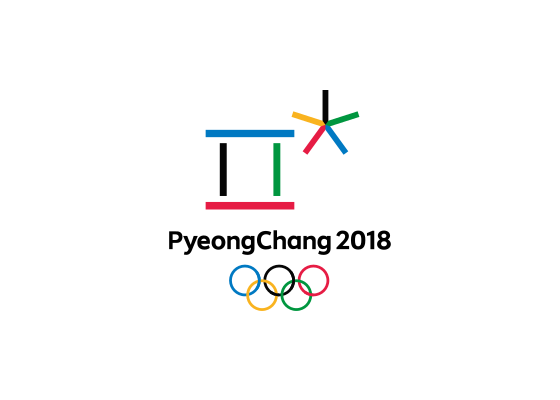
The PyeongChang 2018 emblem is composed of two Korean Hangul characters arranged in a square formation. The left element represents the consonant “ㅍ” (pieup), the first letter of “PyeongChang” in Korean, styled to suggest a gathering of people with arms raised. The right element represents “ㅊ” (chieut), the first letter of “Chang,” rendered to suggest snow and ice in a winter landscape. Together, the two characters create a compact, balanced mark that is both typographically meaningful in Korean and visually evocative of winter sports for international audiences. The emblem uses a palette that shifts across the five Olympic colors with an emphasis on cool blues and cyans.
Meaning and Symbolism
- Hangul characters: The use of the Korean alphabet directly communicates the host country’s linguistic identity. For Korean viewers, the characters are immediately legible as the initials of PyeongChang. For international viewers, they read as abstract geometric forms suggesting human figures and winter landscapes.
- People gathering: The left character (ㅍ) is styled to resemble three human figures standing together, representing the gathering of athletes and nations at the Games.
- Snow and ice: The right character (ㅊ) is styled with pointed forms that suggest ice crystals, snowflakes, and mountain peaks, directly referencing the winter setting.
- Square composition: The two characters fit together in a compact, nearly square format that works well as an icon across digital and physical applications.
Design and History
The PyeongChang 2018 emblem was unveiled in May 2013. The design was developed by the organizing committee’s creative team, drawing on the principle that the Korean alphabet (Hangul) is one of the country’s most significant cultural achievements. King Sejong the Great created Hangul in the 15th century specifically to give the Korean people a writing system that was accessible and rational, replacing the Chinese characters that only the elite could read.
Using Hangul as the foundation of the Olympic emblem was a statement about Korean cultural pride. Previous Korean Olympic branding (Seoul 1988) had used more universally readable symbols. PyeongChang’s decision to center the design on Korean script was a confident assertion that Hangul itself is beautiful and communicative enough to represent the nation on the world stage.
The stylization of the characters required careful balance between legibility for Korean readers and visual meaning for international audiences. The designers achieved this by rendering the characters in a way that simultaneously reads as abstract winter imagery (figures, ice, mountains) and as recognizable Hangul. This dual reading is the emblem’s strongest quality.
PyeongChang was the first Winter Olympics held in South Korea and only the second Olympics in the country after Seoul 1988. The Games were notable for the participation of a unified Korean team in the opening ceremony, with athletes from North and South Korea marching together under a unified flag.
Typography
“PYEONGCHANG 2018” is set beneath the emblem in a clean sans-serif typeface with even proportions. The bilingual presentation includes Korean text in Hangul alongside the romanized English version. The typography is restrained and modern, allowing the emblem’s Hangul-based design to carry the visual weight.
FAQ
Q: What do the shapes in the PyeongChang 2018 logo represent?
A: The shapes are stylized Korean Hangul characters: “ㅍ” (the first letter of “PyeongChang”) and “ㅊ” (the first letter of “Chang”). They are rendered to suggest people gathering and winter landscapes.
Q: Was PyeongChang 2018 the first Winter Olympics in South Korea?
A: Yes. South Korea previously hosted the 1988 Summer Olympics in Seoul. PyeongChang 2018 was the country’s first Winter Games.
Q: What is Hangul?
A: Hangul is the Korean alphabet, created by King Sejong the Great in the 15th century. Its use in the Olympic emblem was a statement of Korean cultural pride.
The PyeongChang 2018 emblem and Olympic rings are trademarks of the International Olympic Committee. This page is for educational and reference purposes only.
More logos with similar colors