Winter Olympic Games Logos
The 2022 Winter Olympics, officially the XXIV Olympic Winter Games, were held in Beijing, China, from February 4 to 20, 2022. Beijing became the first city to host both the Summer (2008) and Winter Olympic Games. The events were staged across three competition zones: downtown Beijing for ice sports, Yanqing for sliding and alpine skiing, and Zhangjiakou for cross-country, biathlon, and ski jumping.
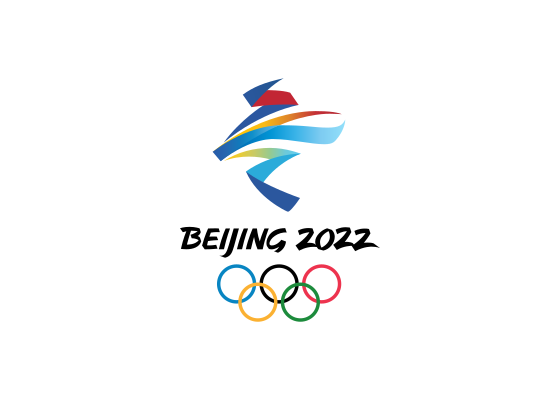
The Beijing 2022 emblem, named “Winter Dream,” depicts a stylized figure of a skater on top and a skier below, integrated into a flowing ribbon form that also suggests the Chinese character for “winter” (冬). The calligraphic strokes are rendered in gradients of blue, transitioning from deep navy to bright cyan, evoking ice, snow, and the winter sky. The figure’s dynamic posture communicates athletic movement, while the ribbon form references traditional Chinese art and the fluid brushwork of calligraphy. Below the emblem, “BEIJING 2022” is set in a clean serif typeface with the Olympic rings beneath. The design was created by Lin Cunzhen and selected from over 4,500 submissions.
Meaning and Symbolism
- Chinese character for “winter” (冬): The emblem’s primary structure references this character, connecting the Games to Chinese written language and culture. The abstraction is subtle enough that viewers unfamiliar with Chinese characters read the mark as a figure in motion.
- Skater and skier figures: The upper portion suggests a figure skater with arms extended, while the lower portion suggests a downhill skier. Both figures are abstracted to the point where they merge with the calligraphic strokes rather than reading as literal illustrations.
- Blue gradient: The shifting blues reference ice, snow, and winter skies. The gradient treatment gives the mark a sense of depth and movement, preventing the calligraphic form from reading as flat.
- Calligraphic brushwork: The flowing, ribbon-like strokes connect the emblem to thousands of years of Chinese artistic tradition while remaining contemporary in execution.
Design and History
The Beijing 2022 emblem was unveiled on December 15, 2017, following a global design competition that attracted 4,506 submissions from across China and around the world. Lin Cunzhen’s winning design went through extensive refinement before its final presentation.
Beijing’s status as the first city to host both Summer and Winter Games created an implicit design challenge: the 2022 emblem needed to be distinct from the 2008 Beijing Summer Olympics emblem (the “Dancing Beijing” seal), while still communicating Chinese cultural identity. Where the 2008 emblem was based on a traditional seal stamp with a running figure, the 2022 emblem uses calligraphic brushwork with a winter sports figure. The shift from seal to calligraphy differentiates the two while maintaining a continuity of Chinese artistic reference.
The Paralympic emblem followed the same visual approach, using similar calligraphic strokes to form a figure in a wheelchair, maintaining the series’ visual coherence.
Typography
“BEIJING 2022” is set in a custom serif typeface beneath the emblem. The letterforms have a classical quality with moderate stroke contrast, complementing the calligraphic character of the emblem without competing with it. The bilingual presentation includes Chinese characters alongside the English text in official applications.
FAQ
Q: What does the Beijing 2022 emblem represent?
A: The emblem combines a stylized winter sports figure with the Chinese character for “winter” (冬) in a calligraphic, ribbon-like form that references traditional Chinese art.
Q: Why is Beijing significant in Olympic history?
A: Beijing is the first city to host both the Summer Olympics (2008) and the Winter Olympics (2022).
Q: Who designed the Beijing 2022 emblem?
A: Lin Cunzhen designed the emblem, which was selected from 4,506 submissions in a global design competition.
The Beijing 2022 emblem and Olympic rings are trademarks of the International Olympic Committee. This page is for educational and reference purposes only.
More logos with similar colors