PayPal is an American financial technology company founded in 1998, originally as Confinity. After merging with Elon Musk’s X.com in 2000, the company became PayPal and was acquired by eBay in 2002 for $1.5 billion. It spun off as an independent public company in 2015 and now processes hundreds of billions of dollars in payments annually across more than 200 markets.
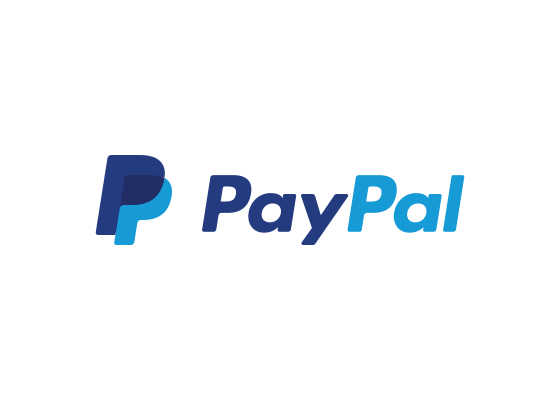
The PayPal logo is a wordmark featuring two overlapping “P” letterforms in different shades of blue. The front “P” is rendered in a lighter, brighter blue (#179BD7) while the back “P” appears in a deeper navy (#253B80). The overlap between the two letters creates a third shade where they intersect, suggesting depth and layered protection. The wordmark “PayPal” appears alongside the monogram in a clean sans-serif typeface. The dual-P monogram can also function as a standalone mark for app icons and compact applications.
Meaning and Symbolism
- Two overlapping P’s: Represent the two parties in every PayPal transaction: the sender and the receiver. The overlap symbolizes the secure connection PayPal creates between them.
- Two blues: The lighter blue communicates friendliness and accessibility, while the darker navy conveys trust and financial authority. Together they position PayPal as both approachable and secure.
- Overlapping transparency: The visible intersection where the two P’s cross suggests transparency in financial dealings and the seamless flow of money between accounts.
- Rounded letterforms: The soft, rounded shapes of the P’s feel consumer-friendly and accessible, distinguishing PayPal from the more rigid, serif-based typography of traditional banking brands.
Design and History
1999: The earliest PayPal logo was a simple wordmark in a sans-serif typeface. The letters “P” in “Pay” and “P” in “Pal” were sometimes highlighted in different colors, but the design was basic and startup-appropriate.
2007: A refined wordmark introduced a more polished typeface and established the two-blue color scheme. The overlapping P monogram had not yet been introduced.
2012: A cleaner, flatter version updated the typography and brightened the color palette. This version bridged the gap between the early logo and the current identity.
2014: Yves Behar’s studio fuseproject led a comprehensive redesign. The dual-P monogram was introduced, giving PayPal a standalone symbol for the first time. The wordmark was redrawn in a custom typeface, and the two-blue system was formalized. This is essentially the logo in use today.
2014: Yves Behar’s studio fuseproject led a comprehensive redesign. The dual-P monogram was introduced, giving PayPal a standalone symbol for the first time. The wordmark was redrawn in a custom typeface, and the two-blue system was formalized. This is essentially the logo in use today.
PayPal’s early visual identity was unremarkable. Like most late-1990s startups, the company prioritized product development over branding. The original logo was functional and forgettable, appropriate for a company that was still figuring out what it was going to be.
The Confinity-X.com merger in 2000 and the eBay acquisition in 2002 brought stability but not visual ambition. For most of its time under eBay’s ownership, PayPal’s logo was a clean blue wordmark that served its purpose without making a strong impression. It appeared on checkout pages and payment confirmations, functional touchpoints where the brand needed to communicate safety rather than personality.
The 2014 redesign by fuseproject was a turning point. Yves Behar and his team recognized that PayPal had evolved beyond its role as eBay’s payment processor. The company was becoming a standalone financial platform, competing with credit cards, banks, and emerging fintech startups. It needed an identity that could stand on its own.
The dual-P monogram was the key innovation. By overlapping two P’s in different blues, the design created a symbol that communicated PayPal’s core value proposition: connecting two parties in a secure transaction. The overlap wasn’t just decorative. It told the story of what the company does.
The choice to use two shades of blue was equally deliberate. Financial services brands tend toward dark, authoritative blues. Consumer tech brands favor brighter, friendlier blues. PayPal needed to be both, a company you trust with your money but also one you’d use to split a dinner bill with friends. The dual-blue approach let the brand occupy both positions simultaneously.
Since the 2014 redesign, PayPal’s identity has remained stable. The monogram appears on the app icon, while the full wordmark with monogram appears on payment buttons, marketing materials, and the website. The consistency has helped PayPal maintain brand recognition even as the fintech landscape has become increasingly crowded.
Typography
The PayPal wordmark uses a custom typeface developed as part of the 2014 fuseproject redesign. The letterforms are geometric sans-serif with rounded terminals, giving the word a clean, modern feel. The capital “P” in both “Pay” and “Pal” uses the same basic form as the monogram, creating visual unity between the symbol and the wordmark. For broader communications, PayPal uses a sans-serif type system that maintains the approachable, technology-forward tone established by the rebrand.
FAQ
Q: What do the two overlapping P’s represent?
A: The two P’s symbolize the two sides of every PayPal transaction: the sender and the receiver. Their overlap represents the secure connection PayPal provides.
Q: Who designed the current PayPal logo?
A: Yves Behar’s studio fuseproject designed the 2014 identity, including the dual-P monogram and the refreshed wordmark.
Q: Why does PayPal use two shades of blue?
A: The lighter blue communicates consumer friendliness while the darker navy conveys financial trustworthiness. Together they position PayPal as both accessible and secure.