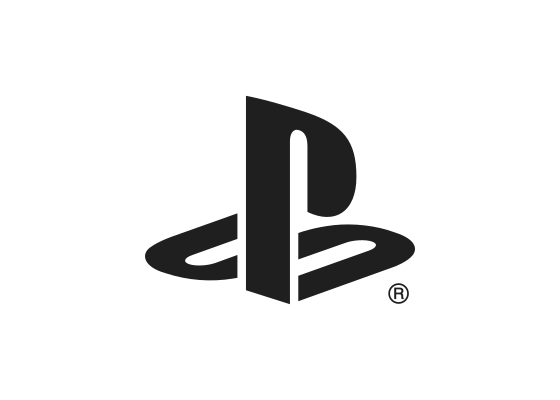
The PlayStation logo features distinctive stacked letters forming a bold “PS” monogram that has become gaming’s most recognizable symbol, representing Sony’s dominance in console gaming since 1994.
PlayStation is Sony Interactive Entertainment’s video gaming brand consisting of five home console generations, handheld systems (PSP and PS Vita), and the PlayStation Network online service. Launched in Japan in December 1994, the original PlayStation revolutionized gaming by embracing CD-ROM technology, attracting mature audiences with titles like Final Fantasy VII and Metal Gear Solid, and establishing Sony as Nintendo’s primary competitor. The PlayStation 2 (2000) became the best-selling console of all time with over 155 million units. The PS3 struggled initially but recovered through exclusive franchises. The PS4 (2013) dominated its generation with over 117 million sales. The current PS5, launched in 2020, continues Sony’s strategy of premium exclusive games and technological leadership.
The PlayStation logo’s stacked “PS” design creates a three-dimensional architectural effect that suggests depth, sophistication, and technical advancement. The monochromatic treatment evolved from colorful 1990s branding to the current minimalist black or white, reflecting PlayStation’s maturation from youthful disruptor to industry establishment. The geometric letterforms feel confident and substantial, appropriate for a brand that has defined console gaming for three decades. The design’s adaptability allows it to work effectively on product packaging, digital interfaces, and marketing materials while maintaining immediate recognizability.
Meaning and Symbolism
- Stacked letters: Create three-dimensional depth suggesting technical sophistication and the immersive experiences PlayStation delivers
- Monochromatic palette: Evolved from vibrant colors to refined black/white, reflecting PlayStation’s journey from rebellious newcomer to industry leader
- Bold geometry: Conveys confidence, substance, and PlayStation’s position as gaming’s premium console brand
- Architectural letterforms: Suggest structural solidity and the platform’s role as foundation for gaming experiences
Design and History
When Sony entered console gaming in 1994, the company challenged Nintendo’s family-friendly dominance by targeting teenagers and adults with more mature content and cutting-edge technology. Designer Manabu Sakamoto created the original colorful PlayStation logo with its distinctive stacked letters forming a three-dimensional “PS” that captured attention in retail environments. The vibrant red, yellow, blue, and green reflected the playful experimentation of 1990s design while the geometric construction conveyed Sony’s technological sophistication.
The logo’s three-dimensional treatment distinguished PlayStation from competitors’ flat logos, suggesting the 3D graphics revolution that CD-ROM technology enabled. The stacked letters created visual interest that worked across languages and cultures, crucial for Sony’s global ambitions. The design’s architectural quality hinted at PlayStation as a platform, a foundation upon which developers would build revolutionary gaming experiences.
As PlayStation matured from disruptive newcomer to market leader, the logo evolved toward minimalism. The PlayStation 2 era retained colorful elements but simplified the treatment. The PS3 introduced the “Spider-Man font” wordmark controversy when Sony initially used a font resembling the Spider-Man movie logo, later reverting to a cleaner design. The PS4 generation established the current monochromatic approach, with the “PS” symbol typically appearing in white or black depending on context.
The minimalist evolution reflected broader design trends toward simplification but also PlayStation’s confident market position. A bold newcomer needs visual flair to capture attention; an established leader can rely on recognition equity. The refined black or white treatment positions PlayStation as premium and sophisticated, differentiating the brand from Nintendo’s playful colors and Xbox’s bold green. The monochromatic palette works seamlessly across PlayStation’s ecosystem from console hardware to controller design to user interface.
Typography
The PlayStation wordmark when spelled out uses a custom sans-serif typeface with clean, modern letterforms and consistent stroke weights. The typography projects contemporary sophistication without excessive embellishment. The “PS” monogram’s stacked architectural treatment creates the brand’s most distinctive typographic element, functioning as both letterforms and sculptural symbol.
FAQ
Q: Who designed the original PlayStation logo? A: Designer Manabu Sakamoto created the distinctive stacked “PS” logo for PlayStation’s 1994 launch, establishing the three-dimensional letterform treatment that remains the brand’s signature element.
Q: Why did PlayStation change from colorful to monochrome logos? A: The evolution from vibrant 1990s colors to minimalist black/white reflects PlayStation’s maturation from disruptive newcomer to established market leader. The refined palette conveys premium positioning and sophisticated design sensibility.
Q: What do the stacked letters represent? A: The architectural “PS” treatment creates three-dimensional depth suggesting technical sophistication, immersive gaming experiences, and PlayStation’s role as a platform foundation for revolutionary games. The geometric construction conveys Sony’s engineering excellence.