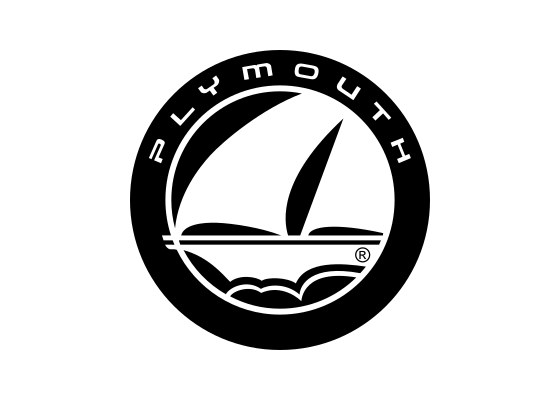
The Plymouth logo featured a circular ship emblem rendered in white, silver, and blue tones, referencing the Mayflower voyage and America’s colonial heritage.
The logo’s central imagery depicted a sailing ship, directly referencing the 1620 Mayflower journey to Plymouth, Massachusetts—one of America’s foundational historical events. This patriotic symbolism positioned Plymouth as an authentically American brand, crucial for competing against Chevrolet and Ford in the value-conscious market segment. The circular badge format gave Plymouth gravitas and tradition despite being Chrysler’s entry-level offering, with the ship motif suggesting reliability, exploration, and American pioneering spirit.
The nautical theme distinguished Plymouth from competitors while connecting the brand to American identity. The circular format echoed traditional automotive badges while the ship imagery offered more visual interest than abstract geometric marks. Throughout Plymouth’s 73-year history (1928-2001), various logo iterations maintained the core ship symbolism, creating consistent brand recognition across multiple model generations from the Depression-era sedans to the muscle car era Barracudas and Road Runners.
Meaning and Symbolism
- Mayflower ship: Represented American heritage, reliability, and the pioneering spirit central to Plymouth brand positioning
- Circular badge: Suggested quality and permanence, elevating Plymouth beyond its “low-priced” market positioning
- Nautical theme: Connected Plymouth to exploration and adventure, making economy cars feel aspirational rather than merely practical
- Blue and white/silver: Conveyed trust, dependability, and classic American values appealing to mainstream buyers
Design and History
Chrysler launched Plymouth in 1928 to compete in the value segment dominated by Ford Model T and Chevrolet. The Mayflower ship logo was strategically chosen to give the economy brand historical gravitas and patriotic credentials that could compete with Ford’s American manufacturing mystique and Chevrolet’s “heartbeat of America” positioning. The nautical symbolism proved flexible enough to work across Plymouth’s diverse model range, from practical sedans to performance vehicles like the Plymouth Superbird.
Plymouth’s peak success came during the 1950s-1970s, when models like the Fury, Valiant, and Barracuda made the ship emblem recognizable to mainstream American consumers. The logo appeared prominently on hood ornaments, grilles, and wheel centers throughout this era. By the 1990s, however, Plymouth had been reduced to rebadged Dodge and Chrysler models, diluting the brand’s distinct identity. Chrysler discontinued Plymouth in 2001, ending 73 years of production.
The Plymouth logo represents an era when automotive brands carried distinct identities rather than serving as interchangeable nameplates within corporate portfolios. The Mayflower imagery worked because it told a coherent story about American values and history—a narrative approach that became less common as automotive branding moved toward abstract symbolism.
Typography
Plymouth wordmarks typically used serif typefaces with traditional proportions, reinforcing the brand’s connection to American history and heritage. Later iterations adopted bolder sans-serif treatments, particularly during the muscle car era when Plymouth needed to project performance credibility. Throughout these evolutions, the typography remained secondary to the iconic ship emblem, which served as Plymouth’s primary brand identifier.
FAQ
Q: Why did Plymouth use a ship in its logo?
A: The Mayflower ship referenced Plymouth, Massachusetts, connecting the automobile brand to American colonial history and pioneering spirit—valuable symbolism for competing in the value-conscious “everyman” car segment.
Q: When was Plymouth discontinued?
A: Chrysler discontinued the Plymouth brand in 2001 after 73 years, citing brand redundancy with Dodge and Chrysler. Remaining Plymouth models were discontinued or rebadged as other Chrysler brands.
Q: What were Plymouth’s most famous models?
A: Notable models include the Barracuda muscle car, Road Runner, Superbird, Fury, Valiant, and various minivans that established the segment during the 1980s-1990s.