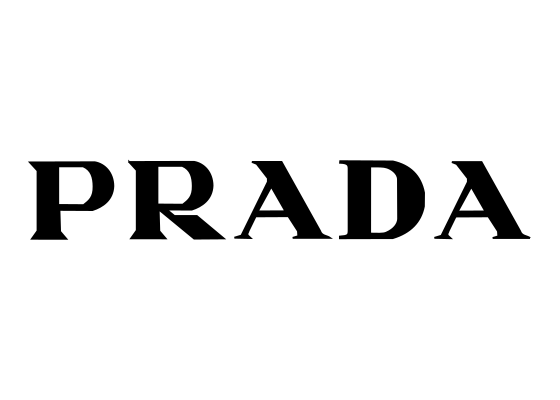
The Prada logo is a serif wordmark spelling “PRADA” in uppercase letters, often appearing inside an inverted triangular badge that references the luggage labels used on the brand’s early trunks.
The typeface is a high-contrast serif with fine hairlines and strong vertical strokes, characteristic of the Didone classification. In its most formal presentation, the wordmark appears inside an inverted triangle with “MILANO” and “DAL 1913” below, anchoring the brand to its city and founding date. The primary color is black on white, though the triangular badge often appears in black enamel with silver or gold lettering on hardware.
The inverted triangle is Prada’s most distinctive visual element. Originally derived from luggage labels affixed to trunks and travel goods, the triangle became a brand mark that signaled quality and provenance. Its geometric precision feels industrial and modern. The absence of color is deliberate: Prada’s visual identity rejects the warmth and richness that most luxury brands pursue, communicating intellectual rigor and austerity instead.
Meaning and Symbolism
- Inverted triangle: The triangular badge originated as a functional luggage label in the early 20th century. Its geometric precision feels industrial and modern, distinguishing Prada from more ornate luxury competitors.
- Serif wordmark: The Didone-style serifs connect Prada to Italian typographic tradition while communicating authority and refinement. The tall, narrow letters create vertical emphasis.
- Black and white: The absence of color is deliberate. Prada’s visual identity rejects the warmth most luxury brands pursue, communicating intellectual rigor and austerity instead.
- “MILANO” and “DAL 1913”: These words anchor the brand to Milan as a fashion capital and establish the founding date, grounding the brand in over a century of Italian craftsmanship.
Design and History
Mario Prada opened Fratelli Prada in 1913 with his brother Martino in the Galleria Vittorio Emanuele II, one of Europe’s most elegant shopping arcades. The business sold leather goods, trunks, and travel accessories, much of it imported from England. Mario believed women should not be involved in business, a belief that proved spectacularly wrong when his granddaughter Miuccia took over in 1978.
Miuccia had a doctorate in political science, was a member of the Italian Communist Party, and had studied mime. She was not an obvious candidate to run a luxury leather goods company. Her first major move was the black nylon bag in 1985, made from Pocono nylon, an industrial fabric used in military parachutes. In a luxury market defined by leather and visible branding, a nylon bag was provocative. The inverted triangle logo, rendered in enamel on a small metal plate, was the only concession to traditional luxury.
Under Miuccia, the inverted triangle transformed from a functional luggage label into the brand’s primary symbol. She took something ordinary and made it meaningful through context. The triangle on a nylon backpack was a statement about what luxury could be. The wordmark has remained remarkably stable: the serif letters, even spacing, and uppercase treatment have been consistent since the brand’s formalization under Miuccia.
Prada’s visual restraint extends to retail environments, advertising, and packaging. The stores are architecturally significant, designed by Rem Koolhaas. The advertising features unconventional models and minimal styling. The logo sits within this context as one element of a brand that communicates through what it does not do as much as through what it does.
Typography
The Prada wordmark uses a Didone-style serif typeface with pronounced thick-thin contrast, fine hairline serifs, and strong vertical axis. The letterforms are tall and narrow, with the “P” and “R” having compact bowls and the “A” featuring a sharp apex. In the inverted triangle badge, “MILANO” and “DAL 1913” are set in smaller, more condensed serif type. For broader communications, Prada uses clean serif and sans-serif typefaces that maintain the brand’s intellectual, restrained quality.
FAQ
Q: What is the Prada triangle?
A: The inverted triangle is Prada’s most recognizable symbol. It originated as a luggage label on the brand’s early trunks and travel goods, elevated to a brand mark when Miuccia Prada introduced the nylon bag collection in the 1980s.
Q: Why does the Prada logo include “MILANO DAL 1913”?
A: “Milano” identifies the brand’s home city and fashion capital. “Dal 1913” (since 1913) establishes the founding date, anchoring the brand in over a century of Italian craftsmanship.
Q: Why is Prada’s branding so minimal?
A: Miuccia Prada has consistently rejected the overtly decorative approach of most luxury brands. The minimal black-and-white identity reflects the house’s intellectual positioning and emphasis on design ideas over visible opulence.