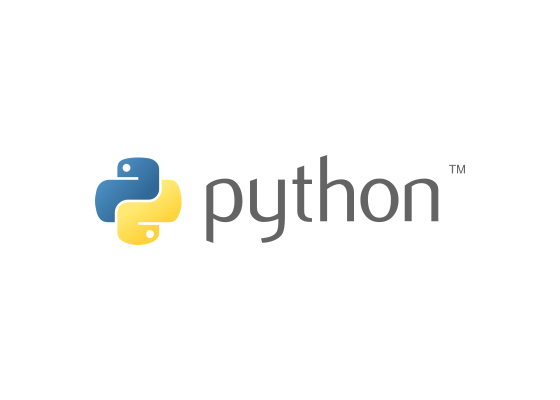
The Python logo features two intertwined snakes forming a yin-yang composition, one in blue (#306998) and the other in yellow (#FFD43B), representing the language’s versatility and dual nature.
The serpentine design creates an elegant symmetry while referencing the language’s name, inspired by the British comedy series Monty Python’s Flying Circus rather than the reptile. The blue python faces right while the yellow python faces left, their bodies wrapping around each other in perfect balance. This duality symbolizes Python’s ability to serve both beginners and experts, working equally well for quick scripts and large-scale applications.
The color palette conveys distinct meanings: the blue represents trust, stability, and the technical foundation, while the yellow suggests accessibility, optimism, and Python’s reputation for making programming approachable. The interlocking forms create negative space that draws the eye inward, suggesting the language’s emphasis on readability and clean code structure.
The snakes’ stylized eyes and simplified forms give the logo a friendly, approachable quality that distinguishes Python from more austere programming language brands. The design avoids intimidating technical imagery, instead presenting programming as creative and accessible.
Meaning and Symbolism
- Intertwined snakes: Represent Python’s dual nature, serving both as a teaching language and a production-ready tool for enterprise applications.
- Blue and yellow pairing: Symbolizes the balance between technical rigor (blue) and user-friendly design (yellow).
- Yin-yang composition: Suggests harmony between Python’s multiple programming paradigms, supporting procedural, object-oriented, and functional approaches.
- Mirror symmetry: Reflects Python’s cross-platform compatibility, running identically on Windows, macOS, and Linux.
- Serpent motif: References the language’s name while suggesting flexibility and adaptability across domains.
Design and History
Tim Parkin designed the Python logo in the mid-2000s, replacing earlier wordmark-only branding. Guido van Rossum, Python’s creator, named the language after Monty Python’s Flying Circus when he began development in December 1989 at Centrum Wiskunde & Informatica in the Netherlands. The snake imagery came later as a visual pun on the name, though van Rossum has emphasized the comedy troupe connection.
The dual-snake design emerged as Python transitioned from an academic curiosity to mainstream adoption. By the time the logo was finalized, Python had established itself in web development, scientific computing, and automation. The friendly, accessible design reflected Python’s philosophy that code should be readable and explicit, captured in “The Zen of Python” by Tim Peters.
Python’s logo appears across the vast ecosystem built around the language, from Django and Flask web frameworks to NumPy and pandas data science libraries. The intertwined snakes have become synonymous with readable, versatile code. The Python Software Foundation maintains strict logo usage guidelines to preserve the brand’s integrity while allowing community projects to reference Python visually.
The logo’s enduring design has required minimal updates since its introduction, speaking to its initial strength. As Python surged to become one of the world’s most popular programming languages in the 2010s and 2020s, particularly in data science and machine learning, the friendly snake duo became increasingly recognizable beyond programming circles.
Typography
Python’s wordmark typically uses a clean, modern sans-serif typeface that emphasizes readability and professionalism. The letterforms maintain consistent weights and generous spacing, reinforcing Python’s design philosophy that code should be clear and explicit. When the wordmark appears alongside the snake logo, it typically uses a neutral gray or black, allowing the blue and yellow symbol to command attention.
FAQ
Q: Why does the Python logo feature snakes when the language is named after Monty Python?
A: While Guido van Rossum named Python after the comedy troupe, the snake imagery emerged later as a visual pun. The serpent motif has become the primary brand identifier, representing flexibility and adaptability.
Q: What do the blue and yellow colors represent?
A: The blue suggests technical stability and trust, while the yellow conveys accessibility and optimism. Together, they symbolize Python’s dual nature as both a beginner-friendly language and a powerful tool for experts.
Q: Has the Python logo changed significantly over time?
A: The intertwined snake design has remained stable since Tim Parkin created it in the mid-2000s. Minor refinements to proportions and colors have occurred, but the core concept endures.
More logos with similar colors