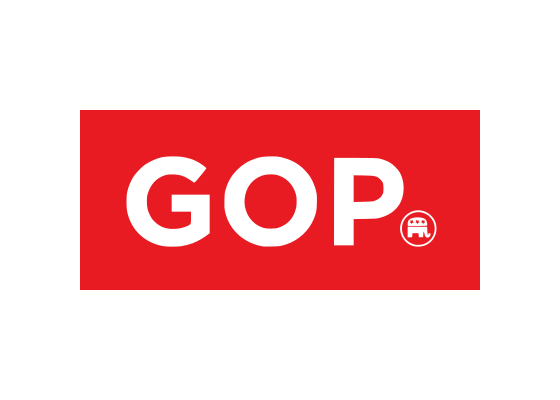
The Republican Party’s red logo (#d71e28) features an elephant within a circular design, representing the GOP (Grand Old Party) founded in 1854 as an anti-slavery party, now one of two major American political parties with over 35 million registered members.
Meaning and Symbolism
- The elephant symbol has represented the Republican Party since Thomas Nast’s 1874 political cartoon established it as the GOP icon
- The red color became associated with Republicans following the 2000 election when television networks standardized red for GOP and blue for Democrats
- The circular design suggests unity, completeness, and the inclusive vision of American conservatism
- The elephant’s strength and memory symbolize the party’s commitment to constitutional principles and traditional values
- The bold red (#d71e28) conveys energy, patriotism, and the party’s assertive conservative positioning
History and Evolution
The Republican Party was founded in 1854 in Ripon, Wisconsin, by anti-slavery activists who opposed the Kansas-Nebraska Act’s expansion of slavery into western territories. The party quickly absorbed members of the Whig Party, Free Soil Party, and anti-slavery Democrats, becoming a major political force within just six years. Abraham Lincoln’s 1860 presidential victory represented the party’s first national triumph and set the stage for the Civil War and eventual abolition of slavery. During Reconstruction, Republicans championed civil rights and the 13th, 14th, and 15th Amendments.
The party evolved significantly over subsequent decades, particularly during the 20th century. Following the Civil Rights Act of 1964, the GOP underwent realignment as Southern conservatives shifted from the Democratic Party, transforming the regional and ideological composition of both parties. Ronald Reagan’s presidency (1981-1989) redefined modern conservatism, emphasizing limited government, free-market economics, strong national defense, and traditional social values. These principles have largely shaped Republican identity through subsequent decades.
The 2024 election cycle saw Donald Trump’s return to the presidency, continuing the party’s populist and nationalist direction initiated during his 2016 campaign. The contemporary GOP focuses on border security, energy independence, religious freedom, Second Amendment rights, and reducing government regulation. Following the 2024 elections, Republicans regained control of the Senate and maintained a slim House majority, giving the party unified government control. The party claims over 35 million registered voters and controls numerous state governments, remaining a dominant force in American politics.
Typography and Design
The Republican Party logo typically features the party name in bold, authoritative typography alongside or below the elephant symbol. The typeface choices vary across different Republican organizations and campaigns but generally emphasize strength, tradition, and American patriotism. The design is optimized for versatility across political applications from yard signs to digital advertising to convention stages.
The signature red color (#d71e28) has become universally recognized as “Republican red” since the 2000 presidential election, when television networks standardized color coding for electoral maps. This vibrant red appears consistently across party materials, campaign signage, convention branding, and digital platforms. The circular elephant emblem works as a standalone symbol or combined with typography, creating a flexible design system that adapts to various political contexts while maintaining instant recognition. The overall aesthetic balances traditional American political symbolism with contemporary design practices.
Frequently Asked Questions
Who designed the Republican Party elephant logo? The elephant symbol originated in Thomas Nast’s 1874 Harper’s Weekly cartoon, though the modern logo has been refined through numerous iterations by various designers and political consultants over 150 years.
When did red become the Republican Party’s color? Red became definitively associated with Republicans during the 2000 presidential election when television networks standardized electoral map colors, with red for Republican states and blue for Democratic states.
What does GOP stand for? GOP stands for “Grand Old Party,” a nickname for the Republican Party that emerged in the 1870s-1880s to emphasize the party’s role in preserving the Union and abolishing slavery during the Civil War era.