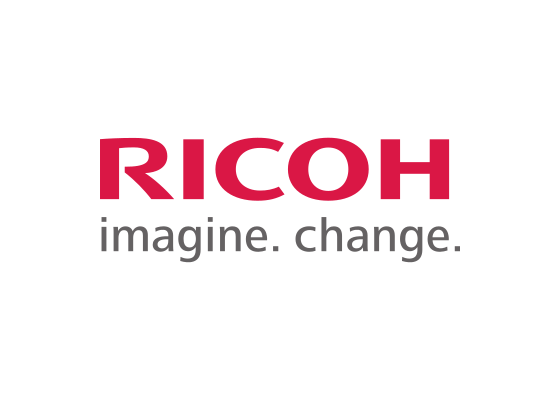
The Ricoh logo features gray letterforms (#656263) with a distinctive red accent (#da1745) on the letter “o,” introduced in 2012 to modernize the imaging and office equipment manufacturer’s brand identity.
Ricoh’s 2012 logo refinement maintained brand recognition while signaling evolution. The gray wordmark (#656263) conveys sophistication, technical expertise, and corporate professionalism appropriate for a company serving enterprise customers with copiers, printers, and document management systems. The red circle accent (#da1745) adds visual interest and differentiates Ricoh from competitors using purely monochromatic logos, suggesting innovation within a traditional industry.
The red circle on the “o” serves dual purposes. Visually, it creates a focal point and aids brand recall. Symbolically, it echoes the circular lens elements in Ricoh’s cameras and imaging devices, connecting the logo to the company’s optical heritage. The dot also suggests precision, a central requirement for photographic equipment and document reproduction technology. This small accent prevents the logo from feeling static while maintaining the restraint expected of enterprise technology brands.
Founded in 1936 as Riken Sensitized Paper (a spinoff from Japan’s Institute of Physical and Chemical Research), Ricoh began manufacturing photographic paper during Japan’s pre-war industrialization. The company evolved through photocopiers, fax machines, and eventually multifunction devices as office technology converged. By the late 1990s through early 2000s, Ricoh had become the world’s largest copier manufacturer, acquiring competitors like Savin, Gestetner, Lanier, and IKON to expand globally.
Meaning and Symbolism
- Gray letterforms (#656263): Convey corporate sophistication, technical expertise, and professional reliability appropriate for enterprise office equipment and document management solutions.
- Red circle accent (#da1745): Adds visual energy and brand differentiation while symbolizing camera lenses, precision optics, and Ricoh’s imaging technology heritage.
- Lowercase typography: Creates modern, approachable brand personality that balances Ricoh’s corporate positioning with user-friendly document solutions for everyday office workers.
- 2012 refinement: The logo update coincided with Ricoh’s strategic pivot toward managed document services and cloud-based workflows, modernizing their market positioning.
Design and History
Ricoh’s name derives from its parent organization, the Riken Concern (an abbreviation of “Institute of Physical and Chemical Research”). Founded on February 6, 1936, the company initially produced photographic paper and film, serving Japan’s growing camera market. Post-war, Ricoh pivoted toward office equipment, launching its first photocopier in 1955 and establishing itself in the duplicating machine market that would define its business for decades.
The 2012 logo refinement represented Ricoh’s most significant brand update in years. The company simplified its visual identity, removing gradients and three-dimensional effects common in earlier corporate logos. This flat design aesthetic aligned with broader design trends toward minimalism and digital-first branding. The refined logo worked better across digital platforms, from website headers to mobile apps to software interface elements as Ricoh expanded beyond hardware into document management software and cloud services.
Ricoh’s aggressive acquisition strategy from the 1990s through 2000s created a complex brand portfolio. While acquired companies like Savin and Lanier initially maintained separate identities, Ricoh gradually unified branding to leverage accumulated recognition. The 2012 logo update supported this consolidation, creating a modern identity that could represent Ricoh’s full range of products and services from multifunction printers to enterprise content management systems, digital projectors to 360-degree cameras for virtual reality applications.
Typography
The Ricoh wordmark employs a custom lowercase sans-serif typeface with clean, modern proportions. The letterforms feature consistent stroke weights and slightly rounded terminals that soften the geometric structure, creating a friendly yet professional appearance. Letter spacing is generous, ensuring legibility at small sizes on product labels and digital interfaces. The lowercase letters feel contemporary and accessible, avoiding the institutional weight of all-caps corporate typography. The custom “o” with its red circle accent becomes the visual anchor, making the logo instantly recognizable even in peripheral vision or when partially obscured.
FAQ
Q: What does the red circle in Ricoh’s logo represent?
A: The red circle accent on the letter “o” symbolizes camera lenses and precision optics, connecting to Ricoh’s imaging heritage while creating a distinctive visual element that aids brand recognition.
Q: When did Ricoh introduce its current logo design?
A: Ricoh unveiled its current logo with gray lettering and red circle accent in 2012 as part of a brand modernization initiative coinciding with the company’s pivot toward document management services.
Q: What does the name “Ricoh” mean?
A: Ricoh derives from “Riken,” short for the Institute of Physical and Chemical Research in Japan. The company was founded in 1936 as a commercial spinoff producing photographic paper.
More logos with similar colors