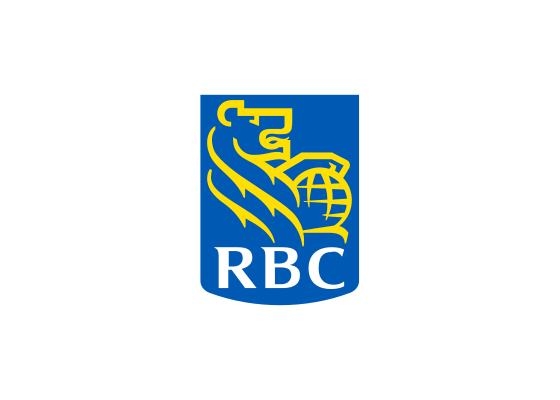
The Royal Bank of Canada logo features a blue shield containing a lion and globe, surrounded by the bank’s name in a curved arrangement. Originally designed in the early 1960s by Lippincott & Margulies, the heraldic emblem balances tradition with modernity, combining symbols of British heritage and global ambition to reflect Canada’s bilingual, international identity.
Royal Bank of Canada’s logo is a masterclass in heraldic modernization. The shield contains four primary elements: the British lion (strength and authority), the crown (royal heritage), a globe (international reach), and the fleur-de-lis (French-Canadian roots). These symbols are not subtle. They declare the bank’s history, national identity, and global aspirations in a single composition. The blue (#0059B3) and gold (#FFDF01) palette reinforces the royal connection while remaining legible and professional.
The original 1962 design replaced an outdated Queen’s crest that felt too formal and disconnected from the modern banking experience the institution wanted to project. Lippincott & Margulies retained the heraldic structure but simplified the details, creating a mark that could work on building signage, printed materials, and eventually digital screens. The lion and globe were rendered with a wood-carved aesthetic that suggested craftsmanship and permanence without feeling archaic.
In 1974, designers Freddi Jaggi and Fritz Gottschalk refined the logo to improve scalability. They simplified fine details that became muddy at small sizes and enhanced the mark’s three-dimensional applications. The core elements remained unchanged, testament to the strength of the original design. In 2001, the bank adopted “RBC Financial Group” as its primary brand, then simplified further to “RBC” in 2007, but the shield logo has persisted through every iteration.
Meaning and Symbolism
- British lion: The lion symbolizes strength, authority, and Canada’s historical ties to the British Commonwealth. It anchors the heraldic composition and communicates institutional stability.
- Crown: The crown reinforces the bank’s royal charter and heritage, positioning RBC as an established, trustworthy institution with deep historical roots.
- Globe: The globe represents international reach and ambition, signaling that RBC operates beyond Canadian borders and serves clients worldwide.
- Fleur-de-lis: The stylized lily acknowledges Canada’s French heritage and Quebec’s cultural significance, important for a bank headquartered in Montreal during the rebranding period.
Design and History
In the early 1960s, the Royal Bank of Canada faced an image problem. Despite being the fourth-largest bank in North America, it was perceived as outdated and overly conservative. The bank’s planned relocation to Place Ville Marie, a sleek modernist complex in downtown Montreal, highlighted the disconnect between its traditional identity and its contemporary ambitions. The bank needed a corporate identity that matched its new headquarters and appealed to a more international, sophisticated clientele.
Lippincott & Margulies was commissioned to lead the transformation. The design process began with employee and customer interviews rather than extensive market research. The goal was pragmatic: help the bank communicate more effectively and align its visual identity with its strategic direction. One early decision was simplifying the bank’s name from “Royal Bank of Canada” to “Royal Bank” for domestic and U.S. markets, streamlining the brand and making it easier to use alongside updated visual elements.
The new logo replaced the old Queen’s crest with a modernized heraldic shield that balanced tradition and contemporary design. The British lion, crown, globe, and fleur-de-lis were combined in a composition that worked across scales and applications. The wood-carved aesthetic suggested permanence and craftsmanship without feeling stuck in the past. The design needed to be versatile enough for building signage, printed materials, and eventually branch interiors, uniforms, and promotional items.
The rebranding extended far beyond the logo. Standardized signage systems unified the appearance of branches across Canada, a significant challenge given the diversity of existing locations. Interior design specialists developed consistent furnishings, colors, textures, and lighting to create a cohesive brand experience. Employee uniforms were redesigned, transforming what had been dull and dated into something staff felt proud to wear. The logo’s simplified design made it easy to reproduce on everything from T-shirts to cuff links, enhancing internal engagement.
Typography
The Royal Bank of Canada wordmark originally used a custom serif typeface with elegant, traditional letterforms that complemented the heraldic shield. When the bank transitioned to “RBC” in 2007, the typography shifted to a cleaner, more modern sans-serif designed for digital environments. The current typeface is bold, confident, and slightly condensed, balancing the ornate shield with contemporary simplicity. The typographic shift reflects the bank’s evolution from a regional institution to a global financial services provider.
FAQ
Q: When was the Royal Bank of Canada logo redesigned?
A: The heraldic shield logo was introduced in the early 1960s by Lippincott & Margulies and refined in 1974 by Freddi Jaggi and Fritz Gottschalk to improve scalability and functionality.
Q: What do the symbols in the RBC logo represent?
A: The British lion symbolizes strength and authority, the crown represents royal heritage, the globe indicates international reach, and the fleur-de-lis reflects Canada’s French cultural roots.
Q: Why did Royal Bank of Canada become RBC?
A: In 2001, the bank adopted “RBC Financial Group” to reflect its diversification beyond traditional banking. This was further simplified to “RBC” in 2007 to create a more streamlined, globally recognizable brand.
More logos with similar colors