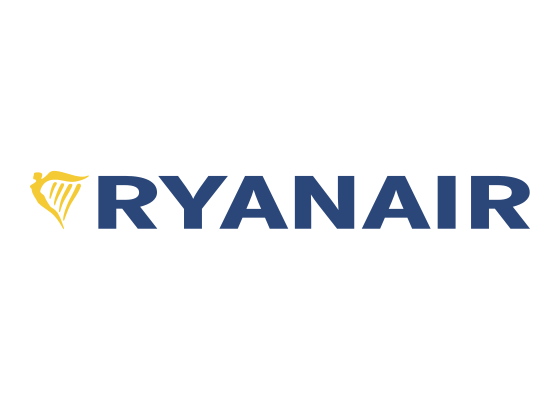
The Ryanair logo combines dark blue (#2b4779) and bright yellow (#f4ca35) in an assertive wordmark that projects the no-frills confidence of Europe’s largest low-cost carrier.
The blue establishes basic airline credibility while the yellow adds visibility and value positioning. This isn’t subtle branding. It’s direct communication of Ryanair’s business model: cheap flights with zero apologies. The bold color combination ensures recognition on crowded European airport tarmacs, where Ryanair’s fleet of over 500 aircraft dominates traffic at secondary airports across the continent.
Founded in 1984, Ryanair transformed European aviation by applying Southwest Airlines’ low-cost model with even more aggressive cost-cutting. CEO Michael O’Leary became famous for provocative statements and fee structures that charged for everything from checked bags to printing boarding passes. The logo’s straightforward treatment matches this philosophy: functional, visible, unapologetic.
Meaning and Symbolism
- Dark blue (#2b4779): Provides minimum airline credibility and trust while avoiding the premium associations of brighter blues used by legacy carriers.
- Bright yellow (#f4ca35): Signals value pricing and high visibility, ensuring recognition while creating psychological associations with discount retail and budget positioning.
- Bold typography: Projects confidence and scale appropriate for Europe’s largest airline by passenger numbers, with no decorative flourishes to inflate operational costs.
- Straightforward wordmark: Reflects Ryanair’s business model transparency, where low fares are explicitly traded for minimal service and aggressive ancillary fees.
Design and History
Ryanair launched in 1984 as a full-service carrier connecting Waterford, Ireland to London Gatwick with a 14-seat aircraft. The airline initially tried competing directly with British Airways and Aer Lingus, nearly bankrupting itself in the process. Salvation came in 1991 when management studied Southwest Airlines’ low-cost model and restructured completely around it.
The transformation was radical. Ryanair abandoned full service, moved operations to secondary airports with lower fees, eliminated free food and drink, operated a single aircraft type (Boeing 737) to minimize training and maintenance costs, and implemented aggressive turnaround times. The airline also pioneered charging fees for services previously included, from seat selection to baggage to printing boarding passes at the airport.
CEO Michael O’Leary, appointed in 1994, became the public face of this ruthless efficiency. His provocative statements and willingness to anger customers while maintaining low fares made Ryanair infamous. The airline’s logo remained consistently blue-and-yellow through these controversies, a visual constant while O’Leary suggested standing-room-only cabins and pay toilets. By 2016, Ryanair carried more international passengers than any other airline globally.
Typography
Ryanair uses bold, condensed sans-serif typography that maximizes impact while minimizing space, a visual metaphor for the airline’s operational philosophy. The letterforms are heavy and slightly compressed, ensuring legibility at distance while packing efficiently into tight spaces. No stylistic flourishes add unnecessary visual weight. The typography is purely functional, much like Ryanair’s approach to cabin interiors, where every design choice serves operational efficiency rather than aesthetic pleasure. The aggressive weight projects market dominance and confidence appropriate for Europe’s largest low-cost carrier.
FAQ
Q: Why does Ryanair use secondary airports?
A: Secondary airports charge lower landing fees and allow faster turnarounds, critical to Ryanair’s low-cost model. Frankfurt-Hahn and Paris-Beauvais are technically “Frankfurt” and “Paris” for marketing, despite being 75+ miles from city centers, but the savings enable lower fares.
Q: Has Ryanair always been low-cost?
A: No. Ryanair launched in 1984 as a conventional full-service carrier and nearly went bankrupt competing against British Airways and Aer Lingus. The airline completely restructured in 1991 after studying Southwest Airlines’ low-cost model, emerging as the ultra-budget carrier it remains today.
Q: Why is Ryanair so controversial?
A: CEO Michael O’Leary’s provocative management style and aggressive fee structure made Ryanair infamous. The airline charges for services most carriers include, famously charging fees for printing boarding passes at airports. O’Leary has suggested pay toilets and standing-room-only cabins, though these remained publicity stunts rather than implemented policies.
More logos with similar colors