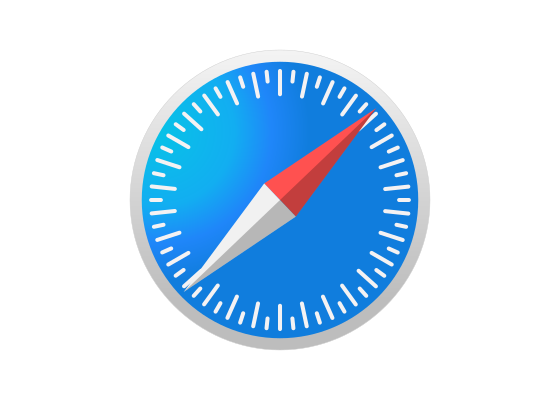
The Safari browser logo features a circular compass rose in blue gradients, embodying navigation and exploration through Apple’s signature minimalist design philosophy and connection to web discovery.
Meaning and Symbolism
- The compass metaphor represents internet navigation and exploration, positioning web browsing as a journey of discovery rather than technical task.
- Blue gradients convey trust, reliability, and clarity, essential attributes for software handling sensitive browsing data and personal information.
- The circular form suggests completeness and seamless integration, reflecting Safari’s role within Apple’s ecosystem across macOS and iOS.
- The compass needle pointing north-northwest creates subtle asymmetry that adds visual interest while maintaining navigational symbolism.
- The glossy, dimensional styling characteristic of early versions evolved toward flat design, mirroring broader industry trends.
History and Evolution
Safari launched in January 2003 with Mac OS X Panther, marking Apple’s entry into the browser market after years of bundling third-party options. The compass icon appeared from the start, immediately distinguishing Safari from competitors like Internet Explorer and Netscape Navigator through distinctive visual metaphor. The browser expanded to iPhone with iOS 1 in 2007, becoming the default mobile browser and establishing Safari as a cross-platform product.
The logo underwent significant evolution alongside Apple’s broader design language shifts. Early versions featured photorealistic chrome effects, dimensional gradients, and glossy finishes consistent with Mac OS X Aqua aesthetics. With iOS 7 in 2013 and subsequent macOS updates, Safari’s icon flattened dramatically, removing shadows and dimensional effects in favor of simple gradients and crisp geometry. This evolution reflected Jony Ive’s design leadership and Apple’s pivot toward clarity and simplicity. The compass rose configuration remained constant even as rendering styles changed, maintaining brand continuity.
Safari briefly appeared on Windows from 2007 to 2012 before Apple discontinued that version to focus on Apple ecosystem integration. The browser remains fundamental to Apple’s services strategy, with privacy features becoming central marketing points.
Typography and Design
The Safari wordmark employs Apple’s custom San Francisco typeface in recent versions, maintaining consistency with system-wide typography across all Apple products. Earlier versions used Myriad Pro or similar clean sans-serif faces. The compass rose icon uses precise geometric construction with cardinal and ordinal directions marked by subtle gradations. The design’s radial symmetry ensures recognition at any rotation while the off-center needle provides directional emphasis. The icon scales effectively from tiny tab favicons to large dock icons, essential for software functioning across desktop and mobile contexts.
Frequently Asked Questions
Who designed the Safari logo? The logo emerged from Apple’s internal design team, though specific individual credits are not publicly documented. The compass concept was established at Safari’s 2003 launch.
When was the Safari logo last updated? Major visual updates occurred with iOS 7 and subsequent OS releases, flattening the design from glossy dimensionality to clean gradients while maintaining the compass rose form.
What do the colors in the Safari logo represent? Blue conveys trust and reliability essential for browsing software, while gradients create dimension and visual interest within Apple’s minimalist design framework.
More logos with similar colors