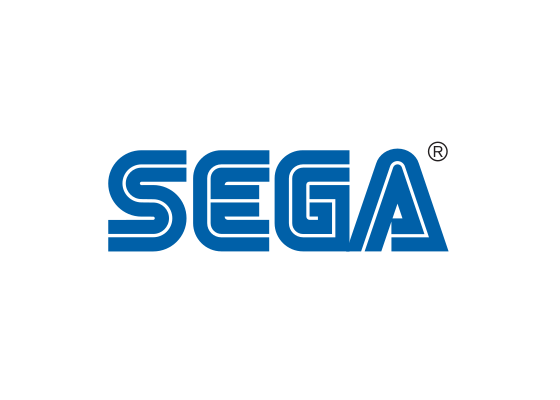
The Sega logo is a bold, italicized wordmark in blue (#0060a8) that captured the speed, attitude, and competitive energy of the 1990s console wars. This aggressive typographic identity represented Sega’s challenge to Nintendo’s dominance and became synonymous with “blast processing,” Sonic the Hedgehog, and the Genesis console that briefly outsold the Super Nintendo in North America.
The italic letterforms lean forward with dynamic momentum, suggesting speed and forward progress. This was entirely intentional: Sega positioned itself as the faster, cooler alternative to Nintendo’s family-friendly image. The aggressive slant matched Sonic’s velocity and the Genesis marketing campaign that directly attacked Nintendo with comparative advertising. The blue conveys technology and trust while differentiating from Nintendo’s red, and the heavy weight ensures impact across arcade cabinets, console packaging, and television advertising.
The white horizontal lines cutting through the letterforms add complexity and suggest the scan lines of CRT displays or the streaking motion blur of high-speed gameplay. This subtle detail reinforces the technological sophistication that Sega marketed against Nintendo’s perceived simplicity. The bold, unapologetic presentation reflects the confidence of a company that dominated arcades before challenging Nintendo in living rooms.
Meaning and Symbolism
- Italic letterforms: Suggest speed, forward momentum, and the aggressive competitive positioning against Nintendo during the console wars.
- Blue color palette: Conveys technology and reliability while differentiating from Nintendo’s red branding and Sony PlayStation’s later arrival with similar blues.
- Horizontal line details: Reference CRT scan lines and motion blur, emphasizing Sega’s technological sophistication and “blast processing” marketing.
- Bold weight and scale: Reflects Sega’s confidence as an arcade giant entering the home console market to challenge the industry leader.
Design and History
Sega began in 1940 as Service Games, providing coin-operated games for American military bases before relocating to Japan in 1952 and merging with Rosen Enterprises in 1965. The name “Sega” combined “Service” and “Games,” and the company pioneered electromechanical arcade hits like Periscope (1966). Sega released pioneering arcade titles throughout the 1970s and early 1980s before entering the home console market.
The SG-1000 (1983) and Master System (1986) struggled against Nintendo’s Famicom and NES, but the 1988 Genesis (Mega Drive internationally) changed everything. The aggressive blue italic logo accompanied Sega’s “Genesis does what Nintendon’t” campaign, directly attacking the market leader. Sonic the Hedgehog’s 1991 debut gave Sega a mascot that embodied the logo’s speed and attitude. The blue wordmark appeared in pre-game splash screens with the iconic “SEGA!” vocal sting, creating multisensory brand recognition.
Sega’s console business collapsed through the late 1990s with the Saturn’s failure and Dreamcast’s premature end in 2001. The company abandoned hardware to become a third-party developer, licensing Sonic and other franchises to former rivals. The blue italic logo persists across Sega’s current software business, though it now evokes nostalgia for the console wars era rather than representing active hardware competition. Sega remains the world’s most prolific arcade game producer despite its console exit.
Typography
The Sega wordmark uses a bold, custom sans-serif with extreme italic slant that creates approximately 15-20 degrees of forward lean. The letterforms feature blunt, squared terminals rather than tapered or rounded endings, reinforcing the aggressive, technological aesthetic. The horizontal white strokes cutting through each letter vary in thickness and position, adding visual complexity without compromising legibility. The “S” and “G” characters use distinctive geometric constructions where curves meet straight segments at precise angles. The blue appears consistently at #0060a8, a medium value that works across light backgrounds while maintaining visibility when reversed out of dark gaming interfaces.
FAQ
Q: What do the white lines through the Sega logo represent?
A: The horizontal strokes reference CRT television scan lines and motion blur effects, reinforcing Sega’s “blast processing” technology claims and emphasis on speed.
Q: Why did Sega stop making consoles?
A: After the Dreamcast’s commercial failure and premature discontinuation in 2001, Sega exited hardware manufacturing to become a third-party software developer, licensing franchises to former console competitors.
Q: Has the Sega logo changed since the company left the hardware business?
A: The core blue italic wordmark has remained remarkably consistent from the Genesis era through Sega’s current identity as a software publisher, maintaining brand continuity across this major business transformation.
More logos with similar colors