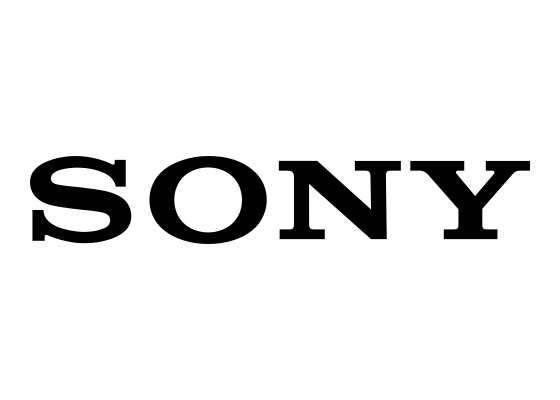
The Sony logo is a black typographic wordmark in a custom serif typeface that has been refined but fundamentally unchanged since 1957, making it one of the longest-running corporate identities in consumer electronics.
Sony Group Corporation is a Japanese multinational conglomerate headquartered in Minato, Tokyo. Founded in 1946 by Masaru Ibuka and Akio Morita as Tokyo Tsushin Kogyo (Tokyo Telecommunications Engineering Corporation), the company adopted the Sony name in 1958. The name combines “sonus,” the Latin root for sound, with “sonny,” American slang for a bright young man, creating a word that sounded modern, international, and optimistic in any language. Sony has shaped consumer electronics history through revolutionary products including the transistor radio, Trinitron television, Walkman portable music player, PlayStation gaming console, and the Blu-ray format.
The Sony wordmark was designed by Japanese designer Yasuo Kuroki, who created the predecessor of the current logotype in 1957. It features bold black letterforms in a rounded serif typeface with distinctive characteristics: the massive serifs were elongated and rounded on their ends, giving the mark unique character. Subsequent refinements in 1961 gave the letters more height and breathing room, while a 1962 update straightened the horizontal lines and made the serifs sharper. The 1973 redesign brought the version closest to today’s mark, with clean, straight serifs and modernized proportions using what resembles the Clarendon Medium font. These incremental refinements over decades represent a masterclass in typographic heritage.
Meaning and Symbolism
- Black wordmark: Conveys sophistication, premium quality, and technical excellence without decorative distraction.
- Custom serif letterforms: The distinctive “S,” circular “O,” geometric “N,” and unique “Y” junction create a typographic signature that distinguishes Sony from generic typefaces.
- Timeless simplicity: Demonstrates Sony’s design philosophy prioritizing function, elegance, and refinement over trendy decoration.
- Consistent identity: Over six decades of essentially unchanged branding signals confidence and long-term vision.
- Universal legibility: The design works across cultures and languages, supporting Sony’s presence in virtually every global market.
Design and History
When Masaru Ibuka and Akio Morita founded their company in 1946, they chose the name Tokyo Tsushin Kogyo, a typical Japanese corporate name that was difficult for foreign markets to pronounce or remember. As exports grew, Morita recognized the need for a brand name that worked in any language. He combined Latin and American English roots to coin “Sony,” a name that sounded modern and optimistic. This was revolutionary thinking for a Japanese company in the 1950s, when most Asian manufacturers used complex logos reflecting traditional design sensibilities.
Yasuo Kuroki’s 1957 logotype established the basic wordmark that endures today. The custom typeface featured bold, rounded serifs and distinctive letterforms that created instant brand recognition without additional symbols or graphics. Sony’s Western-influenced, minimal approach signaled that the company was different, modern, and oriented toward global markets. The design remained essentially unchanged through Sony’s transformation from electronics startup to entertainment conglomerate.
In 1981, celebrating its 35th anniversary, Sony launched an international design competition inviting submissions for a new logo. The company received 29,883 entries from designers worldwide. Three finalists were selected, but Sony ultimately decided that none surpassed the existing identity. The decision to retain the original wordmark demonstrated remarkable brand confidence and recognition that the simple logotype had become invaluable. This consistency proved strategic: while competitors cycled through trendy updates, Sony’s restrained identity accumulated equity decade after decade, appearing on groundbreaking products from the Trinitron TV to the Walkman to the PlayStation.
Typography
The Sony wordmark uses a custom serif typeface closely resembling Clarendon Medium, featuring distinctive characteristics in each letter. The “S” has subtle, confident curves; the “O” is circular with consistent stroke weight; the “N” maintains clean, geometric angles; and the “Y” has a distinctive junction where the diagonal strokes meet the vertical stem. The serifs are straight and clean in the current version, a refinement from the rounded serifs of the original 1957 design. These subtle details create a unique typographic signature while maintaining the simplicity that defines Sony’s visual philosophy.
FAQ
Q: Has Sony’s logo ever changed?
A: The basic Sony wordmark has been refined incrementally since its 1957 debut by Yasuo Kuroki. Key updates occurred in 1961, 1962, and 1973, but the core identity has remained consistent. A 1981 design competition attracted nearly 30,000 entries, but Sony chose to keep the existing logo.
Q: What does the name Sony mean?
A: Sony combines “sonus” (Latin for sound) with “sonny” (American slang for a bright young man). Founders Ibuka and Morita chose a name that sounded modern, optimistic, and worked in any language, replacing the cumbersome Tokyo Tsushin Kogyo.
Q: Where is Sony headquartered?
A: Sony Group Corporation is headquartered in Minato, Tokyo, Japan. The company operates globally across electronics, gaming (PlayStation), entertainment (Sony Pictures, Sony Music), and financial services, employing over 110,000 people worldwide.