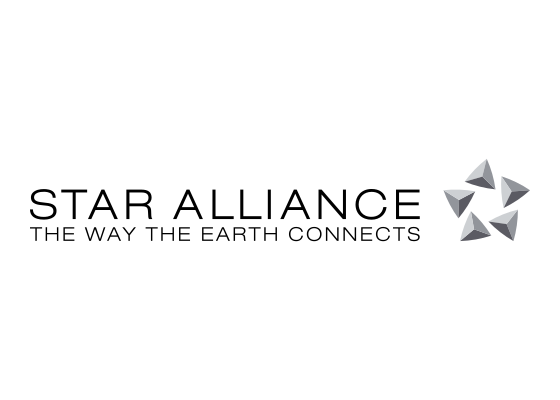
The Star Alliance logo features a five-pointed star formed from curved, interlocking segments in metallic gray, symbolizing the collaborative network of member airlines spanning the globe.
Pentagram’s design for Star Alliance creates a mark that transcends individual airline identities while suggesting unity and global reach. The star symbol uses five organic, swooping curves that flow together to form the classic five-pointed shape. Each curve represents an individual airline, but they connect seamlessly to create something greater than the sum of parts. The silver-gray color palette was chosen for its neutrality, avoiding favoritism toward any member airline’s brand colors while projecting sophistication and premium positioning. The treatment gives the mark a three-dimensional quality that suggests movement and dynamism.
The logo needed to work alongside the distinct identities of member airlines without competing or clashing. Airlines like Lufthansa, United, and Singapore Airlines each have strong visual identities in their own right. Star Alliance serves as a unifying symbol that appears on aircraft, airport signage, and marketing materials, signaling to travelers that they can earn and redeem miles across the network and expect consistent service standards. The monochromatic scheme ensures the mark integrates smoothly with any airline’s color palette.
Meaning and Symbolism
- Five-Pointed Star: Represents excellence, aspiration, and guidance, while the five points reference the alliance’s original five founding member airlines in 1997.
- Interlocking Curves: Each segment symbolizes an individual carrier, coming together to form a unified whole that is stronger through collaboration.
- Metallic Gray Palette: Conveys sophistication, neutrality, and premium positioning while avoiding competition with member airlines’ branded colors.
- Circular Flow: The curved segments create implied motion, suggesting global connectivity and the seamless travel experience the alliance promises.
Design and History
Star Alliance launched in 1997 as the world’s first major airline alliance, founded by Air Canada, Lufthansa, Scandinavian Airlines, Thai Airways International, and United Airlines. These carriers recognized that customers increasingly wanted seamless global travel with reciprocal frequent flyer benefits and coordinated schedules. The alliance needed a visual identity that could represent diverse carriers from different continents while establishing Star Alliance as a credible brand in its own right.
Pentagram developed a mark that balances memorability with diplomatic neutrality. The star shape has universal recognition across cultures, making it ideal for a global alliance. The organic, flowing treatment distinguishes it from military or governmental stars, giving it a more friendly and accessible character. As Star Alliance expanded to 26 member airlines serving over 1,300 destinations, the logo became one of the most visible symbols in aviation, appearing on aircraft alongside member airlines’ own liveries.
The identity has remained remarkably stable since launch, a testament to its fundamental strength. While member airlines have updated their own identities over the decades, the Star Alliance mark has required only minor refinements. This consistency has built recognition among frequent international travelers who associate the star with global connectivity and service quality. The alliance’s slogan, “The Way The Earth Connects,” reinforces the logo’s circular, interconnected design language.
Typography
The Star Alliance wordmark uses a clean, geometric sans-serif typeface with even stroke weights and slightly condensed letterforms. The typography is deliberately understated, allowing the star symbol to remain the primary recognition element. The letterforms have a technical precision that suggests reliability and coordination, essential qualities for an alliance managing complex scheduling and service integration across dozens of airlines. The type appears in the same metallic gray as the symbol, maintaining the monochromatic scheme that ensures compatibility with member airline identities.
FAQ
Q: How does Star Alliance differ from oneworld and SkyTeam?
A: Star Alliance, founded in 1997, is the oldest and largest global airline alliance by number of member airlines and destinations. Oneworld tends toward premium carriers like British Airways and Qantas, while SkyTeam includes carriers like Delta and Air France. Each alliance offers reciprocal benefits but competes for airline membership and customer loyalty.
Q: Why do Star Alliance aircraft show both the alliance logo and the airline’s own branding?
A: Member airlines maintain independent operations and distinct brand identities. The Star Alliance mark appears alongside the airline’s logo to signal membership benefits like lounge access and mileage earning, but each carrier retains its own visual identity and operational control. This dual branding allows airlines to maintain differentiation while promoting alliance advantages.
Q: What does membership in Star Alliance mean for passengers?
A: Passengers can earn and redeem frequent flyer miles across all member airlines, access over 1,000 airport lounges worldwide regardless of which alliance carrier they fly, and enjoy coordinated schedules that simplify international connections. The Star Alliance logo on signage helps travelers identify partner airline facilities and services at airports.