Starbucks Corporation Logos
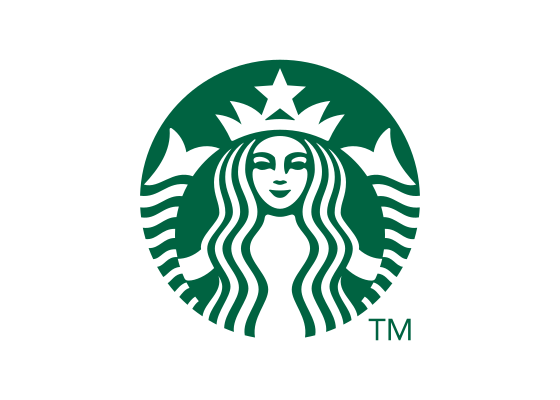
The Starbucks logo features a twin-tailed siren in a circular frame, rendered in the brand’s distinctive green (#006341) and white color scheme that has become synonymous with specialty coffee worldwide.
The siren is depicted from the waist up, with two fish tails extending from her sides in a symmetrical composition. Her crowned head faces forward, and stylized waves surround her within the circular frame. The green color evokes growth, freshness, and the brand’s commitment to sustainability, while the white provides contrast and clarity. The logo’s maritime imagery connects Starbucks to its Seattle origins and the historical coffee trade that brought beans from distant ports.
In 2011, Starbucks removed the wordmark from the logo, allowing the siren symbol to stand alone. This move reflected the brand’s confidence that the image had achieved global recognition and also signaled Starbucks’ expansion beyond coffee into a broader range of products and experiences. The simplified presentation gave the logo more flexibility across packaging, signage, and digital applications.
Meaning and Symbolism
- Twin-tailed siren: Inspired by a 16th-century Norse woodcut, the siren evokes mystery, seduction, and maritime heritage. Sirens in mythology lured sailors with enchanting songs, suggesting the irresistible allure of Starbucks coffee.
- Green color (#006341): Signifies growth, freshness, and environmental responsibility. The green positions Starbucks as a brand committed to ethical sourcing and sustainability.
- Circular format: The circle represents unity, community, and the “third place” concept that Starbucks promotes as a gathering space between home and work.
- Crown: The siren’s crown adds regal authority and positions coffee drinking as a special, elevated experience rather than a mundane transaction.
Design and History
Terry Heckler designed the original Starbucks logo in 1971 when the company was a single store in Seattle’s Pike Place Market selling roasted coffee beans, tea, and spices. Heckler based the siren on a 16th-century Norse woodcut, selecting an image that connected to Seattle’s seafaring history and the maritime coffee trade. The original logo was brown and featured more anatomical detail than later versions, with a fully visible twin-tailed mermaid in a more explicit rendering.
When Howard Schultz acquired Starbucks in 1987, the logo was redesigned with a green color scheme and a simplified, more modest rendering of the siren. The green differentiated Starbucks from other coffee brands and aligned with Schultz’s vision of creating Italian-style espresso bars in America. The siren was cropped closer, showing only her upper body, and the imagery became more stylized and less literal.
The 2011 redesign by Lippincott, in collaboration with Starbucks’ in-house team led by Connie Birdsall, was the most significant change in the logo’s history. The “Starbucks Coffee” text was removed entirely, leaving only the siren within the circle. The green was brightened slightly, and the siren’s features were refined for better reproduction across digital and physical media. This wordmark-free presentation demonstrated Starbucks’ global recognition and freed the brand to expand beyond coffee into food, consumer packaged goods, and new beverage categories.
The evolution from the detailed 1971 woodcut to the streamlined 2011 symbol reflects Starbucks’ transformation from a local Seattle roaster to a global brand operating in over 80 countries.
Typography
When the Starbucks wordmark appears alongside the siren logo, it uses a clean, proprietary sans-serif typeface with slightly rounded terminals. The letterforms are geometric and evenly spaced, creating a modern, approachable quality. For broader brand communications, Starbucks uses a typographic system called Sodo Sans, developed specifically for the brand. Sodo Sans is a humanist sans-serif with warm, friendly proportions that complement the hand-crafted quality Starbucks emphasizes in its coffee preparation. The typeface family includes multiple weights and is designed to work across packaging, signage, digital interfaces, and marketing materials.
FAQ
Q: Who designed the Starbucks logo?
A: Terry Heckler designed the original 1971 logo. The 2011 redesign removing the wordmark was created by Lippincott in collaboration with Starbucks’ in-house team led by Connie Birdsall.
Q: What does the green color symbolize?
A: Green (#006341) represents growth, freshness, and Starbucks’ commitment to environmental sustainability and ethical coffee sourcing.
Q: Why is there a siren in the Starbucks logo?
A: The twin-tailed siren, inspired by 16th-century maritime imagery, represents the allure of coffee and connects Starbucks to Seattle’s seafaring heritage and the historical coffee trade.
More logos with similar colors