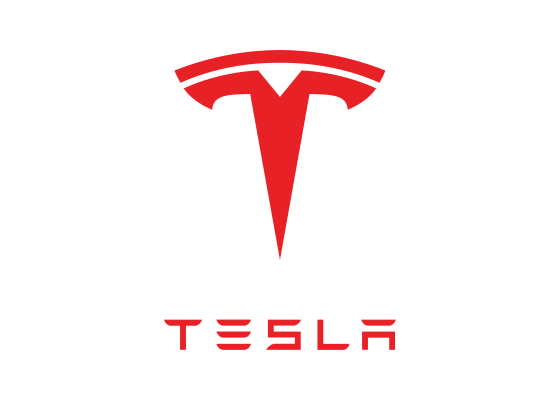
The Tesla logo represents the American electric vehicle manufacturer founded in 2003, named after inventor Nikola Tesla and headquartered in Austin, Texas.
The Tesla logo is a stylized “T” rendered in metallic silver or black on vehicle badges, and in red (#e82127) for marketing applications. The mark was designed by RO Studio and functions as both a letterform and an abstract representation of a cross-section of an electric motor. The upper portion suggests the rotor, while the vertical line represents the stator. The design is minimalist and tech-forward, eschewing traditional automotive heraldry for something closer to a software company’s identity. The simplicity allows it to scale perfectly across digital applications, vehicle badges, and charging infrastructure.
Meaning and Symbolism
- T-shape cross-section: Represents a slice through an electric motor, with the top suggesting the rotor and the vertical line indicating the stator and magnetic flux.
- Minimalist geometry: Signals a break from traditional automotive branding, positioning Tesla as a technology company rather than a legacy car manufacturer.
- Sharp angles: Convey precision engineering and cutting-edge innovation, avoiding the rounded, friendly forms of mass-market brands.
- Monochrome flexibility: The mark works equally well in silver, black, or red, allowing it to adapt to contexts from premium vehicle badging to app icons.
Design and History
Tesla’s logo was created by RO Studio in 2003, the same year the company was founded by Martin Eberhard and Marc Tarpenning. When Elon Musk joined as chairman and later became CEO, the logo remained unchanged, a testament to its effectiveness and foresight. The design brief was to create a mark that honored Nikola Tesla, referenced electric vehicle technology, and avoided automotive clichés. The electric motor cross-section achieves all three objectives while remaining visually distinctive.
The logo’s restraint is unusual in automotive branding, where heritage marks like Ferrari’s prancing horse or Porsche’s crest dominate. Tesla’s T-shield feels more aligned with Apple or Google than with Mercedes-Benz or BMW. This positioning was intentional. Tesla aimed to attract customers who saw themselves buying into a tech ecosystem, not just a car. The logo reinforces that perception.
As Tesla expanded from the original Roadster to the Model S, Model 3, Model X, and Model Y, the logo remained constant across all vehicles and product lines. Unlike traditional automakers that create sub-brands or model-specific badges, Tesla maintains absolute consistency. The T-shield appears on vehicle hoods, steering wheels, key fobs, Supercharger stations, and the Tesla mobile app. This consistency builds recognition quickly, crucial for a brand competing against century-old automotive names.
Typography
Tesla uses a modified version of Gotham for its wordmark and communications, chosen for its modern, geometric clarity. The typeface reinforces the brand’s tech-forward positioning while maintaining excellent readability across applications. On vehicles, the “TESLA” wordmark often appears in a custom sans-serif with slightly extended letterforms, creating a sleek, low profile suitable for trunk lids and door sills. The typography always plays a supporting role to the T-shield logo itself.
FAQ
Q: What does the Tesla logo represent? A: The T-shaped mark is a stylized cross-section of an electric motor. The upper portion represents the rotor, while the vertical line indicates the stator, honoring both the company name and its electric vehicle technology.
Q: Who designed the Tesla logo? A: RO Studio created the logo in 2003, the year Tesla was founded. The design has remained unchanged for over two decades.
Q: Why is the Tesla logo so simple compared to other luxury car brands? A: Tesla intentionally positioned itself as a technology company rather than a traditional automaker. The minimalist logo reflects this identity, aligning more with Silicon Valley aesthetics than automotive heraldry.
Tesla and the Tesla logo are registered trademarks of Tesla, Inc. This page is for educational and reference purposes only.