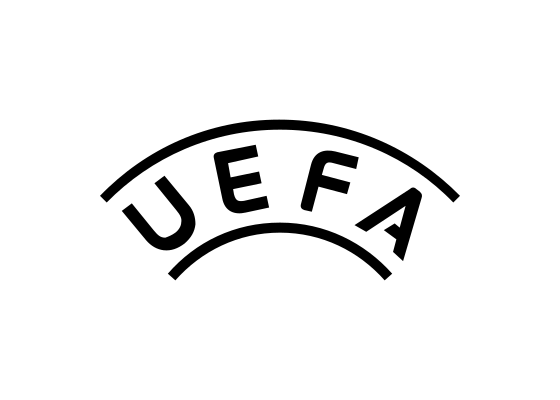
The UEFA logo features bold black letters arranged in a clean, horizontal wordmark that projects institutional authority. As the governing body for European football, UEFA oversees the world’s most commercially successful club competition, the Champions League, along with the European Championship and multiple continental tournaments.
The UEFA wordmark employs a distinctive custom sans-serif typeface with unusual geometric characteristics. The letters feature consistent stroke weights and slightly extended horizontal proportions that create a stable, grounded appearance. The “U” and “A” characters show particular design refinement, with the “U” using a gentle curve and the “A” featuring a distinctive apex angle. The black color conveys regulatory authority and institutional seriousness appropriate for an organization that controls billions in prize money, broadcasting rights, and sponsorship revenues across European football.
The logo’s restraint distinguishes it from individual competition marks like the Champions League’s starball icon or the European Championship’s tournament-specific designs. This hierarchy allows UEFA to maintain overarching institutional authority while individual competitions develop strong visual identities that resonate with fans. The wordmark appears on official documents, referee equipment, and administrative communications rather than on consumer merchandise, which typically features competition-specific branding that drives commercial engagement.
Meaning and Symbolism
- Black Typography: Communicates institutional authority, regulatory power, and administrative seriousness befitting European football governance.
- Horizontal Wordmark: Projects stability, organizational structure, and bureaucratic coordination across 55 member associations.
- Geometric Sans-Serif: Balances modern administrative efficiency with traditional European institutional formality.
- Restrained Design: Distinguishes governing body identity from commercial competition brands that require fan engagement and emotional connection.
Design and History
UEFA was founded in Basel, Switzerland, in 1954 by 25 European football associations seeking to coordinate continental competition and represent European interests within FIFA. The organization created the European Champion Clubs’ Cup in 1955, which evolved into the Champions League, now the world’s most-watched annual sporting competition outside the World Cup. The European Championship, first held in 1960, has grown into a major tournament rivaling the World Cup in competitive quality and commercial value.
UEFA’s commercial transformation accelerated in the 1990s when the European Cup became the Champions League with expanded format, group stages, and sophisticated marketing that generated exponentially higher broadcasting and sponsorship revenues. The Champions League anthem, starball logo, and premium positioning transformed club football economics, allowing the competition to rival international tournaments in prestige and financial rewards. This commercial success funds substantial prize money that influences club strategies, player transfers, and domestic league structures across Europe.
The organization operates from headquarters in Nyon, Switzerland, coordinating competitions, distributing television revenues, enforcing financial fair play regulations, and mediating disputes among powerful clubs, domestic leagues, and national associations. UEFA’s decisions regarding competition formats, prize distribution, and qualification criteria significantly impact European football economics and competitive balance. The logo represents this regulatory authority, appearing in contexts where institutional power matters more than fan emotional engagement.
Typography
The UEFA wordmark uses a custom geometric sans-serif typeface with moderate weight and extended horizontal proportions. The letters feature clean, modernist construction with carefully balanced negative space that creates visual stability. The “E” characters show consistent horizontal bar lengths while the “U” employs a gentle curved base that adds subtle elegance to an otherwise strictly geometric design. The uppercase-only format projects institutional authority. Letter spacing follows optical principles that ensure even visual rhythm. The black color provides maximum contrast against white backgrounds common in official documentation and digital communications.
FAQ
Q: What does UEFA stand for?
A: UEFA is the acronym for Union of European Football Associations, the administrative body governing football, futsal, and beach soccer across Europe. The organization was founded in 1954 and includes 55 member associations from across the European continent.
Q: What competitions does UEFA organize?
A: UEFA operates the Champions League, Europa League, Europa Conference League, European Championship (Euros), Nations League, Super Cup, and Youth Championships. The Champions League represents the world’s most commercially successful annual club competition, while the European Championship rivals the World Cup in competitive quality.
Q: How does UEFA make money?
A: UEFA generates revenue primarily through broadcasting rights, sponsorship agreements, and commercial partnerships for its competitions. The Champions League alone produces billions annually, with funds distributed to participating clubs, member associations, and development programs. The organization operates as a nonprofit, though individual competitions generate substantial commercial revenues.