Under Armour, Inc. is an American sportswear company founded by Kevin Plank in 1996. Headquartered in Baltimore, Maryland, Under Armour manufactures athletic performance apparel, footwear, and accessories. The company grew from a business run out of Plank’s grandmother’s basement into a publicly traded brand that challenged Nike and Adidas in the performance athletic market.
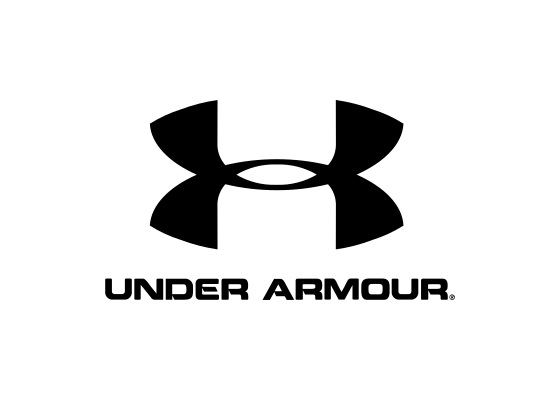
The Under Armour logo is an interlocking U and A that forms a shape resembling a stylized shield or chest plate. The U sits within the A, the two letters sharing structural lines to create a compact, symmetrical monogram. The mark is bold, angular, and aggressive, reflecting the brand’s origins in football and contact sports. It appears primarily in black, white, or gray, though red has been used as an accent color throughout the brand’s history. The logo communicates protection, strength, and athletic performance without any of the softness or approachability that many sportswear competitors favor.
Meaning and Symbolism
- Interlocking UA: The combined U and A create a monogram that reads as a single symbol rather than two letters. The integration suggests unity and strength, with the letterforms reinforcing each other structurally.
- Shield shape: The overall silhouette resembles body armor or a chest plate, directly referencing the brand name. “Under Armour” refers to the base layer worn beneath equipment, and the logo’s protective form reinforces that meaning.
- Angular geometry: The sharp angles and straight lines communicate aggression, determination, and competitive intensity. There are no curves, no soft edges. Every line is deliberate.
- Symmetry: The bilateral symmetry of the mark gives it balance and stability. It reads cleanly at small sizes and works as a standalone icon without any supporting text.
Design and History
1996: Kevin Plank designed the original UA logo himself, sketching the interlocking letters while building the company from his grandmother’s basement in Washington, D.C. The first version was rougher and less refined than the current mark but established the basic concept of the interlocking U and A.
1998-2005: As Under Armour grew from a startup selling moisture-wicking shirts to college football teams into a nationally distributed brand, the logo was cleaned up and standardized. The proportions were tightened, the lines were made more consistent, and the mark was optimized for screen printing on apparel.
2005: Under Armour went public, and the logo received a polish that sharpened its geometry and improved its scalability across product categories including footwear, bags, and retail signage. The basic form remained unchanged.
Present: The current UA mark is a refined version of the original concept. The proportions are precise, the lines are clean, and the mark works across all media from embroidery to digital. Under Armour has also introduced a simplified “UA” text mark for certain applications, but the interlocking symbol remains the primary identifier.
Present: The current UA mark is a refined version of the original concept. The proportions are precise, the lines are clean, and the mark works across all media from embroidery to digital. Under Armour has also introduced a simplified “UA” text mark for certain applications, but the interlocking symbol remains the primary identifier.
Kevin Plank was a walk-on fullback at the University of Maryland who was frustrated by the cotton T-shirts worn under football pads. They soaked through with sweat, became heavy, and never dried. In 1996, he started making moisture-wicking compression shirts from synthetic fabrics in his grandmother’s basement in the Georgetown neighborhood of Washington, D.C. The company name came from the product concept: performance clothing worn under armor, meaning under the pads and equipment.
Plank designed the logo himself, and the amateurism of that origin is part of its character. The interlocking UA was not created by a branding agency or a design consultancy. It was sketched by a 23-year-old former football player who needed a mark for his T-shirt labels. The fact that it works as well as it does is partly luck and partly instinct. The shield-like shape resonated with athletes because it looked like something that belonged on a uniform. It looked like it was built for the field, not the fashion runway.
The early growth of Under Armour was driven by word of mouth among college and professional football players. Plank drove up and down the East Coast in his car, selling shirts out of the trunk. The logo appeared on every garment, and because the shirts were visible during practices and in locker rooms, the UA mark spread through athletic networks organically. When a player wore Under Armour, every teammate saw the logo.
The brand’s breakthrough came in 2003 with a television commercial featuring Eric “Big E” Ogbogu, a former NFL player, that introduced the tagline “Protect This House.” The commercial was aggressive, loud, and physical, and it positioned Under Armour as an insurgent challenger to Nike’s dominance. The UA logo was central to this positioning. Where Nike’s Swoosh was fluid and dynamic, the UA was rigid and confrontational. Where Adidas’ three stripes were horizontal and balanced, the UA was vertical and compact. The logo differentiated Under Armour in a market dominated by established visual languages.
As the company expanded into footwear, casual wear, and women’s athletics, the logo’s aggression became both an asset and a limitation. It worked brilliantly for football, training, and combat sports. It was harder to translate to yoga, running, and lifestyle categories where consumers valued different qualities. Under Armour has navigated this tension by maintaining the UA mark across all categories while adjusting the surrounding design language, using lighter colors, softer photography, and more refined typography for products aimed at broader audiences.
The logo has never been fundamentally redesigned. Plank’s original concept of interlocking letters forming a shield has survived the company’s growth from a basement startup to a publicly traded corporation with billions in annual revenue. Like Nike’s Swoosh, the UA mark benefits from having been created by a founder rather than a committee. It has a conviction that designed-by-consensus logos rarely achieve.
Typography
The Under Armour wordmark uses a custom sans-serif typeface with condensed, athletic proportions. The letters are tall, narrow, and tightly spaced, communicating the same energy and intensity as the UA symbol. The “UNDER ARMOUR” text typically appears in all caps below or alongside the symbol. For marketing and digital applications, the brand uses proprietary typefaces that maintain this condensed, muscular quality. The typography is functional rather than decorative, designed to be read quickly on product labels, retail signage, and digital advertising.
FAQ
Q: Who designed the Under Armour logo?
A: Founder Kevin Plank designed the original interlocking UA logo himself in 1996 when he launched the company from his grandmother’s basement.
Q: What does the Under Armour logo represent?
A: The interlocking U and A form a shield-like shape that references the brand name. “Under Armour” refers to performance base layers worn beneath athletic equipment, and the logo’s protective form reinforces that concept.
Q: Has the Under Armour logo changed?
A: The basic design of interlocking U and A has remained consistent since 1996. The proportions and line quality have been refined over the years, but the fundamental concept is unchanged.