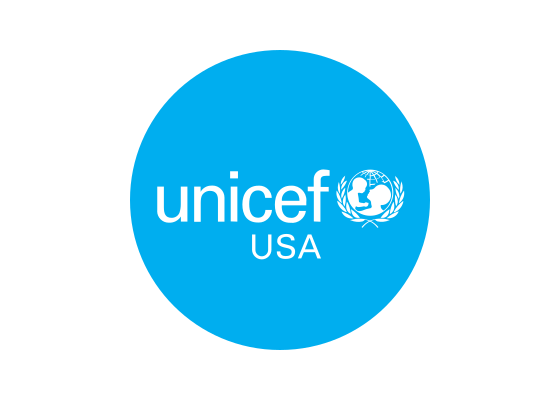
The UNICEF logo features a bright cyan blue circle enclosing a mother-and-child symbol surrounded by olive branches, representing the organization’s mission to protect children’s rights and well-being worldwide since 1946.
Meaning and Symbolism
- Bright cyan blue evokes hope, trust, and the sky, representing universal values and the bright future UNICEF works to create for children
- Mother and child silhouette symbolizes protection, care, and the fundamental relationship UNICEF supports through health and nutrition programs
- Olive branches represent peace and the United Nations framework within which UNICEF operates as a specialized agency
- Circular enclosure suggests global reach and wholeness, encompassing UNICEF’s work in over 190 countries and territories
- Simple, iconic design ensures recognition across cultures and languages, critical for an organization serving the world’s most vulnerable children
History and Evolution
UNICEF (United Nations International Children’s Emergency Fund) was established on December 11, 1946, by the United Nations General Assembly to provide emergency food and healthcare to children in countries devastated by World War II. Initially intended as a temporary organization, UNICEF’s mandate expanded in 1953 to address children’s needs in developing countries, dropping “International” and “Emergency” from its name but retaining the acronym. The organization’s focus broadened to encompass education, disease prevention, and child protection.
The U.S. Fund for UNICEF was founded in 1947 by Helenka Pantaleoni, a humanitarian who had witnessed war’s impact on children firsthand. It is the oldest of 36 UNICEF National Committees that raise funds and advocate for children’s rights in their respective countries. Since inception, the U.S. Fund has contributed over $6.3 billion in cash and gifts-in-kind to UNICEF programs worldwide, making American donors among the organization’s most generous supporters.
The iconic logo with mother, child, and olive branches was adopted in the 1950s and has undergone minimal changes, maintaining remarkable consistency for over 70 years. The design’s longevity reflects its universal resonance and instant recognizability. UNICEF was awarded the Nobel Peace Prize in 1965 for promoting brotherhood among nations, and its programs have achieved milestones including near-universal childhood immunization and dramatic reductions in child mortality rates globally.
Typography and Design
The UNICEF wordmark employs a clean, humanist sans-serif typeface that conveys approachability and professionalism. The letters typically appear in the same cyan blue as the symbol or in black for high-contrast applications. The mother-and-child symbol uses simplified, rounded forms that read as universal human figures rather than specific individuals, ensuring the logo transcends cultural and ethnic boundaries. The olive branches mirror United Nations iconography, firmly positioning UNICEF within the UN system. The bright cyan blue was chosen for its visibility and positive psychological associations with hope, cleanliness, and trust—critical attributes for an organization soliciting donations and building partnerships across governments, corporations, and communities worldwide.
Frequently Asked Questions
Who designed the UNICEF logo? The original UNICEF logo was designed in the 1950s by UN graphic designers, though specific attribution remains unclear. The enduring design has required minimal updates over seven decades.
When was the UNICEF logo last updated? The core symbol of mother, child, and olive branches has remained essentially unchanged since the 1950s, with only minor refinements to line weights and proportions for modern reproduction standards.
What do the colors in the UNICEF logo represent? The cyan blue represents hope, trust, and the bright future UNICEF works to secure for children, while the color’s vibrancy ensures visibility and recognition across diverse global contexts.
More logos with similar colors