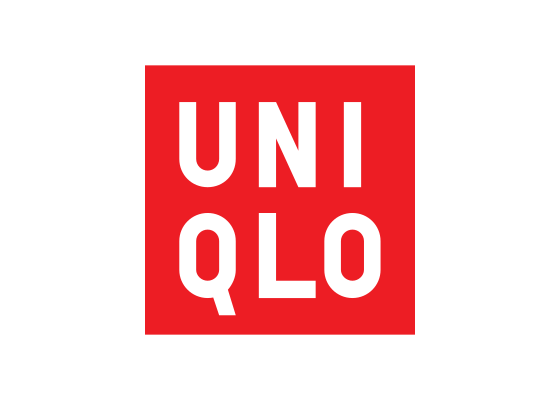
The UNIQLO logo features a red square with white lettering designed by Kashiwa Sato, representing the Japanese casual wear retailer that pioneered functional, minimalist clothing and grew into the world’s third-largest apparel company as part of Fast Retailing.
Uniqlo Co., Ltd. operates as a Japanese casual wear designer, manufacturer, and retailer wholly owned by Fast Retailing Co., Ltd. Tadashi Yanai founded the company in 1984, opening the first Uniqlo store in Hiroshima. The name derives from “Unique Clothing Warehouse,” originally intended as “Uniclo” but registered incorrectly due to clerical error. Rather than correct it, Yanai kept Uniqlo. The brand revolutionized Japanese fashion retail by introducing self-service shopping, which was uncommon in Japan’s traditional retail culture. Uniqlo positioned as offering high-quality basics at reasonable prices through efficient manufacturing and minimal design. The company expanded internationally starting in the 2000s, opening stores across Asia, Europe, and the United States. Today Uniqlo operates over 2,000 stores worldwide and ranks as the world’s third-largest clothing retailer, known for innovative fabrics like Heattech and AIRism that combine technology with minimalist aesthetics.
Kashiwa Sato’s logo redesign in the early 2000s transformed Uniqlo’s identity from local Japanese retailer to global brand. The red square with white “UNIQLO” lettering creates immediate recognition while communicating the brand’s philosophy of functional simplicity. The bold red conveys energy and confidence, while the geometric square suggests order and efficiency. The all-caps typography projects clarity and accessibility, positioning Uniqlo as democratic fashion offering quality basics to everyone.
Meaning and Symbolism
- Red square: Creates strong visual impact and immediate recognition while suggesting Japanese design sensibility of bold simplicity and geometric precision.
- White typography: Provides maximum contrast and legibility while communicating the clean, functional aesthetic that defines Uniqlo’s product philosophy.
- All-caps lettering: Projects democratic accessibility and straightforward communication, positioning Uniqlo as fashion for everyone rather than exclusive style.
- Compact composition: Works effectively across all scales from tiny clothing labels to massive building facades, essential for global retail consistency.
- Japanese minimalism: Reflects the brand’s commitment to essential design without unnecessary decoration, mirroring the clothing’s functional approach.
Design and History
Kashiwa Sato, one of Japan’s most respected art directors, redesigned Uniqlo’s identity in 2006 as the company prepared for global expansion. The previous logo felt regional and lacked impact for international markets. Sato created a mark that communicated Japanese design values while appealing to global consumers. The red square referenced Japan’s flag while creating universal recognition through bold geometry and color.
The logo’s simplicity aligned perfectly with Uniqlo’s product philosophy. The brand focused on perfecting basics like t-shirts, jeans, and sweaters rather than chasing fashion trends. Each garment went through extensive development to optimize fit, fabric, and construction. The minimalist logo suggested this attention to essentials, communicating that Uniqlo cared about getting fundamentals right rather than adding superficial decoration.
Uniqlo’s retail strategy amplified the logo’s impact. Stores featured clean white interiors with organized product displays that felt more like Apple stores than traditional clothing retailers. The red logo provided color and energy against white walls, while the systematic presentation reinforced messages of order and quality. This visual consistency from logo to store design to product created cohesive brand experience that felt distinctly Japanese yet universally appealing.
The logo’s effectiveness internationally demonstrated that strong design principles transcend cultural specifics. While rooted in Japanese minimalism, the mark worked in New York, London, and Paris because its clarity and boldness were universally legible. The red square became as recognizable as Gap’s blue square or Zara’s serif wordmark, proving that Japanese design sensibility could compete globally with American and European fashion branding.
Typography
The Uniqlo wordmark employs a bold, geometric sans-serif typeface with consistent stroke weight and clean construction. The letterforms feature squared terminals and tight spacing that create compact unity within the red square container. The all-caps treatment ensures consistent visual impact while the clear letterforms maintain legibility at all scales. The typography avoids decorative elements, projecting functional clarity appropriate for a brand focused on essential clothing rather than fashion trends.
FAQ
Q: Who designed the Uniqlo logo? A: Kashiwa Sato, a renowned Japanese art director and designer, redesigned the Uniqlo logo in 2006 as part of the company’s global expansion strategy.
Q: What makes Uniqlo different from other fast-fashion retailers? A: Uniqlo focuses on perfecting functional basics rather than chasing trends, developing innovative fabrics like Heattech and AIRism while maintaining minimalist design and quality construction at reasonable prices.
Q: Why is the Uniqlo logo a red square? A: The bold red square creates strong recognition while referencing Japanese design sensibility and the country’s flag, communicating simplicity, quality, and functional approach to clothing that defines the brand globally.
More logos with similar colors