The University of Pennsylvania is a private Ivy League research university founded in 1740 in Philadelphia, making it one of nine colonial colleges established before American independence and the first university in the United States with both undergraduate and graduate programs.
Meaning and Symbolism
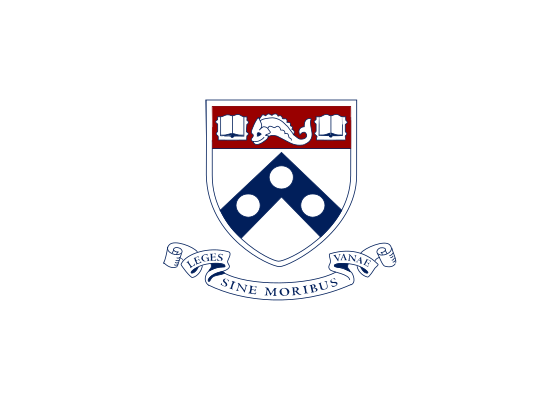
- The shield shape reflects Penn’s colonial heritage and the heraldic traditions of European universities
- Penn Blue (#011f5b) and Penn Red (#990000) create a distinctive color combination that distinguishes Penn from other Ivy League institutions
- The shield contains two books representing knowledge and learning, with seven stripes symbolizing the liberal arts
- Three dolphins on the shield honor Benjamin Franklin’s coat of arms and his pivotal role as founder
- The motto “Leges sine Moribus Vanae” (Laws without morals are useless) emphasizes Penn’s commitment to practical, ethical education
History and Evolution
The University of Pennsylvania was founded in 1740, originally as the Charity School before Benjamin Franklin reorganized it in 1749 into an academy emphasizing practical education alongside classical studies. Franklin’s vision created America’s first modern liberal arts curriculum focused on training leaders for commerce, government, and public service. Penn established the first medical school in America in 1765, the first business school (Wharton) in 1881, and pioneered innovations including the first university-owned hospital and one of the first electronic computers (ENIAC) in 1946.
Today, Penn enrolls over 28,000 students across four undergraduate schools and twelve graduate schools, including the prestigious Wharton School of Business, Perelman School of Medicine, and Penn Law. The university’s endowment exceeds $20 billion, and it maintains extensive research facilities across its Philadelphia campus. Penn’s “One University Policy” allows students to take courses across any of its schools, fostering interdisciplinary collaboration. The university has produced numerous heads of state, Nobel laureates, and business leaders, with its alumni network exceeding 350,000 worldwide.
Typography and Design
The University of Pennsylvania shield logo features a traditional heraldic design that has remained largely consistent since the 18th century, though refined for modern reproduction. The shield’s detailed ornamentation includes Baroque scrollwork, dolphins, and a chevron pattern that divides the shield into distinct sections containing books and other symbolic elements. The university typically pairs the shield with a traditional serif typeface for the institution name, projecting authority and academic tradition.
Penn Blue (#011f5b) serves as the primary institutional color, appearing on official communications, athletic uniforms, and campus signage. Penn Red (#990000) provides a complementary accent that adds warmth and distinction. These colors differentiate Penn from Yale’s darker blue and Harvard’s crimson while maintaining the gravitas expected of an Ivy League institution. The shield appears in various simplified versions for athletic applications and informal use, but the complete heraldic version remains the official university seal for diplomas and formal documents.
Frequently Asked Questions
Who designed the University of Pennsylvania logo? The Penn shield evolved from colonial-era heraldic traditions, with its core design elements established in the 18th century and refined over subsequent decades for modern reproduction.
When was the University of Pennsylvania logo last updated? While the shield’s basic design dates to the colonial era, Penn refined its brand guidelines and modernized logo reproduction standards in the early 2000s to ensure consistency across digital and print media.
What do the dolphins in the Penn shield represent? The three dolphins honor Benjamin Franklin’s family coat of arms and symbolize his foundational role in establishing Penn as America’s first modern university.
More logos with similar colors