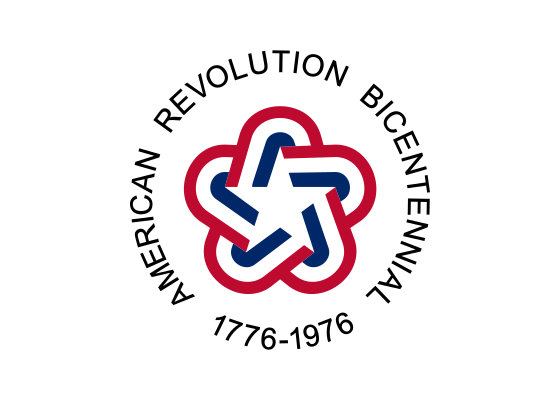
The United States Bicentennial logo designed by Chermayeff & Geismar features a red star enclosed in geometric ribbons forming the number “76”. The elegant patriotic design commemorated the 200th anniversary of American independence and became one of the most widely reproduced American symbols of the 1970s.
Meaning and Symbolism
- Red, white, and blue represent American flag colors and patriotic celebration
- Five-pointed star symbolizes the original colonies and American statehood
- Geometric ribbons form “76” referencing 1776 Declaration of Independence
- Dynamic composition suggests forward progress and bicentennial momentum
- Design balances historical reverence with contemporary 1970s graphic style
History and Evolution
The United States Bicentennial was a series of celebrations during the mid-1970s paying tribute to historical events leading to American independence. The observances culminated on Sunday, July 4, 1976, with the 200th anniversary of the Declaration of Independence adoption. The federal government needed a unifying visual symbol for nationwide celebrations, commemorative products, and international recognition of the milestone.
Chermayeff & Geismar, the legendary New York design firm, created the Bicentennial logo to serve diverse applications from postage stamps to NASA spacecraft markings. The geometric star enclosed in flowing ribbons achieved instant recognition while maintaining dignified simplicity appropriate for a national celebration. The design appeared on everything from commercial products to government communications, becoming ubiquitous throughout 1975-1976. The logo succeeded in creating unified visual identity for a decentralized nationwide celebration, demonstrating how effective graphic design can crystallize national identity during historic moments.
Typography and Design
The Bicentennial logo employs geometric construction that allows the ribbons to flow naturally while forming the distinct “76” numeral. The five-pointed star anchors the composition while the curved ribbons create dynamic movement, suggesting both historical continuity and forward momentum into America’s third century. Chermayeff & Geismar’s design avoided literal colonial imagery like tricorn hats or muskets, instead creating an abstract patriotic symbol that felt both timeless and contemporary. The red, white, and blue palette ensured immediate patriotic recognition while the geometric precision allowed reproduction at any scale from lapel pins to building facades.
Frequently Asked Questions
Who designed the US Bicentennial logo? Chermayeff & Geismar, the renowned New York design firm, created the United States Bicentennial logo featuring a star enclosed in ribbons forming “76” to commemorate America’s 200th independence anniversary.
When was the US Bicentennial logo last updated? The logo was designed for the 1976 Bicentennial celebration and remained unchanged throughout the mid-1970s observances, becoming a historical artifact after July 4, 1976.
What do the colors in the US Bicentennial logo represent? Red, white, and blue represent the American flag and patriotic celebration, while the star symbolizes statehood and the ribbons form “76” referencing the 1776 Declaration of Independence.
More logos with similar colors