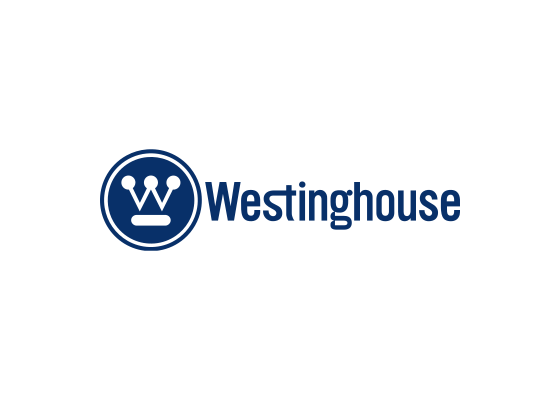
The Westinghouse logo features a distinctive circular mark containing horizontal lines that form a stylized “W”, enclosed within a clean geometric border. Designed by Paul Rand in the early 1960s as part of Eliot Noyes’s comprehensive “Image by Design” program, the logo represents modernist corporate identity at its peak.
Westinghouse’s logo is Paul Rand at his most restrained. The circular mark contains three horizontal bars that create negative space forming the letter “W”. The geometry is precise, the execution is minimal, and the result is timeless. Rand avoided literal interpretations of electricity, manufacturing, or technology, instead creating an abstract mark that could represent a corporation operating across hundreds of product lines and dozens of industries. The circle provides containment and suggests completeness, while the horizontal lines create rhythm and structure.
The navy blue (#083069) communicates authority, reliability, and technical expertise. White provides contrast and ensures the logo reads clearly at any size. The color combination is conservative but confident, appropriate for a company that manufactured everything from nuclear reactors to household appliances. The logo’s strength lies in its adaptability. It worked equally well on a power plant control panel, a refrigerator badge, or corporate stationery.
Eliot Noyes’s “Image by Design” program, which commissioned the logo, was one of the most comprehensive corporate identity initiatives of the 1960s. Noyes, who had previously worked with IBM, understood that visual identity extended beyond logos to encompass product design, architecture, and employee experience. The Westinghouse logo was the centerpiece of this system, unifying over 300,000 product lines across 60 divisions.
Meaning and Symbolism
- Circular form: The circle suggests completeness, unity, and global reach, appropriate for a corporation operating across diverse industries and international markets.
- Horizontal bars: The three lines create negative space forming a “W” while suggesting electrical circuits, sound waves, or radio signals without literalizing any single technology.
- Navy blue: The deep blue (#083069) communicates authority, technical expertise, and institutional reliability, essential for a company manufacturing critical infrastructure and consumer products.
- Geometric precision: The clean lines and exact proportions reflect engineering discipline and manufacturing quality, core values for an industrial corporation.
Design and History
In the early 1960s, Westinghouse Electric Corporation was the fourteenth largest industrial company in the United States, producing electronics for industries ranging from nuclear power and public transportation to household appliances. With over 300,000 product lines across 60 divisions and growing global presence, the company faced a branding challenge: how to maintain a consistent, recognizable image across vastly different operations.
In 1960, Westinghouse brought in Eliot Noyes as consultant director of design to address this fragmentation. Noyes had transformed IBM’s visual identity and understood that corporate design extended beyond logos to encompass architecture, product design, and employee experience. His “Image by Design” initiative aimed to create a unified, modern representation of Westinghouse’s commitment to quality, performance, and innovation.
Noyes enlisted Paul Rand, who had created IBM’s iconic eight-bar logo, to develop Westinghouse’s visual identity. Rand’s solution was characteristically restrained. The circular mark with three horizontal bars created a “W” through negative space rather than explicit letterforms. This abstraction allowed the logo to function across Westinghouse’s diverse product categories without favoring any single division.
The logo’s rollout was comprehensive. It appeared on products, buildings, vehicles, stationery, advertising, and employee materials. The unified visual system helped Westinghouse project a cohesive corporate image despite operating across dozens of distinct markets. The logo remained in use through multiple ownership changes and corporate restructurings, testament to Rand’s design discipline and Noyes’s strategic vision.
Typography
The Westinghouse wordmark originally used a clean, modern sans-serif typeface that complemented Paul Rand’s geometric logo. The letterforms were straightforward and highly legible, designed to work alongside the circular mark without competing for attention. The typography prioritized clarity and professionalism, reflecting the company’s engineering focus and industrial heritage.
FAQ
Q: Who designed the Westinghouse logo?
A: Paul Rand designed the circular “W” logo in the early 1960s as part of Eliot Noyes’s comprehensive “Image by Design” corporate identity program for Westinghouse Electric Corporation.
Q: What do the horizontal bars in the Westinghouse logo represent?
A: The three bars create negative space forming a “W” while suggesting electrical circuits or signals without literalizing any specific technology, allowing the logo to work across Westinghouse’s diverse product lines.
Q: Is the Westinghouse logo still in use?
A: While the original Westinghouse Electric Corporation has been split and sold, the logo continues to appear on products and entities that carry the Westinghouse name, including Westinghouse Electric Company (nuclear power).
More logos with similar colors