WhatsApp is a messaging platform founded by Jan Koum and Brian Acton in 2009. Acquired by Facebook (now Meta) for $19 billion in 2014, it is the world’s most widely used messaging service with over two billion users across 180 countries. The app’s end-to-end encryption became a defining feature of the platform.
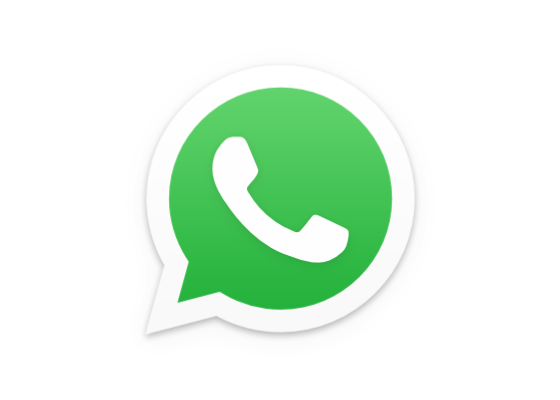
The WhatsApp logo is a white telephone handset inside a speech bubble, set on a green gradient background. The speech bubble is the dominant shape, with rounded corners and a pointed tail extending from the lower left. Inside it, a white telephone receiver is tilted at an angle that suggests action and accessibility. WhatsApp Green (#25D366) is a bright, saturated shade that communicates friendliness and immediacy. The combination of the speech bubble and handset creates a clear visual shorthand for communication. The icon works at any size, from an app badge on a phone screen to signage on a storefront.
Meaning and Symbolism
- Speech bubble: The most universal symbol for messaging and conversation. Its presence makes WhatsApp’s function immediately clear to anyone, regardless of language.
- Telephone handset: References the app’s voice calling capability and its origin as a phone-based communication tool. The angled position suggests picking up the phone, implying readiness and connection.
- Green color (#25D366): Green carries associations with safety, permission, and “go.” For a messaging app, it signals that communication is open and available. The brightness keeps it feeling modern and digital.
- Rounded forms: Every element in the logo uses soft, rounded shapes. Nothing is angular or aggressive, reflecting WhatsApp’s positioning as a personal, intimate communication tool for friends and family.
Design and History
2009: WhatsApp launched with a simple speech bubble icon containing a telephone. The earliest version was more literal and detailed, with a darker green and more realistic handset rendering.
2013: A refined version cleaned up the icon’s proportions and introduced the brighter green gradient. The speech bubble became more stylized, the handset was simplified, and the overall form was optimized for high-resolution mobile screens.
2016: The green shifted slightly brighter. The logo remained structurally the same but was rendered with sharper edges for Retina and high-DPI displays.
2020-present: Meta’s ownership brought the WhatsApp wordmark into alignment with the broader Meta brand system. The icon itself remained unchanged, but the wordmark typography was refreshed. The green gradient deepened slightly at the bottom of the icon.
2020-present: Meta’s ownership brought the WhatsApp wordmark into alignment with the broader Meta brand system. The icon itself remained unchanged, but the wordmark typography was refreshed. The green gradient deepened slightly at the bottom of the icon.
Jan Koum and Brian Acton built WhatsApp on a philosophy of simplicity. No ads, no games, no gimmicks. Just messaging. The logo reflects that philosophy perfectly. Where other messaging apps experimented with mascots, abstract symbols, or clever typography, WhatsApp chose the most direct visual possible: a speech bubble with a phone in it.
The original 2009 icon was rougher around the edges, but the core concept was already there. Koum and Acton were former Yahoo engineers, not designers, and the early logo prioritized function over polish. It communicated exactly what the app did, and that was enough.
By 2013, WhatsApp had grown far beyond its early adopters and needed an icon that could compete visually in crowded app stores. The refinement that year sharpened the proportions, brightened the green, and turned the icon into something genuinely polished. The speech bubble took on a more defined silhouette with a cleaner tail, and the handset was simplified into a crisp white glyph.
The green color choice was strategic. In an app store dominated by blue icons (Facebook, Twitter, LinkedIn, Skype, Telegram in its early days), green made WhatsApp immediately distinguishable. The specific shade, bright and saturated without being neon, struck a balance between digital energy and natural warmth.
When Facebook acquired WhatsApp in 2014 for $19 billion, many expected the brand to be absorbed into Facebook’s blue world. It wasn’t. WhatsApp’s green identity remained completely independent, a smart decision given the app’s massive user base and the brand loyalty that green icon commanded. Even after Facebook became Meta in 2021, WhatsApp kept its own visual identity.
The logo’s greatest strength is its universality. In countries across Africa, South America, South Asia, and Europe where WhatsApp is the primary means of digital communication, the green speech bubble is as recognizable as any brand symbol on Earth. It works across literacy levels, languages, and cultural contexts because it uses visual metaphors that are universally understood.
Typography
The WhatsApp wordmark uses a clean, geometric sans-serif in a slightly rounded style. The letterforms are balanced and modern, with consistent stroke weights. For its product interface, WhatsApp relies on platform-native system fonts (San Francisco on iOS, Roboto on Android) to ensure performance and a native feel. The wordmark typography was refined when Meta updated its family of brands, bringing subtle consistency across WhatsApp, Instagram, and Facebook while keeping each brand visually distinct.
FAQ
Q: What do the WhatsApp logo elements represent?
A: The speech bubble represents messaging, and the telephone handset represents voice calling. Together they communicate WhatsApp’s core function as a communication tool.
Q: Why is WhatsApp green?
A: Green was chosen to stand out from the blue-dominated social media landscape and to communicate safety, permission, and openness. The specific shade (#25D366) balances digital brightness with warmth.
Q: Has the WhatsApp logo changed significantly?
A: The core design (speech bubble with phone handset) has remained the same since 2009. Refinements in 2013 and subsequent years improved proportions and sharpness but kept the fundamental concept unchanged.
More logos with similar colors