IBM (International Business Machines) is an American multinational technology company founded in 1911 as the Computing-Tabulating-Recording Company. Renamed IBM in 1924, it became the dominant force in mainframe computing and has since evolved into a major enterprise technology and consulting company. IBM has produced more patents than any other U.S. company for nearly 30 consecutive years.
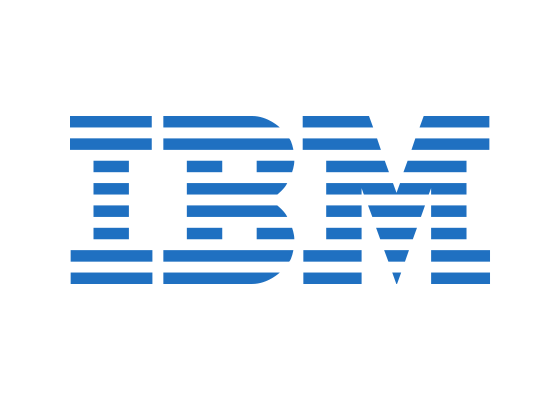
The IBM logo consists of the letters I, B, and M rendered in a bold slab serif typeface with eight horizontal stripes cutting through them. Designed by Paul Rand in 1972, it is one of the most celebrated corporate logos in design history. The striped treatment gives the heavy letterforms a sense of speed and dynamism while creating a distinctive visual rhythm. IBM Blue (#1F70C1) has become so closely identified with the company that IBM earned the nickname “Big Blue.” The logo has remained essentially unchanged for over 50 years, making it one of the longest-running corporate identities in technology.
Meaning and Symbolism
- Eight horizontal stripes: Suggest speed, efficiency, and the parallel processing that defines computing. The stripes also create a visual equivalence sign (=) between the bottom portions of the letters, which Rand described as representing equality.
- Slab serif typeface: Conveys authority, stability, and institutional weight. The letterforms are City Medium, a geometric slab serif that Rand chose for its boldness and clarity.
- Blue color: Communicates trust, intelligence, and corporate professionalism. The shade is cool and confident, appropriate for a company that serves the world’s largest enterprises and governments.
- Monogram format: Using initials rather than the full “International Business Machines” keeps the mark compact and modern, while the full name retains a sense of gravitas for formal contexts.
Design and History
1924: The first IBM logo replaced the Computing-Tabulating-Recording Company name. It featured “IBM” inside a globe design, reflecting the company’s international ambitions.
1947: A simplified version removed the globe and presented “IBM” in a clean, ornate typeface. The letters were more decorative than the current mark, with serif flourishes that reflected mid-century corporate aesthetics.
1956: Paul Rand’s first redesign for IBM. He replaced the ornate lettering with bold City Medium slab serif letters, stripped of decoration. The solid, unstriped version established the basic letterforms that would endure.
1962: Rand introduced 13 horizontal stripes through the letters, creating the first striped version. The stripes were intended to prevent counterfeiting of IBM signage and products while adding visual energy.
1972: Rand reduced the stripes from 13 to eight. This is the version still in use today. The wider stripes improved legibility at small sizes and gave the mark better visual balance. It became one of the most recognized logos in the world.
1972: Rand reduced the stripes from 13 to eight. This is the version still in use today. The wider stripes improved legibility at small sizes and gave the mark better visual balance. It became one of the most recognized logos in the world.
Paul Rand is the designer most responsible for the idea that corporate identity can be both functional and beautiful. His work for IBM is the crown jewel of that philosophy. When Rand first began working with IBM in 1956, the company’s visual identity was scattered and inconsistent. His commission was to bring order and distinction to one of the world’s largest corporations.
Rand’s 1956 logo was a bold statement of simplification. He took the letters I, B, and M and set them in City Medium, a slab serif typeface designed by Georg Trump in 1930. The result was solid, authoritative, and unmistakable. It replaced a more decorative logotype that had served the company since 1947 but lacked the commanding presence Rand wanted.
In 1962, Rand took the design further by introducing horizontal stripes through the letters. The stripes served a practical purpose: they made the logo harder to copy, which was a real concern for a company whose products were sold and serviced worldwide. But the stripes also created something more interesting visually. They broke the mass of the heavy letters into lighter, more dynamic forms. The eye moves across the stripes, creating a sense of speed and rhythm.
The 1972 refinement, reducing the stripes from 13 to eight, was about legibility. Thirteen thin stripes created visual interference at small sizes, making the letters hard to read. Eight wider stripes preserved the striped effect while ensuring the I, B, and M remained crisp and clear at any scale. Rand got the balance right. The logo has not needed another revision since.
The nickname “Big Blue” evolved naturally from the logo’s blue color and IBM’s dominant market position. The company didn’t create the name; it was given by customers, employees, and the press. The fact that a color alone could become a synonym for the company speaks to how deeply the visual identity penetrated public consciousness.
Rand’s IBM work influenced an entire generation of corporate identity design. The principle that a logo should be simple, memorable, and built to last became the standard against which other corporate marks were judged.
Typography
The IBM logo uses City Medium, a geometric slab serif typeface designed by Georg Trump for the Berthold foundry in 1930. Rand chose it for its bold, squared-off forms and consistent stroke weights. For corporate communications, IBM developed its own proprietary typeface called IBM Plex, released in 2017. IBM Plex was designed by Mike Abbink of IBM’s Brand Experience & Design team in collaboration with Bold Monday. The family includes sans-serif, serif, and monospace variants, replacing Helvetica Neue as IBM’s corporate typeface. IBM Plex is open-source and freely available.
FAQ
Q: Who designed the IBM logo?
A: Paul Rand designed the IBM logo. He created the solid-letter version in 1956, added 13 stripes in 1962, and refined it to eight stripes in 1972.
Q: Why does the IBM logo have stripes?
A: Paul Rand introduced the stripes to prevent counterfeiting of IBM signage and to add dynamism to the heavy letterforms. He also noted that the stripes create a visual suggestion of “equals” signs, representing equality.
Q: What typeface is used in the IBM logo?
A: City Medium, a geometric slab serif designed by Georg Trump in 1930. Paul Rand selected it for its bold clarity.