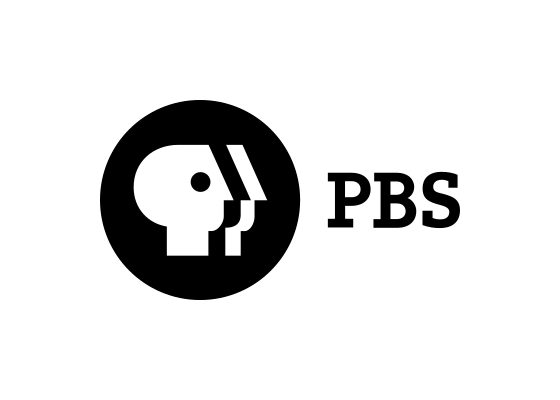
The PBS logo features three stylized profile faces arranged in positive and negative space, creating an instantly recognizable symbol of public television that emphasizes community, diversity, and educational broadcasting.
Chermayeff & Geismar’s 1984 redesign of the PBS identity remains one of American broadcasting’s most enduring logos. The three repeated profile faces use simple geometric curves to suggest human heads looking to the right, representing the diverse American public that PBS serves. The clever use of positive and negative space creates visual rhythm: white faces on blue, blue faces on white, creating a unified pattern that reads both as typography and abstract portraiture.
The logo’s genius lies in its conceptual clarity. By transforming the “P” in PBS into a profile face and repeating the form three times, the design shifts focus from corporate initials to human presence. This perfectly captures PBS’s mission as public television funded by viewers rather than advertisers. The faces looking forward suggest progress, education, and shared vision, aligning with programming focused on learning and cultural enrichment.
The design replaced Herb Lubalin’s 1971 single-face logo, which many viewers found confusing because it omitted the “BS” from the abbreviation. Chermayeff & Geismar retained the face concept but showed three faces to represent all three letters while emphasizing PBS’s broad reach across demographics. The logo’s simplicity allows it to work across countless applications, from on-air station identifications to tote bags in pledge drives.
Meaning and Symbolism
- Three faces: Represent the letters P-B-S while symbolizing the diverse American viewing public PBS serves.
- Profile orientation: Suggests looking forward toward progress, education, and shared cultural understanding.
- Positive-negative space: Creates visual unity and demonstrates design sophistication appropriate for educational programming.
- Geometric simplicity: Ensures recognition and reproduction across all media from broadcast to merchandise.
Design and History
PBS launched in 1970 to unify America’s public television stations under a national identity. The original logo by Herb Lubalin featured a single face in the letter P, stylized from the word “public.” While conceptually clever, viewers complained the logo read as just “P” rather than PBS, and the face’s meaning remained unclear to many.
Chermayeff & Geismar’s 1984 commission addressed these issues systematically. The firm’s solution of three repeated faces elegantly represented all three letters while multiplying the impact of the face concept. The choice of three faces rather than one also shifted the symbolism from an individual to a community, better reflecting public television’s mission.
The redesign sparked controversy when critics learned it cost $35,000, with some arguing the money should have funded programming instead. PBS defended the investment, noting that a strong national identity helped member stations compete for viewers and donations in increasingly crowded television markets. History proved PBS correct. The three-face logo has remained largely unchanged for nearly four decades, providing visual consistency as PBS navigated cable television competition, the rise of Discovery and History channels, and eventually streaming services. Minor refinements adjusted colors and proportions, but the core concept endured.
Typography
The PBS wordmark typically appears below the icon in a custom sans-serif typeface called Lubalin Graph Demi Bold, honoring the designer of the original 1971 logo. The typeface features geometric construction with squared forms and slab-serif characteristics, creating a sturdy, educational feeling appropriate for public broadcasting. Letters are evenly spaced with consistent weight, providing clarity and legibility across all applications. The typography balances approachability with authority, suggesting trustworthy information and quality programming without feeling cold or institutional.
FAQ
Q: Why does the PBS logo have three faces?
A: The three faces represent the letters P-B-S while symbolizing the diverse American public that PBS serves. The design replaced an earlier single-face logo that viewers found confusing because it only showed the letter P.
Q: Who designed the PBS logo?
A: Chermayeff & Geismar designed the current three-face logo in 1984, replacing Herb Lubalin’s 1971 single-face design. The firm is also responsible for iconic logos for National Geographic, Smithsonian, and NBC.
Q: What do the PBS logo faces represent?
A: The faces symbolize the viewing public, looking forward toward education, progress, and cultural understanding. The repeated profiles emphasize PBS’s service to diverse communities across America rather than any single demographic.