The Reliance Industries logo represents the Indian multinational conglomerate headquartered in Mumbai, the largest publicly traded company in India by market capitalization and the most profitable, operating across energy, petrochemicals, retail, and telecommunications.
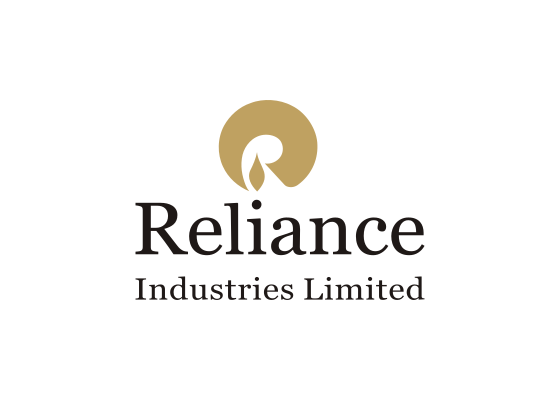
The Reliance Industries logo features an abstract symbol rendered in gold or bronze tones paired with black typography, projecting heritage, industrial strength, and the diversified business empire built by founder Dhirubhai Ambani. The metallic gold color suggests value, prosperity, permanence, and the massive scale of operations spanning oil refining, petrochemicals, retail chains, and telecommunications networks. The abstract geometric forms in the symbol evoke industrial processes, molecular structures, or interconnected business units, reflecting the integrated operations that create competitive advantages across Reliance’s portfolio. The combination of traditional gold tones with contemporary geometric abstraction balances respect for founding heritage with forward-looking business ambitions. The black typography ensures clarity and professional authority appropriate for India’s largest private sector employer with over 300,000 employees.
The prestigious visual identity reflects Reliance’s position as business institution rather than single-purpose corporation, operating businesses that collectively account for approximately 5 percent of India’s government revenue through customs and excise duties. The gold and black palette projects establishment gravitas while the abstract symbol suggests the complexity and interconnections across energy production, petrochemical manufacturing, consumer retail, and digital services that make Reliance unique among Indian conglomerates. The design needed to work across vastly different business contexts from oil refineries to consumer-facing retail chains and mobile telecommunications services.
Meaning and Symbolism
- Gold metallic color: Represents value, prosperity, industrial strength, and the massive scale of operations making Reliance India’s largest company by revenue and market capitalization.
- Abstract geometric symbol: Suggests industrial processes, molecular structures, integrated operations, and the interconnected business units spanning energy, petrochemicals, retail, and telecommunications.
- Black typography: Ensures clarity, professional authority, and institutional gravitas appropriate for India’s most profitable company and largest private sector employer.
- Heritage and ambition: The combination balances respect for founding history with forward-looking positioning across traditional industry and digital services.
Design and History
Dhirubhai Ambani founded Reliance Industries in 1966, initially focusing on textile manufacturing before expanding into petrochemicals, oil refining, and eventually telecommunications and retail. Ambani pioneered the equity cult in India, democratizing stock ownership by encouraging millions of middle-class Indians to invest in Reliance shares, creating loyal shareholder base that supported aggressive expansion. The company grew through vertical integration, building refining capacity, petrochemical plants, and retail distribution that captured value across entire supply chains. This integrated model created competitive advantages and economies of scale that made Reliance India’s largest private sector company.
After Dhirubhai’s death in 2002, control passed to sons Mukesh and Anil Ambani, who eventually divided the empire with Mukesh retaining the core Reliance Industries operations. Under Mukesh’s leadership, Reliance expanded aggressively into retail through Reliance Retail chains and telecommunications through Jio mobile service that disrupted Indian telecom markets with rock-bottom data prices and free voice calls. The Jio launch in 2016 brought hundreds of millions of Indians online, fundamentally changing the country’s digital landscape while establishing Reliance as telecommunications leader alongside traditional energy and petrochemical businesses.
Reliance Industries became India’s first company to exceed $200 billion market capitalization, eventually reaching valuations exceeding major global corporations. The company’s scale made it critical to Indian economy, accounting for approximately 7 percent of the country’s total merchandise exports while being the highest income tax payer in the private sector. This economic significance gave Reliance influence with government policy while creating strategic importance that attracted foreign investors including Facebook, Google, and Saudi Aramco who invested billions in Jio Platforms and other Reliance ventures.
The conglomerate structure created portfolio diversification unusual among modern corporations, with operations spanning upstream oil production through downstream retail distribution. Critics questioned whether such diversification created or destroyed value, but Mukesh Ambani maintained that integrated operations across energy, materials, retail, and telecommunications created synergies and strategic flexibility. The visual identity needed to encompass this vast empire while maintaining coherent brand meaning across businesses serving consumers, industrial customers, and government entities.
Typography
The Reliance Industries wordmark employs strong, authoritative typography with confident weight and clear construction. The letterforms project institutional stability and professional competence appropriate for India’s largest company by revenue. The black color ensures maximum legibility while the formal construction reinforces seriousness and the industrial heritage underlying the diversified business portfolio.
FAQ
Q: When was Reliance Industries founded? A: Dhirubhai Ambani established Reliance in 1966, initially focusing on textile manufacturing before expanding into petrochemicals, oil refining, retail, and telecommunications over subsequent decades.
Q: How large is Reliance Industries? A: Reliance is India’s largest publicly traded company by market capitalization and revenue, employing over 300,000 people. The company accounts for approximately 7 percent of India’s merchandise exports and is ranked 100th on the Fortune Global 500.
Q: What businesses does Reliance operate? A: The conglomerate operates across energy (oil and gas production), petrochemicals, oil refining, retail (Reliance Retail chains), telecommunications (Jio mobile service), and media, creating an integrated business empire unique among Indian companies.
More logos with similar colors