Skip to Content
    Support us
    A-Z Agency Colors Country Designer Industry Tags Year Trending Reports
    Olympics 1968 Mexico sports Mexico teal blue gray red orangesportsMexicotealbluegrayredorange

    1968 Summer Olympic Games in Mexico City

    • Logo
    • Mexico
    • Sports
    • Olympics 1968 Mexico

    Olympics 1968 Mexico Logo

    Explore the iconic Olympics 1968 Mexico logo – its design, history, and visual identity.

    Trending Popular
    Olympics 1968 Mexico logo - free SVG vector, sports brand from Mexico

    Olympics 1968 Mexico Brand Colors

    Browse more logos with teal, blue, gray, red and orange colors.

    Olympics 1968 Mexico Brand Facts

    Key information about Olympics 1968 Mexico: origin, designer, industry, and logo introduction year.

    Websiteen.wikipedia.org
    DesignerLance Wyman
    CountryMexico
    IndustrySports
    Logo Introduced1968
    Download Olympics 1968 Mexico logo Embed Olympics 1968 Mexico logo
    views · downloads this week
    4.6 (45 ratings)

    Explore the Olympics 1968 Mexico brand, discover Olympics 1968 Mexico colors, and download the Olympics 1968 Mexico vector logo in SVG or PNG formats. Browse related logos and logos with similar colors.

    Summer Olympic Games Logos

    Olympics 2012 London logo vector - free SVG download

    Olympics 2012 London

    Sports
    Olympics 2028 LA logo vector - free SVG download

    Olympics 2028 LA

    Sports
    Olympics 2000 Sydney logo vector - free SVG download

    Olympics 2000 Sydney

    Sports
    Olympics 2016 Rio logo vector - free SVG download

    Olympics 2016 Rio

    Sports
    Olympics 2008 Beijing logo vector - free SVG download

    Olympics 2008 Beijing

    Sports
    Olympics 1964 Tokyo logo vector - free SVG download

    Olympics 1964 Tokyo

    Sports
    Olympics 1980 Moscow logo vector - free SVG download

    Olympics 1980 Moscow

    Sports
    Olympics 1988 Seoul logo vector - free SVG download

    Olympics 1988 Seoul

    Sports
    Olympics 2004 Athens logo vector - free SVG download

    Olympics 2004 Athens

    Sports
    Olympics 1992 Barcelona logo vector - free SVG download

    Olympics 1992 Barcelona

    Sports
    Olympics 2024 Paris logo vector - free SVG download

    Olympics 2024 Paris

    Sports
    Olympics 1972 Munchen logo vector - free SVG download

    Olympics 1972 Munchen

    Sports
    Olympics 2020 Tokyo logo vector - free SVG download

    Olympics 2020 Tokyo

    Sports
    Olympics 1976 Montreal logo vector - free SVG download

    Olympics 1976 Montreal

    Sports
    Olympics 1996 Atlanta logo vector - free SVG download

    Olympics 1996 Atlanta

    Sports

    The 1968 Summer Olympics, officially the Games of the XIX Olympiad, were held in Mexico City from October 12 to 27, 1968. These were the first Olympic Games staged in Latin America and the first in a Spanish-speaking country. The Games were preceded by political turmoil, including the Tlatelolco massacre on October 2, when Mexican security forces killed an estimated 300 to 400 student protesters ten days before the opening ceremony. The Games are also remembered for Tommie Smith and John Carlos’s Black Power salute on the medal podium.

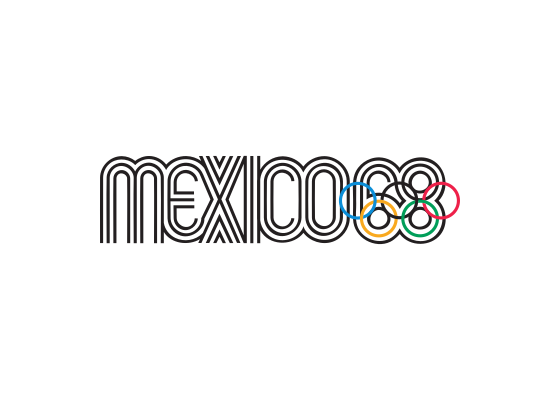
    The Mexico 1968 emblem, designed by Lance Wyman, is one of the most celebrated pieces of graphic design in the 20th century. The design integrates the text “MEXICO 68” into a single, indivisible typographic composition using concentric op-art lines that radiate outward from each letterform. The letters and numerals become the starting points for expanding concentric patterns that merge and interfere with one another, creating a vibrating, optical effect. The design draws simultaneously from the op-art movement of the 1960s and from the geometric patterns of pre-Columbian Huichol art, creating a visual language that is both internationally contemporary and specifically Mexican. The emblem is typically rendered in black and white, though the broader color system used the five Olympic colors in the same concentric-line language. It was part of a comprehensive visual identity that extended from the emblem to wayfinding, merchandise, stamps, and the entire urban environment of Mexico City.

    Meaning and Symbolism

    • Op-art concentric lines: The radiating, concentric lines that extend from each letter create an optical vibration that gives the mark kinetic energy. This referenced the op-art movement that was at its peak in the mid-1960s, making the design feel unmistakably of its moment.
    • Pre-Columbian geometry: The repetitive, concentric patterns also reference the geometric art of Mexico’s indigenous cultures, particularly Huichol yarn paintings and textile patterns. This dual reference, international contemporary art and Mexican traditional art, was the design’s conceptual breakthrough.
    • Integrated typography: The letters “MEXICO 68” are not separate from the decorative pattern; they are the pattern. Each letter generates the concentric lines that flow outward, making text and image inseparable. This integration was technically innovative and visually striking.
    • Olympic rings integration: The five Olympic rings were rendered in the same concentric-line language, becoming part of the overall visual system rather than existing as a separate element.

    Design and History

    Lance Wyman was a young American designer working at a New York firm when he entered the competition to design the Mexico 1968 visual identity. His winning concept emerged from the observation that the number “68” could be extended into the word “MEXICO” using the same letterform width, and that the concentric lines of op-art could tie these elements together while also referencing Mexican indigenous art.

    The result was one of the first truly comprehensive environmental graphic design systems. Wyman and his team, including Eduardo Terrazas, extended the concentric-line language across the entire urban experience of Mexico City. Street signage, metro stations, maps, tickets, uniforms, postage stamps, and building facades all used the same visual vocabulary. The effect was transformative: for the duration of the Games, Mexico City itself became a designed environment, with the visual identity woven into the fabric of the city.

    The design’s genius was in its dual cultural reading. International audiences saw a contemporary, psychedelic, op-art composition that felt exciting and modern. Mexican audiences recognized the geometric patterns of their own artistic heritage. Neither reading was primary; both were genuine. This cross-cultural fluency, achieved without compromise to either reference, set a standard for culturally specific, internationally legible design that has rarely been matched.

    The 1968 Games themselves were politically charged. The Tlatelolco massacre cast a shadow that the visual identity’s exuberance could not dispel. Smith and Carlos’s raised-fist protest on the 200-meter podium became one of the most iconic images of the 20th century, a moment where the Olympics became a stage for civil rights. Bob Beamon’s long jump of 8.90 meters, which broke the existing record by 55 centimeters, remains one of the most astounding individual performances in Olympic history.

    Wyman’s Mexico 68 identity has been exhibited in design museums worldwide and is studied in virtually every graphic design program. It demonstrated that a visual identity could be more than a logo and a color palette, that it could be an environmental experience that transforms a city.

    Typography

    The “MEXICO 68” letterforms are the emblem itself, rendered in a geometric, monoline sans-serif that provides the starting geometry for the concentric-line patterns. The uniform stroke width of the letters allows the radiating lines to maintain consistent spacing as they expand outward. For the broader brand system, this typographic approach was extended across all applications, with the concentric-line language applied to wayfinding, event names, and navigational text throughout Mexico City.

    FAQ

    Q: Who designed the Mexico 1968 emblem? A: Lance Wyman, a young American designer, created the visual identity. It is considered one of the most important graphic design projects of the 20th century and pioneered the concept of comprehensive environmental graphic design.

    Q: What are the radiating lines in the Mexico 1968 logo? A: The concentric lines radiate outward from each letterform in “MEXICO 68,” creating an optical vibration effect. They draw from both the op-art movement of the 1960s and the geometric patterns of pre-Columbian Mexican indigenous art.

    Q: Why is the Mexico 1968 design considered revolutionary? A: It was one of the first comprehensive environmental graphic design systems, extending a single visual language across an entire city. The concentric-line language appeared on street signs, metro stations, uniforms, stamps, and building facades, transforming Mexico City into a designed environment.

    The Mexico 1968 emblem and Olympic rings are trademarks of the International Olympic Committee. This page is for educational and reference purposes only.


    More Sports logos from Mexico

    CONCACAF logo vector - free SVG download

    CONCACAF

    Sports
    1986 FIFA logo vector - free SVG download

    1986 FIFA

    Sports
    1970 FIFA logo vector - free SVG download

    1970 FIFA

    Sports
    CONCACAF Gold Cup logo vector - free SVG download

    CONCACAF Gold Cup

    Sports
    Capitanes logo vector - free SVG download

    Capitanes

    Sports
    Mexico logo vector - free SVG download

    Mexico

    Sports

    More logos with similar colors

    Harmony logo vector - free SVG download

    Harmony

    Crypto
    Timely logo vector - free SVG download

    Timely

    Software
    Jabil logo vector - free SVG download

    Jabil

    Electronics
    Photobucket logo vector - free SVG download

    Photobucket

    Media
    FCC logo vector - free SVG download

    FCC

    Construction
    CFA Institute logo vector - free SVG download

    CFA Institute

    Nonprofit
    Qualtrics logo vector - free SVG download

    Qualtrics

    Software
    Finn Harps logo vector - free SVG download

    Finn Harps

    Sports
    Vue js logo vector - free SVG download

    Vue js

    Software
    Edison logo vector - free SVG download

    Edison

    Energy

    The "1968 Summer Olympic Games in Mexico City" appears in: Athletics Logos , Competition Logos , North America Logos , Recreation - Sport Logos , Olimpics Logos and Summer Logos .

    Frequently asked questions about the Olympics 1968 Mexico logo

    The 1968 Summer Olympic Games in Mexico City logo represents a sports brand from Mexico, designed in 1968 by Lance Wyman. Learn more on the official Olympics 1968 Mexico website.

    Why is the Olympics 1968 Mexico logo in SVG format?
    The Olympics 1968 Mexico logo is provided as an SVG (Scalable Vector Graphics) file because vectors offer unlimited scaling without pixelation, smaller file sizes than raster images, and are ideal for responsive web design. SVG logos work perfectly across all screen sizes — from mobile devices to billboard prints — maintaining crisp edges at any resolution.
    Should I use SVG or PNG for the Olympics 1968 Mexico logo?
    Use SVG for websites, apps, and any digital design requiring scalability. SVG files are resolution-independent and load faster. Use PNG (converted from SVG at 300 DPI) for presentations, printed materials, or software that doesn’t support SVG. Convert using Adobe Illustrator, Inkscape, Affinity Designer, or online tools like CloudConvert. Export at 300 DPI for print, 72-150 DPI for web.
    What software can open the Olympics 1968 Mexico SVG logo?
    The Olympics 1968 Mexico SVG logo opens in both code editors (VS Code, Sublime Text, Notepad++) and graphic design software (Figma, Adobe Illustrator, Affinity Designer, Sketch, Inkscape). Modern web browsers can also display SVG files directly. For quick edits, online editors like SVGEdit or Method Draw work without installing software.
    What font does the Olympics 1968 Mexico logo use?
    Many professional brands, including Olympics 1968 Mexico, use custom-designed typefaces for their logos to ensure unique brand identity and trademark protection. If the Olympics 1968 Mexico logo uses a custom font, no exact public version may exist. For similar typography, analyze the logo’s letter characteristics (serif vs sans-serif, weight, spacing) and search font databases like WhatTheFont, Identifont, or MyFonts for close alternatives.
    What is a Logo or Logotype?
    A logo is a graphic mark, emblem, or symbol used to aid public identification and recognition. Logos fall into three classifications: ideographs (abstract forms), pictographs (iconic designs), and logotypes/wordmarks (text-based). The logo is central to a brand’s visual identity system.
    Can I use the Olympics 1968 Mexico logo legally?
    The Olympics 1968 Mexico logo is a registered trademark and cannot be used commercially without explicit written permission from Olympics 1968 Mexico. This website provides the logo for educational, informational, and reference purposes only. For commercial projects, partnerships, or official brand assets, contact Olympics 1968 Mexico’s communications or legal department directly.
    Where can I find Olympics 1968 Mexico brand guidelines?
    Official Olympics 1968 Mexico brand guidelines typically include logo usage rules, color codes, typography, spacing requirements, and prohibited modifications. Check the Olympics 1968 Mexico website for a “Brand,” “Press,” “Media Kit,” or “Resources” section. Official assets are also available through press kits and authorized partner portals.
    Do I need to credit logotyp.us when using the Olympics 1968 Mexico logo?
    No attribution to logotyp.us is required. However, the Olympics 1968 Mexico logo itself is trademarked intellectual property — using it requires permission from Olympics 1968 Mexico, regardless of where you downloaded it. This site serves as a reference library; downloading a logo here does not grant usage rights.

    Report Outdated Logo

    logotyp.us

    Download high-quality vector logos in SVG format — free for designers, developers, and brand enthusiasts. Browse 4,700+ brand logos by industry, country, color, and designer.

    Help Keep This Free Logos and Brands
    Browse
    • Logos by Industry
    • Logos by Country
    • Logos by Color
    • Logos by Designer
    • A–Z Logo Index
    Discover
    • Popular Logos
    • Search Logos
    • Logo Reports
    Top Countries
    • United States
    • United Kingdom
    • Global
    • Japan
    • Germany
    • Canada
    • France
    • India
    • Sweden
    • Spain
    • Italy
    • Australia
    • Switzerland
    • Netherlands
    • China
    • View All Countries →

    © 2026 logotyp.us. All logos are trademarks of their respective owners.

    Build 0307-1037