Summer Olympic Games Logos
The 1980 Summer Olympics, officially the Games of the XXII Olympiad, were held in Moscow, Soviet Union, from July 19 to August 3, 1980. The Games were the first Olympics held in a socialist state and in Eastern Europe. They were profoundly affected by a United States-led boycott protesting the Soviet invasion of Afghanistan, with 65 nations declining to participate. Despite the boycott, 5,179 athletes from 80 nations competed in 203 events across 21 sports.
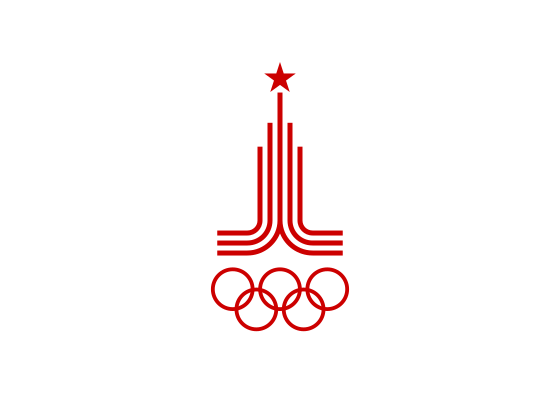
The Moscow 1980 emblem is a vertically composed mark consisting of parallel lines that rise upward and converge, topped by a five-pointed star. The lines represent both a running track (the parallel lanes converging in perspective) and the architectural aspiration of Soviet design, reaching upward toward the star. At the base, the five Olympic rings anchor the composition. The star at the top references the Kremlin’s Spassky Tower, one of Moscow’s most recognizable landmarks and a symbol of the Soviet state. Designed by Vladimir Arsentyev, then a student at the Stroganov Academy, the emblem is rendered in a single red color, the color of the Soviet flag and of international socialism. Below the emblem, “MOSCOW 80” is set in a clean typeface. The mark is both an Olympic emblem and a Soviet-era graphic design artifact, its vertical thrust and star motif unmistakably products of their political context.
Meaning and Symbolism
- Parallel rising lines: The vertical lines create a sense of upward motion and convergence. They read simultaneously as the lanes of a running track (seen in perspective, converging toward a vanishing point) and as an architectural form suggesting towers, columns, or the monumental scale of Soviet construction.
- Kremlin star: The five-pointed star at the top references the ruby stars that crown the Kremlin’s towers, the most recognizable symbols of the Soviet capital. This anchored the emblem firmly in Moscow’s identity and political context.
- Red color: The single red references the Soviet flag, the Red Square, and the broader symbolism of the socialist state. Like the Calgary 1988 emblem that would follow, the monochromatic approach gave the mark bold impact and simplified reproduction.
- Olympic rings: The five rings at the base of the composition provide the universal Olympic reference, connecting the Soviet-specific elements above to the international sporting tradition.
Design and History
The Moscow 1980 emblem was designed by Vladimir Arsentyev, who created the concept while a student at the Stroganov Moscow State Academy of Industrial Art. The authorship was disputed for some time, but Arsentyev is generally credited with the original concept.
The emblem was a product of its political moment. The Soviet Union saw the 1980 Olympics as an opportunity to demonstrate the achievements of the socialist system to the world, and the visual identity reflected that ambition. The upward thrust of the parallel lines and the Kremlin star at the apex communicated aspiration, power, and ideological confidence. The design language was unmistakably Soviet, drawing on the constructivist graphic tradition and the monumental aesthetic that characterized official Soviet visual culture.
The Games themselves were overshadowed by the boycott led by the United States in response to the Soviet invasion of Afghanistan in December 1979. Sixty-five nations joined the boycott, including West Germany, Japan, Canada, and China. The absence of major sporting powers diminished the competitive quality of many events and turned the Games into a political statement as much as a sporting event.
Despite the boycott, the Moscow Olympics were technically well-organized. The Soviet state mobilized enormous resources to ensure the Games ran smoothly, building new venues and infrastructure across Moscow. The opening and closing ceremonies were characteristically Soviet in their scale and precision, and the mascot, Misha the bear, became one of the most beloved Olympic mascots in history. The closing ceremony, during which a giant Misha shed a tear as the balloon-supported figure rose into the Moscow sky, remains one of the most emotionally memorable moments in Olympic history.
The broader visual identity extended the emblem’s Soviet aesthetic across venue dressing, merchandise, posters, and publications. The red-dominated palette and the monumental graphic language created a visual experience that was inseparable from the political context of the host country.
Typography
“MOSCOW 80” is set in a clean, modern sans-serif typeface beneath the emblem. The letterforms are straightforward and functional, reflecting the Soviet preference for clarity in public communications. The typography provides a stable base for the vertical, upward-reaching composition above. For the broader brand system, typefaces maintained this functional clarity across wayfinding, publications, and official materials.
FAQ
Q: Who designed the Moscow 1980 emblem?
A: Vladimir Arsentyev designed the emblem while a student at the Stroganov Moscow State Academy of Industrial Art. It features parallel rising lines topped by a five-pointed star, referencing both a running track and the Kremlin’s towers.
Q: Why did many countries boycott the 1980 Olympics?
A: The United States led a boycott of 65 nations in protest of the Soviet invasion of Afghanistan in December 1979. The boycott significantly affected participation and turned the Games into a political event.
Q: What is the star at the top of the Moscow 1980 emblem?
A: The five-pointed star references the ruby stars that crown the Kremlin’s towers in Moscow, one of the city’s most recognizable symbols. It anchored the emblem in Moscow’s identity and the political context of the Soviet state.
The Moscow 1980 emblem and Olympic rings are trademarks of the International Olympic Committee. This page is for educational and reference purposes only.