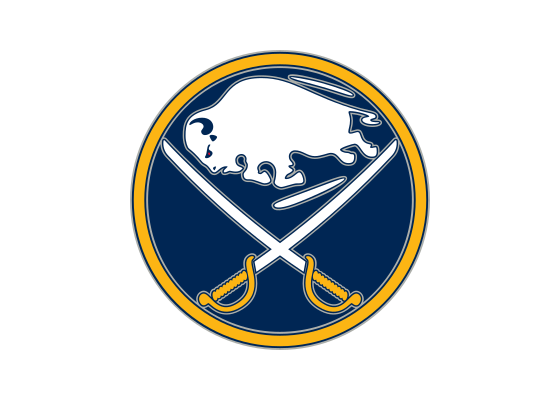
The Buffalo Sabres logo features a charging buffalo with two crossed sabers beneath, merging the city’s namesake animal with weaponry that suggests both offensive capability and defensive protection appropriate to competitive hockey.
The Sabres logo represents successful return to foundational concepts after experimentation with trendy alternatives. The original 1970 design paired a fierce, charging buffalo with crossed sabers in a circular blue-and-gold badge that communicated both regional pride and aggressive intent. Subsequent redesigns attempted modernization through illustration style changes and color shifts, but the 2010 restoration to refined versions of the original concept demonstrated that the strongest ideas endure across decades and resist improvement through modification.
The buffalo-and-sabers pairing works because both elements carry layered meaning. Buffalo references the city name (likely derived from the French “beau fleuve” meaning beautiful river, though popularized as referencing American bison) while communicating strength and power. Sabers add offensive weaponry connotations while the team name itself plays on both the weapon and the act of being savvy or capable, creating linguistic richness that purely animal-based names lack.
Meaning and Symbolism
- The charging buffalo honors Buffalo’s city name while symbolizing strength, determination, and unstoppable forward momentum
- Crossed sabers beneath suggest both offensive weapons and defensive crossed-sword guard positions
- Blue and gold palette ties the design to Buffalo’s official city colors and Western New York regional identity
- The buffalo’s forward-facing charge creates direct confrontation with viewers, implying aggressive territorial defense
- Circular composition suggests both wholeness and the dynamic rotation of movement
Design and History
Founded in 1970 as an NHL expansion franchise, the Sabres adopted name and logo through public contest, with “Sabres” winning for its dual meaning (weapon and capability) and the buffalo providing natural local connection. The original logo featured the charging buffalo over crossed sabers in a blue circle with gold trim, establishing the color scheme that would define the franchise across most of its history.
The disastrous 2006 “Buffaslug” redesign attempted to modernize through streamlined illustration and motion lines, but fan rejection was swift and brutal. The simplified, cartoonish buffalo head felt like corporate rebranding disconnected from the franchise’s heritage. This failure reinforced that some logos achieve optimal execution early and resist improvement through simplification or trendy updating.
The 2010 restoration refined the original concept with cleaner line work and improved color saturation while maintaining the essential composition. This decision demonstrated organizational maturity: recognizing that heritage assets outvalue novelty and that refinement serves better than reinvention when foundational design achieves cultural resonance.
Typography
The Sabres wordmark employs bold, slightly condensed sans-serif capitals with subtle forward slant suggesting motion and aggression. The letterforms maintain straightforward athletic character while the italic angle creates kinetic energy. “BUFFALO” typically appears above “SABRES” in smaller scale, establishing geographic identity while allowing the team name prominence. The type occasionally features dimensional effects (shadows, highlights) that add depth without overwhelming legibility.
FAQ
Q: Why did the Buffaslug logo fail so badly? A: The 2006 design abandoned the charging buffalo’s fierce personality for a simplified, passive profile that felt corporate rather than competitive. Removing the sabers eliminated half the brand’s meaning, and the motion lines dated immediately. Fans saw it as disrespecting franchise heritage in favor of trendy rebranding that served merchandise departments rather than team identity.
Q: What’s the connection between buffalo and Buffalo? A: The city’s name likely derives from the French “beau fleuve” (beautiful river) rather than the animal, but the buffalo/bison became civic symbol regardless. The Sabres logo leverages this association even though American bison never heavily populated Western New York, demonstrating how symbols gain meaning through adoption rather than strict historical accuracy.
Q: Why keep returning to the original 1970 design? A: The original concept achieved optimal balance between elements, created strong visual impact, and connected meaningfully to regional identity. Attempts to improve it through illustration style changes or color shifts proved that the fundamental design was already optimal. The 2010 refinement acknowledged this reality, choosing to perfect rather than replace the original vision.
More logos with similar colors